

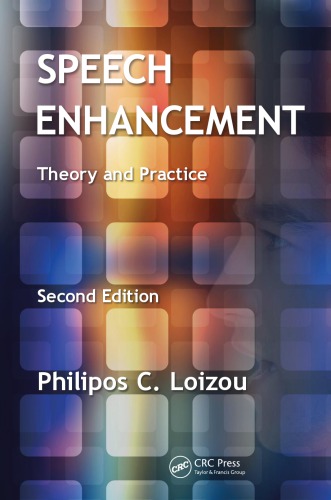
Speech Enhancement Theory and Practice 2nd Edition by Philipos C Loizou ISBN 1466504218 9781466504219

Original price was: $50.00.$35.00Current price is: $35.00.
Speech Enhancement Theory and Practice 2nd Edition by Philipos C. Loizou – Ebook PDF Instant Download/Delivery: 1466504218, 9781466504219
Full download Speech Enhancement Theory and Practice 2nd Edition after payment
Product details:
ISBN 10: 1466504218
ISBN 13: 9781466504219
Author: Philipos C. Loizou
With the proliferation of mobile devices and hearing devices, including hearing aids and cochlear implants, there is a growing and pressing need to design algorithms that can improve speech intelligibility without sacrificing quality. Responding to this need, Speech Enhancement: Theory and Practice, Second Edition introduces readers to the basic problems of speech enhancement and the various algorithms proposed to solve these problems. Updated and expanded, this second edition of the bestselling textbook broadens its scope to include evaluation measures and enhancement algorithms aimed at improving speech intelligibility.
Fundamentals, Algorithms, Evaluation, and Future Steps
Organized into four parts, the book begins with a review of the fundamentals needed to understand and design better speech enhancement algorithms. The second part describes all the major enhancement algorithms and, because these require an estimate of the noise spectrum, also covers noise estimation algorithms. The third part of the book looks at the measures used to assess the performance, in terms of speech quality and intelligibility, of speech enhancement methods. It also evaluates and compares several of the algorithms. The fourth part presents binary mask algorithms for improving speech intelligibility under ideal conditions. In addition, it suggests steps that can be taken to realize the full potential of these algorithms under realistic conditions.
What’s New in This Edition
- Updates in every chapter
- A new chapter on objective speech intelligibility measures
- A new chapter on algorithms for improving speech intelligibility
- Real-world noise recordings (on downloadable resources)
- MATLAB® code for the implementation of intelligibility measures (on downloadable resources)
- MATLAB and C/C++ code for the implementation of algorithms to improve speech intelligibility (on downloadable resources)
Valuable Insights from a Pioneer in Speech Enhancement
Clear and concise, this book explores how human listeners compensate for acoustic noise in noisy environments. Written by a pioneer in speech enhancement and noise reduction in cochlear implants, it is an essential resource for anyone who wants to implement or incorporate the latest speech enhancement algorithms to improve the quality and intelligibility of speech degraded by noise.
Includes downloadable resources with Code and Recordings
The downloadable resources provide MATLAB implementations of representative speech enhancement algorithms as well as speech and noise databases for the evaluation of enhancement algorithms.
Table of contents:
Part I Fundamentals
Discrete-Time Signal Processing and Short-Time Fourier Analysis
Discrete-Time Signals
Linear Time-Invariant Discrete-Time Systems
z-Transform
Discrete-Time Fourier Transform
Short-Time Fourier Transform
Spectrographic Analysis of Speech Signals
Summary
References
Speech Production and Perception
Speech Signal
Speech Production Process
Engineering Model of Speech Production
Classes of Speech Sounds
Acoustic Cues in Speech Perception
Summary
References
Noise Compensation by Human Listeners
Intelligibility of Speech in Multiple-Talker Conditions
Acoustic Properties of Speech Contributing to Robustness
Perceptual Strategies for Listening in Noise
Summary
References
Part II Algorithms
Spectral-Subtractive Algorithms
Basic Principles of Spectral Subtraction
Geometric View of Spectral Subtraction
Shortcomings of the Spectral Subtraction Method
Spectral Subtraction Using Oversubtraction
Nonlinear Spectral Subtraction
Multiband Spectral Subtraction
MMSE Spectral Subtraction Algorithm
Extended Spectral Subtraction
Spectral Subtraction Using Adaptive Gain Averaging
Selective Spectral Subtraction
Spectral Subtraction Based on Perceptual Properties
Performance of Spectral Subtraction Algorithms
Summary
References
Wiener Filtering
Introduction to Wiener Filter Theory
Wiener Filters in the Time Domain
Wiener Filters in the Frequency Domain
Wiener Filters and Linear Prediction
Wiener Filters for Noise Reduction
Iterative Wiener Filtering
Imposing Constraints on Iterative Wiener Filtering
Constrained Iterative Wiener Filtering
Constrained Wiener Filtering
Estimating the Wiener Gain Function
Incorporating Psychoacoustic Constraints in Wiener Filtering
Codebook-Driven Wiener Filtering
Audible Noise Suppression Algorithm
Summary
References
Statistical-Model-Based Methods
Maximum-Likelihood Estimators
Bayesian Estimators
MMSE Estimator
Improvements to the Decision-Directed Approach
Implementation and Evaluation of the MMSE Estimator
Elimination of Musical Noise
Log-MMSE Estimator
MMSE Estimation of the pth-Power Spectrum
MMSE Estimators Based on Non-Gaussian Distributions
Maximum A Posteriori (Map) Estimators
General Bayesian Estimators
Perceptually Motivated Bayesian Estimators
Incorporating Speech Absence Probability in Speech Enhancement
Methods for Estimating the A Priori Probability of Speech Absence
Summary
References
Subspace Algorithms
Introduction
Using SVD for Noise Reduction: Theory
SVD-Based Algorithms: White Noise
SVD-Based Algorithms: Colored Noise
SVD-Based Methods: A Unified View
EVD-Based Methods: White Noise
EVD-Based Methods: Colored Noise
EVD-Based Methods: A Unified View
Perceptually Motivated Subspace Algorithms
Subspace-Tracking Algorithms
Summary
References
Noise-Estimation Algorithms
Voice Activity Detection vs. Noise Estimation
Introduction to Noise-Estimation Algorithms
Minimal-Tracking Algorithms
Time-Recursive Averaging Algorithms for Noise Estimation
Histogram-Based Techniques
Other Noise-Estimation Algorithms
Objective Comparison of Noise-Estimation Algorithms
Summary
References
Part III Evaluation
Evaluating Performance of Speech Enhancement Algorithms
Quality vs. Intelligibility
Evaluating Intelligibility of Processed Speech
Evaluating Quality of Processed Speech
Evaluating Reliability of Quality Judgments: Recommended Practice
Summary
References
Objective Quality and Intelligibility Measures
Objective Quality Measures
Evaluation of Objective Quality Measures
Quality Measures: Summary of Findings and Future Directions
Speech Intelligibility Measures
Evaluation of Intelligibility Measures
Intelligibility Measures: Summary of Findings and Future Directions
Summary
References
Comparison of Speech Enhancement Algorithms
NOIZEUS: A Noisy Speech Corpus for Quality Evaluation of Speech Enhancement Algorithms
Comparison of Enhancement Algorithms: Speech Quality
Comparison of Enhancement Algorithms: Speech Intelligibility
Summary
References
Part IV Future Steps
Algorithms That Can Improve Speech Intelligibility
Reasons for the Absence of Intelligibility Improvement with Existing Noise-Reduction Algorithms
Algorithms Based on Channel Selection: A Different Paradigm for Noise Reduction
Channel-Selection Criteria
Intelligibility Evaluation of Channel-Selection-Based Algorithms: Ideal Conditions
Implementation of Channel-Selection-Based Algorithms in Realistic Conditions
Evaluating Binary Mask Estimation Algorithms
Channel Selection and Auditory Scene Analysis
Summary
References
People also search for:
speech 7-12
7 speech strategies
4-h speech examples
3 speech topics
3 speeches
university speech and hearing clinic
Tags: Philipos C Loizou, Speech, Enhancement, Theory, Practice