

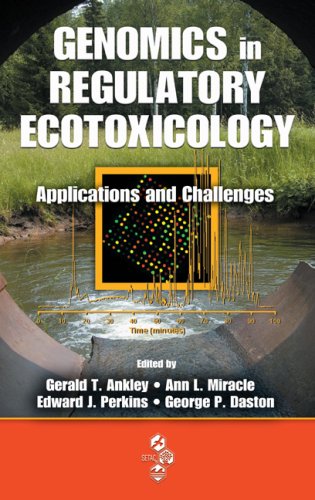
Genomics in regulatory ecotoxicology applications and challenges 1st Edition by Gerald Ankley, Ann Miracle, Edward Perkins, George Daston ISBN 0367388189 978-0367388188


Original price was: $50.00.$35.00Current price is: $35.00.
Genomics in regulatory ecotoxicology applications and challenges 1st Edition by Gerald Ankley, Ann Miracle, Edward Perkins, George Daston – Ebook PDF Instant Download/Delivery: 0367388189, 978-0367388188
Full download Genomics in regulatory ecotoxicology applications and challenges 1st edition after payment
Product details:
ISBN 10: 0367388189
ISBN 13: 978-0367388188
Author: Gerald Ankley, Ann Miracle, Edward Perkins, George Daston
Fueled partially by large, well-publicized efforts such as the Human Genome Project, genomic research is a rapidly growing area in multiple biological disciplines, including toxicology. Much of this potential, however, has been discussed in the literature and at technical meetings only in relatively broad terms, making it difficult to assess exactly how data generated from new genomics technologies might actually impact or benefit the risk assessment process.
Genomics in regulatory ecotoxicology applications and challenges 1st Table of contents:
1 Toxicogenomics in Ecological Risk Assessments: Regulatory Context, Technical Background, and Workshop Overview
1.1 REGULATORY CONTEXT
1.2 TECHNICAL BACKGROUND
1.3 WORKSHOP OVERVIEW
1.3.1 Scope of The Workshop: Global Versus Focused Molecular Analyses
1.3.2 WorkShop Structure
1.3.2.1 Workgroup 1: Application of Genomics to Screening-Level Risk Assessments
1.3.2.2 Workgroup 2: Application of Genomics to Tiered Testing
1.3.2.3 Workgroup 3: Application of Genomics to Comprehensive Assessments
1.3.3.4 Workgroup 4: Application of Genomics to Environmental Monitoring
1.3.3.5 Workgroup 5: Application of Genomics to Environmental Remediation or Resource Recovery
1.4 CONCLUSION
REFERENCES
2 Application of Genomics to Screening
2.1 INTRODUCTION
2.2 CURRENTLY USED SCREENING ASSAYS
2.2.1 Single Endpoint Assays
2.2.2 Multiple Endpoint Assays
2.3 THE PROMISE OF GENOMICS FOR SCREENING ASSAYS
2.3.1 International Efforts By Government And Industry
2.3.2 Lessons From Human Health Assessments
2.3.3 Potential Use of Genomics In Ecological Risk Assessment
2.3.4 Specific Examples of Applications of Genomics In Ecotoxicology
2.4. CURRENT LIMITATIONS OF GENOMIC TECHNOLOGIES IN ECOLOGICAL SCREENING
2.4.1. Variability And Reproducibility
2.4.2 Biological Challenges
2.5. PRIORITY RESEARCH QUESTIONS AND RECOMMENDATIONS
2.5.1 Which Currently Available Genomic Techniques Are Most Reliable And Appropriate For Application to Ecotoxicology Screens?
2.5.2 What Is The Effect of Different Conditions And Different Life Stages of Exposure On Gene Expression For A Given Species?
2.5.3 Genetic Sequence Data For New Ecological Species: Which Species Have Greatest Maturity In Terms of Current Data And Resources?
2.5.4 Which Genomics Techniques Are Expected to Be Ready For Ecotoxicology Screens In The Near Future (5 to 10 Years)?
2.5.5 What Is The Best Approach to Understand Cross-Species Genomic Similarities And Differences In Response That Are Predictive of Cross -Species In Vivo Endpoint Response Differences?
2.6. CONCLUSIONS AND GENERAL RECOMMENDATIONS
REFERENCES
3 Application of Genomics to Tiered Testing
3.1 BACKGROUND AND REGULATORY FRAMEWORK
3.1.1 Tiered Testing
3.1.2 Effects Assessment
3.1.3 Exposure Assessment
3.1.4 Rationale of The Tiered Approach
3.2 INTELLIGENT TESTING STRATEGIES AND GENOMICS
3.3 GENOMICS AND TIERED TESTING
3.3.1 Single Biomarkers
3.3.2 Genomics
3.3.2.1 Transcriptomics
3.3.2.2 Proteomics
3.3.2.3 Metabolomics
3.3.2.4 Fingerprinting and Profiling
3.4 POTENTIAL APPLICATIONS OF GENOMICS IN TIERED TESTING
3.5 ANIMAL SPECIES
3.6 COST BENEFITS AND REDUCTION OF ANIMAL USAGE IN APPLYING GENOMICS IN TIERED TESTING
3.6.1 Genomic Cost
3.6.2 Vertebrate Animal Reduction
3.7 APPLICATION OF GENOMICS INTO TIERED TESTING: WHAT, WHEN, AND ASSOCIATED RESEARCH NEEDS
3.8 BIOINFORMATICS
3.9 REGULATORY CHALLENGES AND RECOMMENDATIONS
REFERENCES
4 Application of Genomics to Regulatory Ecological Risk Assessments for Pesticides
4.1 BACKGROUND AND REGULATORY FRAMEWORK
4.1.1 Priority Setting: Near to Midterm Regulatory And Scientific Challenges
4.1.2 Evolution of A Hypothesis-Driven Risk Assessment Paradigm For Conventional Pesticides: Long-Term Regulatory And Scientific Challenges
4.1.3 Developing A Coordinated Regulatory And Research Program
4.2 INCORPORATION OF GENOMIC TECHNOLOGY IN THE RISK ASSESSMENT PARADIGM
4.3 PESTICIDE RISK ASSESSMENT PROCESS, CHALLENGES, AND POTENTIAL APPLICATIONS FOR GENOMICS
4.3.1 Epa, Opp, Ecological Risk Assessment (Era) Process— Conventional Outdoor Pesticide Active Ingredients
.4.3.1.1 Application of Genomics to Exposure Assessment
4.3.1.2 Application of Genomics to Effects Characterization
4.3.1.3 Application of Genomics to Risk Characterization
4.4 RISK ASSESSMENT FOR ANTIMICROBIALS AND INERT INGREDIENTS
4.4.1 Antimicrobials
4.4.1.1 Current Practices
4.4.2 Inert Ingredients
4.4.2.1 Current Practices
4.4.3 Application of Genomics to Era For Inert Ingredients And Antimicrobials
4.5 NECESSARY DEVELOPMENTS IN APPLICATION OF GENOMIC APPROACHES TO RISK ASSESSMENT OF PESTICIDES, ANTIMICROBIALS, AND INERT INGREDIENTS
4.5.1 Establish Baseline Variation of The Transcriptome, Proteome, And Metabolome
4.5.2 Cross-Species Experiments Using Existing tools
4.5.3 Development of Genomic tools For The Most Ecologically Relevant Model Species
4.5.4 Need For Large-Scale Demonstration Projects
REFERENCES
5 Application of Genomics to Assessment of the Ecological Risk of Complex Mixtures
5.1 BACKGROUND
5.2 ENVIRONMENTAL MONITORING IN A GENERAL ECOLOGICAL RISK ASSESSMENT FRAMEWORK
5.2.1 Current Approaches to Monitoring Exposure And Effects
5.2.2 Measurements of Biological Exposure And/or Effects
5.2.3 Examples of Current Approaches to Exposure And Effects Monitoring
5.2.4 Assessing Exposure And Effects With Mixtures of Contaminants
5.2.5 Current Challenges In Environmental Monitoring And Assessment
5.3 THE PROMISE OF GENOMICS IN MONITORING
5.3.1 Potential Contributions of Genomics to Regulatory Assessment
5.4 APPLICATION OF GENOMICS IN ENVIRONMENTAL MONITORING
5.4.1 Using Genomics to Aid In Problem Formulation And Hypothesis Generation: Tier I
5.4.1.1 Genomics Can assist in problem Formulation and hypothesis Generation in Real-World situations: Examples from seVeral Current studies
5.4.2 Genomics And Exposure And Effects Screening And Monitoring: Tier II
5.4.2.1 Development of Screening tools For Exposure And Effects Using Genomics
5.4.2.2 Biological Significance: Linking Changes At The Molecular Level With Adverse Effects
5.4.3 Assessing Acute And Chronic Effects With Genomics: Tier III
5.4.4 Using Genomics In Assessments On Complex, Case-Specific Conditions: Tier IV
5.4.4.1 Understanding Chemical Mixture Effects and Interactions of Multiple stressors
5.4.4.2 Defining Modes and Mechanisms of Action Can Answer Many Questions
5.4.4.3 Determining Impacted Functions through pathway analysis
5.4.4.4 Extrapolation of Chemical Effects Across Many Species
5.4.4.5 Reducing Uncertainty in population Impacts by defining distribution of Individual Sensitivities
5.5 Developing Genomics For Regulatory Monitoring
5.6 THE OUTLOOK FOR GENOMICS AND ENVIRONMENTAL MONITORING
5.6.1 Increasing Availability of Complete Genomes, Annotation, And Arrays
5.6.2 Development and Maintenance of databases Support Application of GenomicS to Monitoring
5.6.3 The Future of Genomics In Understanding Effects: Systems Toxicology
REFERENCES
6 Application of Genomic Technologies to Ecological Risk Assessment at Remediation and Restoration Sites
6.1 BACKGROUND
6.2 REGULATORY FRAMEWORK
6.3 REMEDIATION TECHNOLOGIES
6.4 Application of Genomics In Eras For Remedial Activities
6.4.1 Overview
6.4.2 Specific Approaches
6.4.2.1 Toxicity Reduction Evaluation and Direct Toxicity Assessment
6.4.2.1.1 Compound Identification
6.4.2.1.2 Sensitivity
6.4.2.1.3 Rapid Response
6.4.2.1.4 Extrapolation to Other Species
6.5 RESEARCH ISSUES, CHALLENGES, AND NEEDS
6.5.1 Choice of organisms And Populations
6.5.2 Chronic Exposure to Complex Mixtures of Chemicals
6.5.3 Establishment of Assessment Endpoints
6.5.4 Surrogate Species
6.5.5 Noninvasive And Nondestructive Sampling
6.5.6 Challenges For Interpretation
6.5.7 Resources
6.5.8 Risk Communication
6.6 Conclusion
REFERENCES
7 Toxicogenomics in Ecological Risk Assessments: A Prospectus
People also search for Genomics in regulatory ecotoxicology applications and challenges 1st :
genomics and toxicology
genomic toxicity
genomic regulatory systems
regulatory ecotoxicology
a genomic regulatory network for development
Tags: Gerald Ankley, Ann Miracle, Edward Perkins, George Daston, regulatory ecotoxicology