

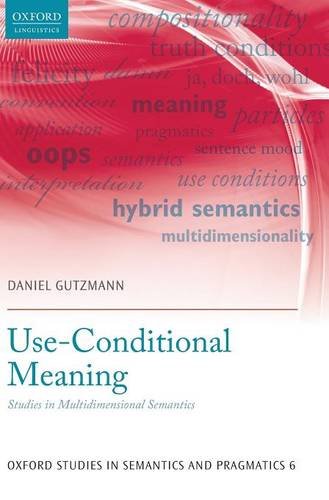
Use conditional meaning studies in multidimensional semantics 1st Edition by Daniel Gutzmann ISBN 0198723822 9780198723820


Original price was: $50.00.$35.00Current price is: $35.00.
Use conditional meaning studies in multidimensional semantics 1st Edition by Daniel Gutzmann – Ebook PDF Instant Download/Delivery: 0198723822, 9780198723820
Full download Use conditional meaning studies in multidimensional semantics 1st Edition after payment
Product details:
ISBN 10: 0198723822
ISBN 13: 9780198723820
Author: Daniel Gutzmann
Use conditional meaning studies in multidimensional semantics 1st Table of contents:
1: Introduction
1.1 Pragmatics and the scope of semantics
1.2 Use-conditional meaning
1.3 Hybrid semantics
1.4 Goals for the book
1.5 Notes on terminology
1.6 Overview of the individual chapters
2: The case for use-conditional meaning
2.1 Use-conditional semantics
2.1.1 Denotations for use-conditional content
2.1.2 Hybrid semantics
2.1.3 Reasoning in hybrid semantics
2.2 Varieties of UCIs
2.2.1 Expressives in the narrow sense
2.2.2 Particles
2.2.3 Non-lexical UCIs
2.2.4 Types of UCIs
2.3 Chapter summary
3: Previous approaches to multidimensional meaning
3.1 Introduction
3.2 LCI—The logic of conventional implicatures
3.2.1 Types for LCI
3.2.2 Modes of composition
3.2.3 Interpretation
3.3 Assessment of LCI
3.3.1 Types of UCIs in LCI
3.3.1.1 Isolated expletive UCIs in LCI
3.3.1.2 Functional expletive UCIs in LCI
3.3.1.3 Functional shunting UCIs in LCI
3.3.1.4 Isolated mixed UCIs in LCI
3.3.1.5 Functional mixed UCIs
3.3.2 Use-conditional modifiers
3.3.3 Abstraction problem
3.4 L+CI—Accounting for mixed content
3.4.1 From trees to proofs
3.4.2 New types in L+Cl
3.4.3 New rules of proof in L+CI
3.4.4 Omitting mixed types from L+CI
3.5 Assessment of L+CI
3.5.1 Types of UCIs in L+CI
3.5.1.1 Isolated mixed UCIs in L+CI
3.5.1.2 Functional mixed UCIs in L+CI
3.5.1.3 Functional shunting UCIs
3.5.2 Use-conditional modifiers
3.5.3 Abstraction problems in L+CI
3.5.4 Quantification problems in L+CI
3.5.5 Summary of the assessment of L+CI
3.6 Compositionality issues with L*CI
4: A multidimensional logic for hybrid semantics
4.1 Introduction
4.2 Use-conditional types
4.3 Towards true multidimensionality
4.3.1 Compositional LCI
4.3.2 Compositional L+CI
4.4 The new logic LTU
4.4.1 Extension and generalization
4.4.2 Lexical extension rules
4.4.3 Abbreviation conventions
4.4.4 The architecture of LTU
4.5 Assessment of LTU
4.5.1 Types of UCIs in LTU
4.5.1.1 Isolated expletive UCIs in LTU
4.5.1.2 Functional mixed UCIs in LTU
4.5.1.3 Functional expletives and shunting UCIs in LTU
4.5.1.4 Isolated mixed UCIs in LTU
4.5.2 Further cases
4.5.2.1 Use-conditional modifiers
4.5.1.2 Multidimensional quantification in LTU
4.5.1.3 Abstraction in LTU
4.6 Chapter summary
5: Sentence mood
5.1 Introduction
5.2 Kinds of approaches to sentence mood
5.2.1 An integrative approach
5.2.2 An implicit approach
5.2.3 A multidimensional approach
5.3 A compositional approach to sentence mood
5.3.1 Epistemic interpretation
5.3.2 Movement and visibility
5.3.3 Deontic interpretation
5.3.4 Hearer knowledge
5.3.5 Imperatives
5.4 From integration to multidimensionality
5.4.1 Presuppositions?
5.4.2 Truth conditions?
5.5 Use conditions and sentence mood
5.6 Formalization of a use-conditional approach to sentence mood
5.6.1 Deontic attitude
5.6.2 Epistemic attitude
5.6.3 Hearer knowledge
5.7 Chapter summary
6: Modal particles
6.1 Introduction
6.2 Properties of modal particles
6.2.1 The syntax of modal particles
6.2.1.1 Intrasentential distribution
6.2.1.2 Projectional behavior
6.2.2 The semantics of modal particles
6.2.2.1 Non-truth-conditionality
6.2.2.2 Negation and scope
6.2.3 Modal particles and sentence mood
6.2.3.1 Intersentential distribution
– The distribution of ja
– The distribution of denn
– The distribution of wohl
6.2.3.2 Interaction with sentence mood
6.3 Hybrid semantics for modal particles
6.3.1 Modal particles as use-conditional items
6.3.2 Non-truth-conditionality
6.3.3 Negation
6.3.4 Scope
6.4 Deriving syntax from semantics
6.4.1 Projectional behavior
6.4.2 Coordination
6.4.3 Focus
6.4.4 Questions
6.4.5 Fronting
6.5 Modal particles and sentence mood
6.5.1 Selectional restrictions due to types
6.5.2 Selectional restrictions due to meaning
6.6 Chapter summary
7: Uncharted dimensions
7.1 Introduction
7.2 Use-conditional and non-at-issue meaning
7.3 Meaning dimensions and discourse updates
7.4 Hybrid semantics and language change
7.5 Typology of use-conditional meaning
People also search for Use conditional meaning studies in multidimensional semantics 1st:
use conditional formatting with multiple conditions
use conditional in a sentence
use-conditional meaning studies in multidimensional semantics
measures in a multi-dimensional analysis
multidimensional self concept