

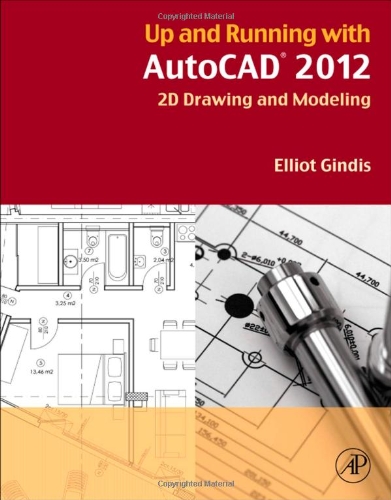
Up and Running with AutoCAD 2012 2D Drawing and Modeling 1st Edition by Elliot J Gindis ISBN 0123876834 9780123876836

Original price was: $50.00.$35.00Current price is: $35.00.
Up and Running with AutoCAD 2012 2D Drawing and Modeling 1st Edition by Elliot J Gindis – Ebook PDF Instant Download/Delivery: 0123876834, 9780123876836
Full download Up and Running with AutoCAD 2012 2D Drawing and Modeling 1st Edition after payment
Product details:
ISBN 10: 0123876834
ISBN 13: 9780123876836
Author: Elliot J Gindis
Get “Up and Running” with AutoCAD using Gindis’ combination of step-by-step instruction, examples, and insightful explanations. The emphasis from the beginning is on core concepts and practical application of AutoCAD in architecture, engineering and design. Equally useful in instructor-led classroom training or self-study, the book is written with the student in mind by a long-time AutoCAD user and instructor based on what works in the industry and the classroom
- Strips away complexities and reduces AutoCAD to easy-to-understand basic concepts
- Explains “why” something is done, not just “how”: the theory behind each concept or command is discussed prior to engaging AutoCAD so the student has a clear idea of what they are attempting to do
- All basic commands are documented step-by-step: what the user types in and how AutoCAD responds is spelled out in discrete and clear steps with numerous screen shots
- Extensive supporting graphics (screen shots) and a summary with a self-test section and topic specific drawing exercises are included at the end of each chapter
- Also available in a 2D+3D version with 10 additional chapters covering 3D concepts. ISBN for the 2D+3D version is 978-012-387029-2
Up and Running with AutoCAD 2012 2D Drawing and Modeling 1st Table of contents:
LEVEL 1. Chapters 1–10
CHAPTER 1 AutoCAD Fundamentals: Part I
1.1 Introduction and Basic Commands
1.2 The AutoCAD Environment
1.3 Interacting with AutoCAD
1.4 Practicing the Create Objects Commands
1.5 View Objects
1.6 Practicing the Edit/Modify Objects Commands
1.7 Selection Methods
1.8 Drawing Accuracy—Part 1
1.9 Drawing Accuracy—Part 2
1.10 OSNAP Drafting Settings
Summary
CHAPTER 2 AutoCAD Fundamentals: Part II
2.1 Grips
2.2 Units and Scale
2.3 Snap and Grid
2.4 Cartesian Coordinate System
2.5 Geometric Data Entry
2.6 Inquiry Commands
2.7 Additional Drafting Commands
Summary
CHAPTER 3 Layers, Colors, Linetypes, and Properties
3.1 Introduction to Layers
3.2 Introduction to Linetypes
3.3 Introduction to Properties
3.4 In-Class Drawing Project: Floor Plan Layout
Summary
SPOTLIGHT ON: ARCHITECTURE
CHAPTER 4 Text, Mtext, Editing, and Style
4.1 Introduction to Text and Mtext
4.2 Text
4.3 Mtext
4.4 Style
4.5 Spell Check
4.6 In-Class Drawing Project: Adding Text and Furniture to Floor Plan Layout
Summary
CHAPTER 5 Hatch Patterns
5.1 Introduction to Hatch
5.2 Hatch Procedures
5.3 Working with Hatch Patterns
5.4 Gradient and Solid Fill
5.5 In-Class Drawing Project: Adding Hatch to Floor Plan Layout
Summary
CHAPTER 6 Dimensions
6.1 Introduction to Dimensions
6.2 Types of Dimensions
6.3 Editing Dimensions
6.4 Customizing Dimensions
6.5 In-Class Drawing Project: Adding Dimensions to Floor Plan Layout
Summary
SPOTLIGHT ON: MECHANICAL ENGINEERING
CHAPTER 7 Blocks, Wblocks, Dynamic Blocks, Groups, and Purge
7.1 Introduction to Blocks
7.2 Insert
7.3 Purge
7.4 Wblocks
7.5 Dynamic Blocks
7.6 Groups
Summary
CHAPTER 8 Polar, Rectangular, and Path Arrays
8.1 Polar Array
8.2 Rectangular Array
8.3 Path Array
8.4 In-Class Drawing Project: Mechanical Device
Summary
CHAPTER 9 Basic Printing and Output
9.1 Introduction to Printing and Plotting
9.2 The Essentials
9.3 The Plot Dialog Box
9.4 Page Setup Manager
Summary
SPOTLIGHT ON: INTERIOR DESIGN
CHAPTER 10 Advanced Output—Paper Space
10.1 Introduction to Paper Space
10.2 Paper Space Concepts
Summary
Level 1. Answers to Review Questions
LEVEL 2. Chapters 11–20
CHAPTER 11 Advanced Linework
11.1 Introduction to Advanced Linework
11.2 Pline (Polyline)
11.3 Xline (Construction Line)
11.4 Ray
11.5 Spline
11.6 Mline (Multiline)
11.7 Sketch
Level 2 Drawing Project (1 of 10): Architectural Floor Plan
Summary
CHAPTER 12 Advanced Layers
12.1 Introduction to Advanced Layers
12.2 Script Files
12.3 Layer State Manager
12.4 Layer Filtering
Level 2 Drawing Project (2 of 10): Architectural Floor Plan
Summary
CHAPTER 13 Advanced Dimensions
13.1 Introduction to Advanced Dimensions
13.2 Dimension Style Manager
13.3 Introduction to Constraints
13.4 Geometric Constraints
13.5 Dimensional Constraints
13.6 Dimension Driven Design
Level 2 Drawing Project (3 of 10): Architectural Floor Plan
Summary
SPOTLIGHT ON: ELECTRICAL ENGINEERING
CHAPTER 14 Options, Shortcuts, CUI, Design Center, and Express Tools
14.1 Options
14.2 Shortcuts
14.3 Customize User Interface
14.4 Design Center
14.5 Express Tools
Level 2 Drawing Project (4 of 10): Architectural Floor Plan
Summary
CHAPTER 15 Advanced Design and File Management Tools
15.1 Introduction to Advanced Design and File Management Tools
15.2 Align
15.3 Audit and Recover
15.4 Blend
15.5 Break and Join
15.6 CAD Standards
15.7 Calculator
15.8 Defpoints
15.9 Divide and Point Style
15.10 Donut
15.11 Draw Order
15.12 eTransmit
15.13 Filter
15.14 Hyperlink
15.15 Lengthen
15.16 Object Tracking (OTRACK)
15.17 Overkill
15.18 Point and Node
15.19 Publish
15.20 Raster
15.21 Revcloud
15.22 Sheet Sets
15.23 Selection Methods
15.24 Stretch
15.25 System Variables
15.26 Tables
15.27 Tool Palette
15.28 UCS and Crosshair Rotation
15.29 Window Tiling
15.30 Wipeout
Level 2 Drawing Project (5 of 10): Architectural Floor Plan
Summary
CHAPTER 16 Importing and Exporting Data
16.1 Introduction to Importing and Exporting Data
16.2 Importing and Exporting to and from MS Office Applications
16.3 Screen Shots
16.4 JPG
16.5 PDFs
16.6 Other CAD Software
16.7 Exporting and the Save As Feature
16.8 Inserting and OLE
Level 2 Drawing Project (6 of 10): Architectural Floor Plan
Summary
SPOTLIGHT ON: AEROSPACE ENGINEERING
CHAPTER 17 External References (Xrefs)
17.1 Introduction to Xrefs
17.2 Using Xrefs
17.3 Layers in Xrefs
17.4 Editing and Reloading Xrefs
17.5 Multiple Xrefs
17.6 Ribbon and Xrefs
Level 2 Drawing Project (7 of 10): Architectural Floor Plan
Summary
CHAPTER 18 Attributes
18.1 Introduction to Attributes
18.2 Creating the Design
18.3 Creating the Attribute Definitions
18.4 Creating the Attribute Block
18.5 Attribute Properties and Editing
18.6 Attribute Extraction
18.7 Invisible Attributes
Level 2 Drawing Project (8 of 10): Architectural Floor Plan
Summary
CHAPTER 19 Advanced Output and Pen Settings
19.1 Introduction to Advanced Output and Pen Settings
19.2 Setting Standards
19.3 The ctb File
19.4 Additional ctb File Features
19.5 The lwt Option
Level 2 Drawing Project (9 of 10): Architectural Floor Plan
Summary
SPOTLIGHT ON: CIVIL ENGINEERING
CHAPTER 20 Isometric Drawing
20.1 Introduction to Isometric Perspective
20.2 Basic Technique
20.3 Ellipses in Isometric Drawing
20.4 Text and Dimensions in Isometric Drawing
Level 2 Drawing Project (10 of 10): Architectural Floor Plan
Summary
Level 2. Answers to Review Questions
Appendices
APPENDIX A. Additional Information on AutoCAD
Who Makes AutoCAD?
What Is AutoCAD LT?
How Is AutoCAD Purchased and How Much Does It Cost?
Are There Significant Differences between AutoCAD Releases?
Is There an AutoCAD for the Mac?
A Brief History of Autodesk and AutoCAD
AutoCAD Releases
Major Autodesk Products
People also search for Up and Running with AutoCAD 2012 2D Drawing and Modeling 1st:
up and running with autocad 2022
up and running with autocad 2023
up drawing easy
using autocad 2022
2d drawing in autocad 2022
Tags: Elliot J Gindis, AutoCAD, Drawing