

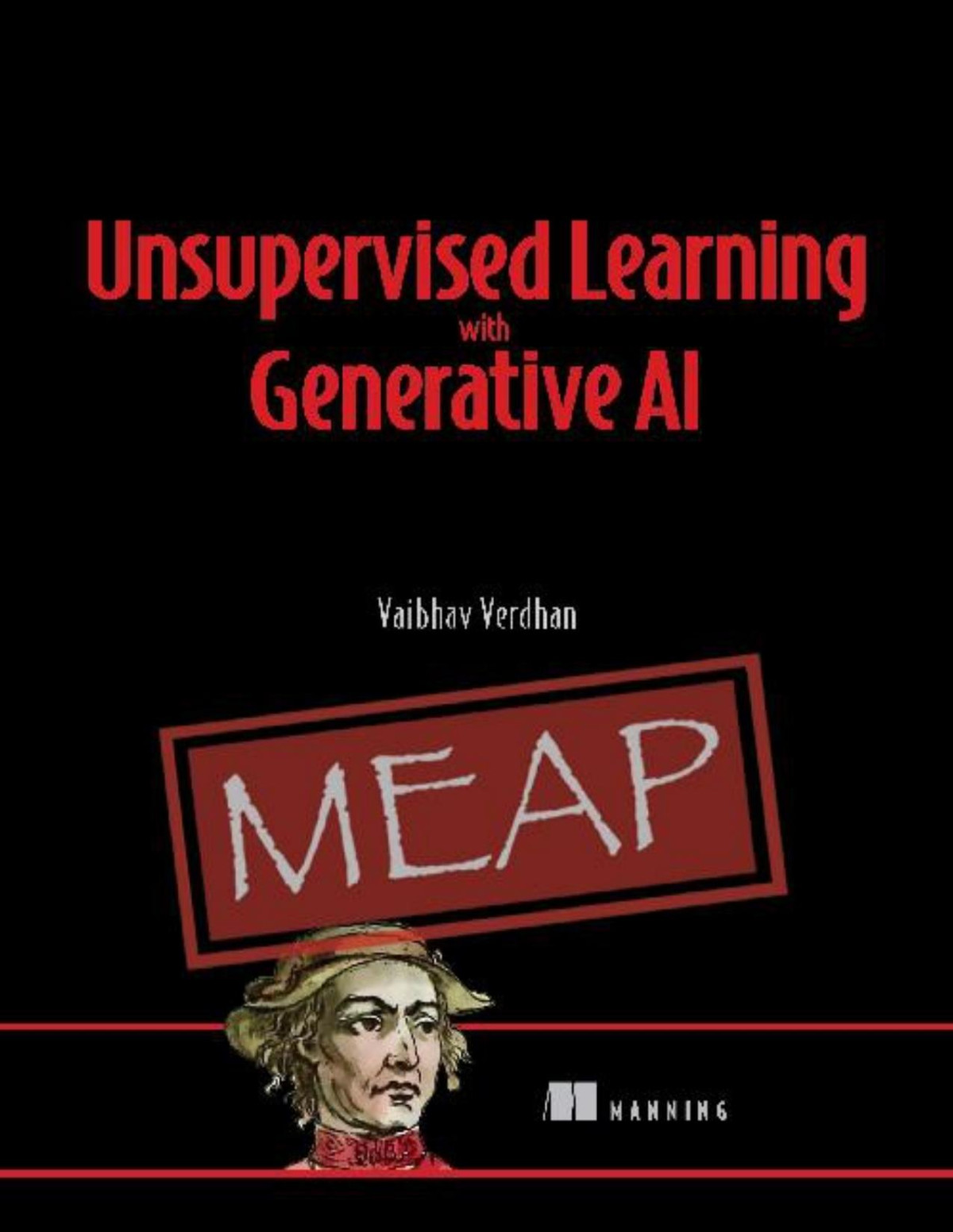
Data Without Labels Master unsupervised learning with deep learning and generative AI 1st Edition by Vaibhav Verdhan ISBN 1617298727 9781617298721
Original price was: $50.00.$35.00Current price is: $35.00.
Data Without Labels Master unsupervised learning with deep learning and generative AI 1st Edition by Vaibhav Verdhan – Ebook PDF Instant Download/Delivery: 1617298727, 9781617298721
Full download Data Without Labels Master unsupervised learning with deep learning and generative AI 1st Edition after payment
Product details:
ISBN 10: 1617298727
ISBN 13: 9781617298721
Author: Vaibhav Verdhan
Data Without Labels teaches you to apply a full spectrum of machine learning algorithms to raw data. You’ll master everything from kmeans and hierarchical clustering, to advanced neural networks like GANs and Restricted Boltzmann Machines. You’ll learn the business use case for different models, and master best practices for structured, text, and image data. Each new algorithm is introduced with a case study for retail, aviation, banking, and more—and you’ll develop a Python solution to fix each of these real-world problems. At the end of each chapter, you’ll find quizzes, practice datasets, and links to research papers to help you lock in what you’ve learned and expand your knowledge.
Data Without Labels Master unsupervised learning with deep learning and generative AI 1st Table of contents:
Part I – Introduction to Unsupervised Learning
Introduction: The Power of Data Without Labels
Overview of unsupervised learning
The significance of unlabeled data in the modern AI landscape
The intersection of deep learning, generative AI, and unsupervised learning
From Supervised to Unsupervised: A Paradigm Shift
Differences between supervised and unsupervised learning
The need for unsupervised learning in real-world applications
Key Concepts in Unsupervised Learning
Clustering, dimensionality reduction, anomaly detection, and more
Exploring the importance of feature learning and representation
Part II – Foundations of Deep Learning in Unsupervised Learning
Neural Networks and Deep Learning for Unsupervised Learning
Basics of neural networks and how they relate to unsupervised tasks
Autoencoders, unsupervised pre-training, and self-supervised learning
Self-Organizing Maps and k-Means Clustering
A deeper dive into unsupervised clustering algorithms
Practical examples of SOMs and k-means in data exploration
Dimensionality Reduction Techniques
PCA (Principal Component Analysis) vs. t-SNE (t-Distributed Stochastic Neighbor Embedding)
Latent variable models and their applications in deep learning
Part III – Generative AI and Unsupervised Learning
Introduction to Generative AI
What is generative AI, and how does it differ from traditional machine learning?
Overview of key generative models: GANs, VAEs, and flow-based models
Generative Adversarial Networks (GANs) for Unsupervised Learning
Architecture and mechanics of GANs
Using GANs for data generation, image synthesis, and unsupervised learning tasks
Variational Autoencoders (VAEs) and Their Role in Unsupervised Learning
The theory behind VAEs and their application in generating complex data distributions
Latent space exploration and anomaly detection with VAEs
Flow-Based Models: Normalizing Flows and Their Applications
Understanding normalizing flows for learning complex distributions
Applications of flow-based models in unsupervised learning
Part IV – Advanced Techniques in Unsupervised Deep Learning
Clustering with Deep Learning
Deep clustering algorithms: Deep k-means, DBSCAN with deep learning
The role of deep learning in improving traditional clustering techniques
Self-Supervised Learning: Learning Representations from Unlabeled Data
Introduction to self-supervised learning concepts
How self-supervised learning enables models to learn useful features from unlabeled data
Unsupervised Reinforcement Learning: Learning from Experience
Fundamentals of reinforcement learning in the unsupervised context
Using unsupervised methods in exploration-based tasks
Part V – Applications of Unsupervised Learning and Generative AI
Anomaly Detection: Identifying Outliers in Unlabeled Data
Techniques and applications of anomaly detection in industry
Using deep learning for robust anomaly detection
Natural Language Processing (NLP) with Unsupervised Learning
Unsupervised methods in text analysis and language models
Topic modeling, word embeddings, and language generation with generative AI
Unsupervised Learning in Computer Vision
Image clustering, segmentation, and feature extraction
Generative AI in image generation and image-to-image translation
Audio and Speech Processing with Unsupervised Learning
Applications of unsupervised learning in audio signal processing
Deep learning methods for speech recognition and music generation
Part VI – Challenges and Future Directions
Challenges in Unsupervised Learning
Lack of labeled data, interpretability, and model evaluation
Dealing with the curse of dimensionality and high variance
Ethical Considerations in Unsupervised Learning and Generative AI
Bias in generative models
Ethical concerns in AI-generated content, privacy, and fairness
The Future of Unsupervised Learning: Trends and Innovations
Emerging research in unsupervised learning and generative AI
Prospects for advancing unsupervised techniques in real-world applications
People also search for Data Without Labels Master unsupervised learning with deep learning and generative AI 1st:
unsupervised generative models
unsupervised neural machine translation with generative language models only
unsupervised learning via meta-learning
unsupervised generative modeling using matrix product states
ai unsupervised learning
Tags: Vaibhav Verdhan, Data, generative