

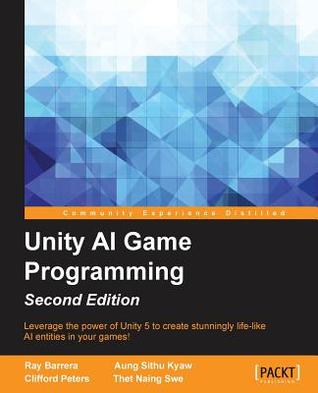
Unity AI Game Programming Leverage the power of Unity 5 to create stunningly life like AI entities in your games 2nd Edition by Ray Barrera, Aung Sithu Kyaw, Clifford Peters, Thet Naing Swe ISBN 1849693404 9781849695305

Original price was: $50.00.$35.00Current price is: $35.00.
Unity AI Game Programming Leverage the power of Unity 5 to create stunningly life like AI entities in your games 2nd Edition by Ray Barrera, Aung Sithu Kyaw, Clifford Peters, Thet Naing Swe – Ebook PDF Instant Download/Delivery: 1849693404, 9781849695305
Full download Unity AI Game Programming Leverage the power of Unity 5 to create stunningly life like AI entities in your games 2nd Edition after payment
Product details:
ISBN 10: 1849693404
ISBN 13: 9781849695305
Author: Ray Barrera, Aung Sithu Kyaw, Clifford Peters, Thet Naing Swe
Unity 5 provides game and app developers with a variety of tools to implement artificial intelligence. Leveraging these tools via Unity’s API or built-in features allows limitless possibilities when it comes to creating your game’s worlds and characters. Whether you are developing traditional, serious, educational, or any other kind of game, understanding how to apply artificial intelligence can take the fun-factor to the next level!
This book helps you break down artificial intelligence into simple concepts to give the reader a fundamental understanding of the topic to build upon. Using a variety of examples, the book then takes those concepts and walks you through actual implementations designed to highlight key concepts, and features related to game AI in Unity 5. Along the way, several tips and tricks are included to make the development of your own AI easier and more efficient.
Starting from covering the basic essential concepts to form a base for the later chapters in the book, you will learn to distinguish the state machine pattern along with implementing your own. This will be followed by learning how to implement a basic sensory system for your AI agent and coupling it with a finite state machine (FSM). Next you will be taught how to use Unity’s built-in NavMesh feature and implement your own A* pathfinding system. Then you will learn how to implement simple flocks and crowd’s dynamics, the key AI concepts. Then moving on you will learn how a behavior tree works and its implementation. Next you will learn adding layer of realism by combining fuzzy logic concepts with state machines. Lastly, you learn applying all the concepts in the book by combining them in a simple tank game.
Unity AI Game Programming Leverage the power of Unity 5 to create stunningly life like AI entities in your games 2nd Table of contents:
-
Setting Up Unity for AI Game Development
-
2.1 Installing and Configuring Unity 5
-
2.2 Navigating the Unity Interface for AI Development
-
2.3 Key Unity Components for AI Programming
-
2.4 Understanding Unity’s Physics Engine for AI Behavior
-
-
Fundamentals of AI in Unity
-
3.1 Introduction to AI Techniques in Games
-
3.2 AI Systems Overview: Finite State Machines, Behavior Trees, and Pathfinding
-
3.3 Scripting AI with C# in Unity
-
3.4 Optimizing Performance for AI Systems
-
-
Creating NPCs and Characters with AI
-
4.1 Designing Believable NPCs (Non-Player Characters)
-
4.2 Implementing Basic AI: Movement and Interaction
-
4.3 Using Unity’s NavMesh for Pathfinding
-
4.4 Advanced Character AI: Reactivity, Dialogue, and Emotion Simulation
-
-
Pathfinding and Navigation Systems
-
5.1 Understanding Pathfinding Algorithms (A*, Dijkstra’s)
-
5.2 Implementing Navigation Meshes (NavMesh) in Unity
-
5.3 Dynamic Obstacles and Real-Time Path Recalculation
-
5.4 Pathfinding Optimization and Performance Considerations
-
-
Behavior Trees for Complex AI
-
6.1 Introduction to Behavior Trees: Concept and Use Cases
-
6.2 Building Simple Behavior Trees in Unity
-
6.3 Complex Behavior Trees for Strategic and Tactical AI
-
6.4 Debugging and Tuning Behavior Trees for Realistic Interactions
-
-
AI Sensing and Perception Systems
-
7.1 Vision and Hearing: Implementing Perception Systems
-
7.2 Line of Sight and Field of View Calculations
-
7.3 Sensing Environments: Using Raycasting and Triggers
-
7.4 Memory Systems and the Importance of Context Awareness
-
-
Creating Realistic Combat AI
-
8.1 Developing Combat AI: Melee and Ranged
-
8.2 Decision-Making in Combat: State Machines and Strategy
-
8.3 Dynamic Tactics and Adapting to Player Behavior
-
8.4 Implementing Group AI: Coordinating Multiple Entities in Battle
-
-
Implementing AI Learning and Adaptation
-
9.1 Introduction to Machine Learning in Unity AI
-
9.2 Reinforcement Learning for Adaptive NPCs
-
9.3 Creating Evolving Behaviors: Genetic Algorithms and Neural Networks
-
9.4 Practical Applications and Limitations of AI Learning in Games
-
-
Enhancing AI with Unity’s Animation System
-
10.1 Integrating AI with Unity’s Animation Controller
-
10.2 Using Blend Trees for Smooth Transitions
-
10.3 AI-Driven Animation: Reactive Movements and Actions
-
10.4 Synchronizing AI Behavior and Animation for Realistic Motion
-
Advanced AI Techniques
-
11.1 AI for Stealth and Evasion: Simulating Human-Like Intelligence
-
11.2 Dynamic Flocking, Swarming, and Herd Behavior
-
11.3 AI in Large-Scale Games: Mass NPC Interactions and Simulations
-
11.4 Implementing Multiplayer AI: Adapting to Human Players
-
Optimizing AI Performance in Unity
-
12.1 Identifying and Solving Common AI Performance Issues
-
12.2 Object Pooling and Memory Management for AI Entities
-
12.3 Parallelism and Multi-threading for AI Processing
-
12.4 Profiling and Debugging AI Code for Optimal Efficiency
-
AI for Interactive Storytelling and Dynamic Dialogue
-
13.1 Designing AI for Branching Dialogue Systems
-
13.2 Creating Dynamic and Reactive Storylines Based on Player Decisions
-
13.3 Using AI to Simulate NPC Emotions and Relationship Building
-
13.4 Implementing Voice Recognition and AI-Driven Conversations
-
Testing and Debugging AI Systems
-
14.1 Best Practices for Testing AI Behavior
-
14.2 Debugging AI Systems in Unity: Tools and Techniques
-
14.3 Performance Benchmarks and Stress Testing AI Systems
-
14.4 Player Feedback and Fine-tuning AI for Better Engagement
-
Case Studies and Real-World Examples
-
15.1 Case Study: Creating AI for a First-Person Shooter
-
15.2 Case Study: AI in Strategy Games
-
15.3 Case Study: AI for Racing and Simulation Games
-
15.4 Lessons Learned from Industry Examples
-
Future Trends in Unity AI Development
-
16.1 The Rise of AI-Driven Game Design
-
16.2 Artificial Intelligence and Virtual Reality (VR)
-
16.3 The Impact of AI in Procedural Content Generation
-
16.4 Preparing for the Future: AI in Next-Generation Games
People also search for Unity AI Game Programming Leverage the power of Unity 5 to create stunningly life like AI entities in your games 2nd:
unity ai game programming second edition
unity 2017 game ai programming
beginning game ai with unity programming artificial intelligence with c#
unity 5 x game ai programming cookbook
is unity good for game development
Tags: Ray Barrera, Aung Sithu Kyaw, Clifford Peters, Thet Naing Swe, AI Game, Programming Leverage, AI entities