

Treaty Interpretation 2nd Edition by Richard Gardiner ISBN 0199669236 9780199669233


Original price was: $50.00.$35.00Current price is: $35.00.
Treaty Interpretation 2nd Edition by Richard Gardiner – Ebook PDF Instant Download/Delivery: 0199669236, 9780199669233
Full download Treaty Interpretation 2nd Edition after payment
Product details:
ISBN 10: 0199669236
ISBN 13: 9780199669233
Author: Richard Gardiner
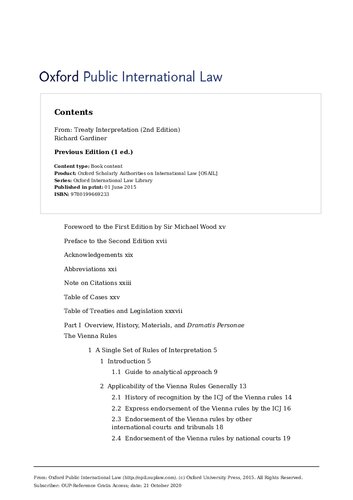
Treaty Interpretation 2nd Table of contents:
Part I. Overview, History, Materials, and Dramatis Personae
The Vienna Rules
1. A Single Set of Rules of Interpretation
1. Introduction
1.1 Guide to analytical approach
2. Applicability of the Vienna Rules Generally
2.1 History of recognition by the ICJ of the Vienna rules
2.2 Express endorsement of the Vienna rules by the ICJ
2.3 Endorsement of the Vienna rules by other international courts and tribunals
2.4 Endorsement of the Vienna rules by national courts
3. Definitions and Key Concepts
3.1 Treaty
3.2 Party, signatory, etc
3.3 Treaty relations
3.4 Preparatory work
3.5 Intertemporal law
3.6 ‘Interpretation’, ‘application’, and ‘construction’
4. The Process of Interpretation and the Nature of the Rules
4.1 The process of interpretation and the principle of autonomous interpretation
4.2 A general ‘rule’ and ‘rules’ of interpretation
4.3 Are the Vienna rules ‘rules’?
5. Five Examples
5.1 Interpretation by the European Court of Human Rights— a typical approach
5.2 An arbitral award illustrating the difference between treaty interpretation and application of law
5.3 An interpretation by an arbitral tribunal of the International Centre for Settlement of Investment Disputes (ICSID)— interpretation and application of a treaty
5.4 Interpretation within a national legal system— contrasting application of Vienna rules and domestic precedent
5.5 Interpretation within a national legal system— increasing awareness of the Vienna rules in courts in the UK
2. Development of Rules of Interpretation
1. Introduction
2. Treaty Interpretation in the Greco-Roman Era
3. Grotius, Pufendorf, Vattel, and Canons of Interpretation
4. The Harvard Draft Convention on the Law of Treaties
5. The Permanent Court of International Justice
6. Restrictive Interpretation and Effectiveness
7. Institut de Droit International
8. The Practice of the International Court of Justice Before the Vienna Convention
9. The New Haven School and World Public Order
10. The Work of the International Law Commission and the Vienna Conference
3. Interpretative Material Generated in Making Treaties
1. Introduction
2. Making Treaties
2.1 Who initiates and negotiates treaties?
2.2 Negotiating and drawing up a treaty
2.2.1 Negotiation and full powers
2.3 Adoption and authentication of a treaty text
2.4 Concluded and other instruments
2.4.1 Final acts and protocols
2.4.2 Distinguishing treaties from other instruments
3. Reservations and Statements or Declarations Affecting Interpretation of Treaties
3.1 Reservations
3.2 Interpretative declarations
3.2.1 Interpretative declarations in preparatory work and at, or after, conclusion
3.3 Differentiating between reservations and interpretative declarations
3.3.1 The nature of the difference
3.3.2 Wrinkles in the distinction and ‘conditional interpretative declarations’
3.3.3 Confusing terminology: statements and declarations
3.3.4 Differentiating in practice
3.3.5 The scheme for differentiation envisaged in the ILC’s Guide
3.4 Other declarations
3.5 Procedure relating to interpretative declarations
3.5.1 Approval of an interpretative declaration
3.5.2 Opposition to an interpretative declaration
3.5.3 Recharacterization of an interpretative declaration
3.6 Effects of interpretative declarations
3.6.1 Effects of general agreement to an interpretative declaration
3.6.2 Effects of approval by only one state or fewer than all
3.6.3 Decisions of courts and tribunals on interpretative declarations
3.7 Conclusion on interpretative declarations
4. Preparatory Materials
4.1 How far does preparatory work trace history?
4.1.1 What illuminates a common understanding?
4.1.2 Tracing a historical line
4.1.3 Looking at the main source
4.1.4 Using all material available to negotiators
4.2 Whether preparatory work can be differentially admissible
4.3 Documents associated with treaty negotiations
4.4 Admissibility of documents from a unilateral source
4. Who Uses the Vienna Convention to Interpret Treaties?
1. Introduction
2. International Organizations
2.1 General interpretative competence in international organizations
2.2 The two Vienna Conventions on the Law of Treaties
2.3 The United Nations and other organizations
2.4 The European Community and European Union
3. International Courts and Tribunals
3.1 International Court of Justice
3.2 Arbitration
3.3 The World Trade Organization Dispute Settlement Understanding
3.4 The International Centre for Settlement of Investment Disputes (ICSID)
3.5 The European Court of Human Rights
3.6 The European Court of Justice (Court of Justice of the European Union)
3.6.1 The treaties founding the Community
3.6.2 Treaties to which the Community is a party with non-Member States
3.6.3 Community instruments giving effect to treaties with non-members
3.7 Other international courts and tribunals
4. National Legal Systems
4.1 Implementation of treaties
4.2 Judicial interpretation within national legal systems
4.2.1 Parties to the Vienna Convention generally
4.2.2 The common law tradition
4.2.3 States which are not parties to the Vienna Convention
Part II. Interpretation Applying the Vienna Convention on the Law of Treaties
A. The General Rule
5. The General Rule: (1) The Treaty, its Terms, and their Ordinary Meaning
1. A ‘Treaty’
1.1 The ‘treaty’ and its ‘terms’
1.2 The sound of silence—absent and implied terms
2. ‘Good Faith’
2.1 History and preparatory work relating to ‘good faith’
2.2 Ordinary meaning of ‘good faith’
2.3 ‘Good faith’ in context and in the light of the Convention’s object and purpose
2.4 Issues and practice
2.4.1 ‘Good faith’ generally
2.4.2 ‘Good faith’ meaning reasonableness
2.4.3 ‘Good faith’ limiting interpretation of a power
2.4.4 ‘Good faith’ requiring balancing of treaty elements
2.4.5 ‘Good faith’ and the principle of effectiveness (ut res magis valeat quam pereat)
3. ‘Ordinary Meaning’
3.1 History and preparatory work
3.2 Ordinary meaning of ‘ordinary meaning to be given to the terms of the treaty’
3.3 Issues and practice
3.3.1 Role of ordinary meaning
3.3.2 Dictionaries and other sources of definitions
3.3.3 Literal meanings of single terms
3.3.4 No ordinary meaning or no single one?
3.3.5 Generic terms
3.3.6 ‘Ordinary’ to whom?
3.3.7 Treaty language and terms
3.3.8 Terms and concepts
4. ‘Context’
4.1 Background and context
4.2 Issues and practice
4.2.1 Immediate context—grammar and syntax
4.2.2 Title, headings, and chapeaux
4.2.3 Context showing structure or scheme
4.2.4 Related and contrasting provisions
4.2.5 Preamble
4.2.6 Punctuation and syntax
4.2.7 Different meanings of same term in a single instrument
4.2.8 Link with object and purpose
5. ‘Object and Purpose’
5.1 History and preparatory work relating to ‘object and purpose’
5.2 Ordinary meaning of ‘object and purpose’ in context
5.3 Issues and practice
5.3.1 Singular object and purpose
5.3.2 Finding object and purpose from preamble and substantive provisions
5.3.3 Can the object and purpose be used to counter clear substantive provisions?
5.3.4 Object and purpose identifying general scope of treaty
5.3.5 Object and purpose in a particular provision
5.3.6 Principle of effectiveness (general)
6. Conclusions
6. The General Rule: (2) Agreements as Context, Subsequent Agreements, and Subsequent Practice
1. Introduction
1.1 The linking notion of agreement
1.2 Substantial identity of effect of subsequent agreements on interpretation as of those at time of conclusion
1.3 Interpretative agreement in subsequent practice
2. Agreements and Instruments Made in Connection with Conclusion of a Treaty
2.1 Meaning of ‘Conclusion’ of a treaty
2.1.1 Issues arising as to ‘in connection with conclusion’ of a treaty
2.2 Interpretative role of agreements connected with conclusion of a treaty
2.3 Interpretative role of instruments made by one or more parties
2.3.1 Instruments covered by article 31(2)(b) of the Vienna Convention
2.3.2 Role of unilateral instruments covered by article 31(2)(b)
3. Subsequent Agreements
3.1 Fact of agreement, not form, is the key factor
3.1.1 History and analysis
3.1.2 ICJ looks for fact of agreement, not form
3.2 Less formal or informal agreement
3.3 Formal amendment and changed wording
3.3.1 Effect of amending agreements
3.3.2 Changed wording in related or comparable agreements
4. Subsequent Practice
4.1 Elements of subsequent practice
4.1.1 History and development of the provision
4.1.2 Meaning of ‘subsequent practice’
4.1.3 Frequency and uniformity of practice
4.1.4 Practice may consist of executive, legislative, and judicial acts
4.1.5 ‘Subsequent practice’ and ‘subsequent conduct’ distinguished
4.1.6 Practice ‘in the application of the treaty’
4.2 Deduction from absence of subsequent practice
4.2.1 Absence of action
4.2.2 Combining action with absence of reaction
4.3 Parties participating in the practice
4.3.1 Practice must be attributable to parties
4.3.2 Agreement, not practice, of all parties is required
4.3.3 Practice of some parties only does not interpret a treaty ‘inter se’ unless so agreed
4.3.4 Practice of some parties in absence of that of others
4.4 ‘Establishing’ agreement
4.5 Subsequent practice linked with informal agreement, understandings, or other instruments
4.6 Subsequent practice and ‘evolutive’ interpretation distinguished
4.7 Subsequent practice and amendment differentiated
4.8 Subsequent practice in international organizations
4.8.1 Whose practice in the organization?
4.8.2 Practice in relation to a treaty establishing an organization
4.8.3 Practice in relation to treaty provisions other than in constitutions of international organizations
4.8.4 Does practice of courts and tribunals constitute precedent?
4.9 Possible overlap with relevant rules of international law
5. Conclusions
7. The General Rule (3): Relevant Rules of International Law and Special Meanings
1. Introduction
1.1 The intertemporal rule in general international law
1.2 Time factors in treaty interpretation
2. History and Preparatory Work of Article 31(3)(c)
3. Ordinary Meaning of Article 31(3)(c) in Context, etc
3.1 There shall be taken into account, together with the context …
3.2 Relevant rules of international law
3.2.1 Relevance
3.2.2 Rules of international law
3.3 Which are ‘the parties’?
4. Issues and Practice
4.1 Terms
4.1.1 Extent of relevant ‘international law’
4.1.2 ‘Rules’
4.1.3 Applicable in the relations between which ‘parties’?
4.1.4 Conclusion as to ‘parties’
4.2 Intertemporal and temporal issues
4.3 Clarifying meaning by reference to international law
4.4 Reference to other treaties
4.4.1 Reference to international law stated in common form treaties
4.4.2 Reference to the same word as used in other treaties
4.4.3 Reference to terms or phrases used in treaties on the same subject
4.4.4 Requirement to take into account another treaty
4.5 Filling gaps by reference to general international law
4.6 Parallel and conflicting obligations
4.7 Taking account of international law developments
5. Special Meanings
5.1 Introduction
5.2 History and preparatory work
5.3 Issues and practice
5.3.1 Special meaning and ordinary meaning distinguished
5.3.2 Burden of establishing a special meaning
5.3.3 Evidence required to establish a special meaning
5.3.4 Special meanings and special regimes
6. Conclusions
B. Supplementary Means of Interpretation
8. Supplementary Means of Interpretation
1. Introduction
2. History and Preparatory Work
2.1 Separating supplementary means from the general rule
2.2 Ready reference to preparatory work distinguished from basing interpretations on it alone
2.3 Distinction between use of supplementary means ‘to confirm’ and ‘to determine’ the meaning
3. Meaning of ‘Recourse’ and ‘Supplementary’
3.1 ‘Recourse’
3.2 ‘Supplementary’
3.3 Further supplementary means
3.4 Relationship between supplementary means and the general rule
4. Issues and Practice
4.1 Systematic use of gateways, unsystematic use, and by-passing them
4.1.1 Explicit reference to the qualifying gateway
4.1.2 Reaching the preparatory work informally
4.1.3 Incidental use of supplementary means
4.1.4 Admitting preparatory work introduced by parties
4.2 Confirming meaning
4.2.1 Confirming a clear meaning
4.2.2 Role of ‘confirming’ when preparatory work contradicts meaning afforded by application of general rule
4.2.3 Using supplementary means to confirm ‘intention’
4.2.4 Using supplementary means to ‘reinforce’ an interpretation
4.2.5 Using preparatory work as general support
4.2.6 Reciting and using preparatory work contrasted
4.3 Determining meaning
4.3.1 Qualifying conditions: ‘ambiguous or obscure’ or ‘manifestly absurd or unreasonable’
4.3.2 Ambiguous by reference to availability of another word having one of the claimed meanings
4.4 Modalities of use of supplementary means
4.4.1 Using and construing preparatory work
4.4.2 Reading preparatory work to show agreement to exclude
4.4.3 Deduction from absence from preparatory work
4.4.4 Change of word or words during negotiation of treaty
4.4.5 Exclusion of preparatory work from consideration
4.4.6 May preparatory work be deployed as context?
4.4.7 Using preparatory work to identify or confirm object and purpose
4.4.8 Effect of interpretation recorded in preparatory work
4.4.9 Reading preparatory work in combination with other supplementary means
4.5 Circumstances of conclusion and other supplementary means
4.5.1 Meaning of ‘circumstances of conclusion’
4.5.2 Comparison with provisions in other treaties or associated material as a circumstance of conclusion
4.5.3 Commentaries, explanatory reports, academic writing, etc
4.5.4 Other supplementary means
5. Conclusions
C. Languages
9. Languages
1. Introduction
2. History and Preparatory Work
3. Ordinary Meaning of Terms in Article 33
4. Issues and Practice
4.1 Interpretation by reference first to only one of several languages
4.2 Use of ‘versions’, ‘official’, and other texts
4.3 Presumption of the same meaning in all authentic texts
4.4 How many languages must be considered if there is a need to reconcile texts?
4.5 Is the ‘original’ language of a treaty particularly significant for interpretation?
4.6 Translation of terms and legal concepts in different languages
4.7 Reconciliation where one or more texts are clear but another is ambiguous
4.8 Different punctuation in different languages
4.9 Reconciliation of language differences by reference to object and purpose
4.10 Using preparatory work in reconciling differences between languages
5. Conclusions
Part III. Conclusion
10. Criticism, Themes, Issues, and Conclusions
1. The notion of ‘rules’ of interpretation
1.1 Reviewing ‘interpretation’
1.2 What can ‘rules’ achieve?
2. Ambiguity and vagueness distinguished
3. ‘Textual’, ‘teleological’, ‘seeking intention’, and other approaches
3.1 ‘Textual’ does not mean ‘literal’ and is an unhelpful label
3.2 ‘Teleological’ is not warranted as a description of the general approach
3.3 Seeking intention
4. Evolutionary Interpretation
4.1 The International Court of Justice
4.2 The European Court of Human Rights
5. Particular Regimes
5.1 International Human Rights Law
5.2 International Criminal Law
6. Inconsistent Interpretations
6.1 Is there always a single interpretation that is correct?
6.2 Divergence over the same terms or from preparatory work: investment disputes
6.2.1 Meaning of ‘investment’
6.2.2 ‘Umbrella’ clauses
6.2.3 ‘Most Favoured Nation’ clauses
People also search for Treaty Interpretation 2nd:
general rules of treaty interpretation
vclt treaty interpretation
tax treaty interpretation
methods of treaty interpretation
subsequent practice treaty interpretation
Tags: Richard Gardiner, Treaty Interpretation