

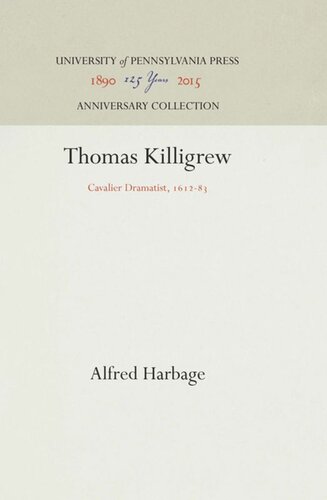
Thomas Killigrew Cavalier Dramatist 1612 83 1st Edition by Alfred Harbage ISBN 1512812161 978-1512812169

Original price was: $50.00.$35.00Current price is: $35.00.
Thomas Killigrew Cavalier Dramatist 1612 83 1st Edition by Alfred Harbage – Ebook PDF Instant Download/Delivery:1512812161, 978-1512812169
Full download Thomas Killigrew Cavalier Dramatist 1612 83 1st Edition after payment
Product details:
ISBN 10: 1512812161
ISBN 13: 978-1512812169
Author: Alfred Harbage
The life and work of a Restoration playwright whose name has been overshadowed by his reputation as a roué.
Table of contents:
INTRODUCTION
No minor literary figure of the seventeenth century is better known, by name, than Thomas Killigrew. At the reopening of the theatres after the Interregnum, he was appointed with Sir William Davenant co-monopolist of the London stage, and for over a decade he governed the King’s Players and managed the Theatre Royal in Drury Lane. His position as royal patentee and ultimately as Master of the Revels during a period of dramatic fecundity has won him prominence in English literary history—a vicarious prominence, because quite unrelated to his own pretensions as a playwright. Other factors have combined to make…
I A FAMILY OF COURTIERS
Thomas Killigrew belonged to an ancient Cornish family. Had he been inclined (and there is no doubt that he frequently was, since vainglory is one weakness which tradition has attached to him without injustice), he might have boasted that among his ancestors was numbered no less a luminary than Richard Coeur de Lion. According to family tradition, to Hals the seventeenth-century Cornish antiquarian, and to the more modern expert in heraldry, the family originated from King Richard’s nephew and namesake the Earl of Cornwall, titular King of the Romans, and his concubine Jean de Valletorta, widow of Sir Alexander Oakeston…
II A YOUNGER SON
To have had three older brothers must have seemed nothing short of calamitous to Thomas Killigrew as soon as he was old enough to realize that his father’s position at Hanworth was midway between that of a proprietor and that of a caretaker. It would be interesting for us to have full information concerning our dramatist’s youth and his early experiences in winning a place for himself, but, as must be expected, this is the period of his life about which we can learn the least. His career upon the whole can be reconstructed more completely than those of many…
III A PLAYWRIGHT IN EXILE
At the outbreak of the Civil Wars, the Killigrews rallied around the standard of the King. There may have been a few exceptions to this rule, but not among members of the younger branches of the family. The Earl of Clarendon has left us the description of a typical Killigrew action. Sir Henry (a second cousin of Thomas) was sitting in the House of Commons when Parliament was raising an army against the King. Various members were taking the floor to announce what forces they would raise and maintain. Sir Henry Killigrew could stand it no longer, and, rising to…
IV A ROYAL FAVORITE
In the spring of the year 1660 King Charles returned in triumph to his realm; and Thomas Killigrew, who had promptly turned his back upon the Netherlands, was in his troop of rejoicing courtiers. On May 24 Samuel Pepys, who was aboard the Naseby (later the Charles), set down in his Diary that
“…Walking upon the decks, were persons of honour all the afternoon, among others Thomas Killigrew, (a merry droll, but a gentleman of great esteem with the King) who told us many merry stories.”
There is ample proof that Killigrew was truly “of great esteem”…
V AMATEUR PLAYS
In the decade preceding the closing of the theatres it became more and more the custom of gentlemen to dabble in the art of writing plays; and the wane of the great period of English dramatic activity was marked, like its beginning, by a number of productions which can be designated only as amateur experiments. Thomas Killigrew’s first three plays, The Prisoners, Claricilla, and The Princess, are distinctly amateur plays, written by a young courtier under twenty-five years of age whose more serious interests in life lay elsewhere than in the theatre. We must recognize, however, that a man of…
VI SEMI-PROFESSIONAL PLAYS
After writing his three tragi-comedies, Thomas Killigrew put aside his pen and for several years produced no more plays. He probably believed at the time that he would have no occasion to indulge in this amusing pastime again. A talented young courtier might gain something by displaying dexterity in amusing the court with plays, but, after all, the avenue to substantial advancement was not literary achievement. In the years following the completion of the last of his amateur plays in 1636, there ensued Killigrew’s marriage to Cecilia Crofts, the birth of his son, the subsequent death of his wife, and…
VII “CLOSET DRAMA”
It has been implied from time to time in preceding chapters that Thomas Killigrew was a dramatist with ulterior motives, that he began to write plays as a means of attracting attention to his polite accomplishments and later became interested in the stage for its financial or professional possibilities. These implications are quite justified; we have, nevertheless, evidence that Killigrew was sincerely interested in literary endeavor, and derived pleasure from writing plays. As Oliver Cromwell wound the reins of the English government more and more firmly about his hands, and as the Exile wore on and threatened to be interminable…
BIBLIOGRAPHY
[List of sources and references used in the work.]
INDEX
[An alphabetical list of topics, names, and places mentioned in the book.]
People also search for:
thomas killigrew plays
thomas killigrew and william davenant
6. cavalier king charles spaniel
4. cavalier king charles spaniel
Tags: Alfred Harbage, Thomas Killigrew, Cavalier Dramatist