

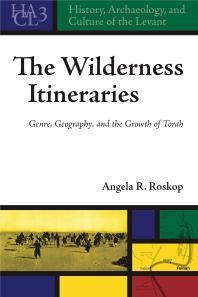
The Wilderness Itineraries Genre Geography and the Growth of Torah History Archaeology and Culture of the Levant 1st Edition by Angela R Roskop ISBN 1575062127 978-1575062129

Original price was: $50.00.$35.00Current price is: $35.00.
The Wilderness Itineraries Genre Geography and the Growth of Torah History Archaeology and Culture of the Levant 1st Edition by Angela R.Roskop – Ebook PDF Instant Download/Delivery:1575062127 ,978-1575062129
Full download The Wilderness Itineraries Genre Geography and the Growth of Torah History Archaeology and Culture of the Levant 1st Edition after payment
Product details:
ISBN 10:1575062127
ISBN 13:978-1575062129
Author:Angela R.Roskop
As we read the wilderness narrative, we are confronted with a wide variety of cues that shape our sense of what kind of narrative it is, often in conflicting ways. It often appears to be history, but it also contains genres and content that are not historiographical. To explain this unique blend, Roskop charts a path through Akkadian and Egyptian administrative and historiographical texts, exploring the way the itinerary genre was used in innovative ways as scribes served new literary goals that arose in different historical and social situations. She marries literary theory with philology and archaeology to show that the wilderness narrative came about as Israelite scribes used both the itinerary genre and geography in profoundly creative ways, creating a narrative repository for pieces of Israelite history and culture so that they might not be forgotten but continue to shape communal life under new circumstances.
The itinerary notices also play an important role in the growth of the Torah. Many scholars have expressed frustration with historical criticism because it seems at times to focus more on deconstructing a narrative than explaining how this composite text manages to work as a whole. The Wilderness Itineraries explores the way that fractures in the itinerary chain and geographical problems serve both as clues to the composition history of the wilderness narrative and as cues for ways to navigate these fractures and read this composite text as a unified whole. Readers will gain insight into the technical skill and creativity of ancient Israelite scribes as they engaged in the process of simultaneously preserving and actively shaping the Torah as a work of historiography without parallel.
Table of contents:
1.Chapter 1 The Torah as History: Rethinking Genre
In his classic work Zakhor: Jewish History and Jewish Memory, Yosef Hayim Yerushalmi explores a deeply felt tension between the drive to study and record the past and the drive to remember the past in a way that sustains the life of a community. Memory of the past has always been central to Jewish experience but has rarely taken on the intellectual or literary form of historiography. History and memory were, in Yerushalmi’s view, intertwined in the Bible but pulled apart in postbiblical Judaism. The rabbis were concerned with the past but sought to explore its meaning through other forms…
2.Chapter 2 Emplotment and Repertoire: A Reading Strategy
Even the most enduring texts were written and are read in specific historical and social contexts. We open the Torah with a whole set of historically conditioned assumptions about it that influence our reading, even as we may often (and rightly) work hard to set at least some of these assumptions aside. The authors of the Torah likewise brought to their work a set of skills, resources, and knowledge about their world that were conditioned by their historical context. Perhaps because all we have left of these scribes is the literature they produced, it is easy to focus on the…
3.Chapter 3 Itineraries: Their Forms and Contexts
Our ability to comprehend successfully the meaning of an ancient text, no less than a modern text, depends in part on how well we understand the cultural repertoire used by its author. Wolfgang Iser emphasized that elements of repertoire are ideally shared by both author and reader. If the speaker in a conversation refers to something with which the listener is not familiar, the listener must learn it by guessing or asking for clarification. Moreover, if the listener is not simply ignorant of it but understands it to be something other than what the speaker is referring to, miscommunication may…
4.Chapter 4 Experimenting with Genre: Using Sources and Shaping Narratives
We take it for granted that historians use sources. A trip to the archives to draw on whatever material might be available and useful in writing a narrative about a particular subject is a necessary part of the modern historian’s work. Historians in antiquity also had access to and drew upon source material. We know this because they explicitly referred to sources within their narratives, because they sometimes did a less-than-careful job of integrating their sources, and because they left traces of the genre characteristics of their source documents. Louis D. Levine suggested that we might further explore the sources…
5.Chapter 5 An Israelite “Annal”
Innovative uses of the itinerary genre in Egyptian and Neo-Assyrian military narratives, as we have seen above, were driven at core by a shift in royal ideology. Kings were no longer simply builders and maintainers of the cult, their traditional roles in commemorative building inscriptions, but were also conquerors. Their scribes found a way not only to commemorate but also to promote this role by creating new literary forms. Despite the innovations involved in creating them, these new literary forms stretch the norms of itineraries and commemorative inscriptions only so far. Egyptian scribes continued to use source documents as a…
6.Chapter 6 The Routes of the Wilderness Sojourn: Itineraries and Composition History
A well-crafted narrative is a pleasure to read. Roland Barthes, in The Pleasure of the Text, discusses two different ways to enjoy reading. Readerly pleasure is pleasure taken in a more-or-less passive reading of a text focused on processing the narrative as a whole, understanding the meaning and significance of the text. Writerly pleasure, on the other hand, is pleasure taken in more active and analytical reading of a text focused on understanding how it was written, appreciating the artistry that went into its composition. The difference is easy to grasp if you imagine standing a distance away from a…
7.Chapter 7 Places in the Wilderness: Geography as Artistry
Whether an administrative document or an origin narrative, a text takes shape through a scribe’s sometimes quite typical and sometimes profoundly creative use of genre. Selecting and foregrounding elements of social, historical, and geographical repertoire from the real world help a text take place. An author creates a discourse world in the text no matter what type of document he is writing; as Paul Werth noted, “all situations must be represented in the minds of the participants, whether they refer to the real world, to memory, or to imagination.” How geography is used in a text depends on the author’s…
8.Epilogue
Marc Zvi Brettler in The Creation of History in Ancient Israel defines history as “a narrative that presents a past.” The Torah is a story of Israel’s past and can be understood, if only in this very broad sense, as history. By the end of his study, Brettler had run up against the same poverty of language that Yosef Haim Yerushalmi spoke of in Zakhor, and he came to the conclusion that “the term ‘history’ or ‘historical/historiographical narrative’ should be dropped from the form-critical lexicon, since the form of a text has little bearing on its historicity.” Biblical narrative is…
People also search for:
wilderness trail 6 year wheated bourbon
it’s the wildest ride in the wilderness
out the wilderness
map of the wilderness journey
in the wilderness in the bible
Tags: Angela R Roskop, Wilderness, tineraries, Geography