

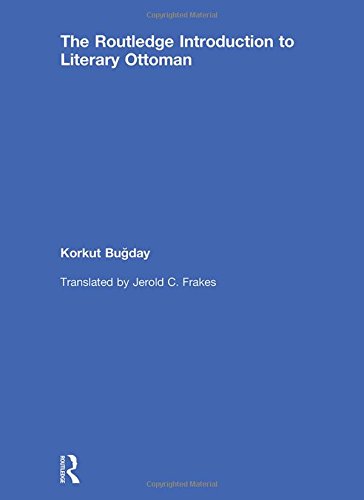
The Routledge Introduction to Literary Ottoman 1st Edition by Korkut Bugday ISBN 0415493382 9780415493383
Original price was: $50.00.$35.00Current price is: $35.00.
The Routledge Introduction to Literary Ottoman 1st Edition by Korkut Bugday – Ebook PDF Instant Download/Delivery: 0415493382, 9780415493383
Full download The Routledge Introduction to Literary Ottoman 1st Edition after payment
Product details:
ISBN 10: 0415493382
ISBN 13: 9780415493383
Author: Korkut Bugday
The Routledge Introduction to Literary Ottoman 1st Table of contents:
Chapter 1
1.1 Script and alphabet
1.1.1 Vowel signs (ḥarekāt حرکات) and other markings
1.2 The pronunciation of the letters
1.3 Ligatures and handwriting
Exercises
Chapter 2
2.1 The representation of vowels in words of Turkic origin
2.2 On transcription
2.2.1 The transcription of و ,ا, and ى
2.2.2 Plene and defective orthography
2.3 On the pronunciation and transcription of vowels in words of Persian and Arabic origin
2.4 Rules for writing hemze
2.5 Numerals
Exercises
Chapter 3
3.1 Vowel harmony
3.2 Consonant harmony
3.3. General information on word order, articles, gender, plural formation, case, nominative case
3.4 Dative case
3.5 Accusative case
3.6 Locative case
3.7 Imperative mood
3.8 Cardinal numbers (Turkish) 1–10
3.9 Possessive suffix of 3rd person singular
3.10 miş-past tense
3.11 Aorist tense
3.12 Converbs in -üb, -ken, -erek, and -ü (gerunds)
3.13 Verb formation with ėtmek / eylemek
3.14 The izafet construction
Text: A Ḫoca Naṣreddīn Tale: “A Dream”
Vocabulary
Exercises
Chapter 4
4.1 Infinitive in -mek
4.2 Genitive case
4.3 Ablative case
4.4 Demonstrative pronouns
4.5 Personal pronouns and personal inflections
4.6 Interrogatives ne, kim, nere
4.7 Participles in -en
4.8 The formative -li
4.9 The formative -dir
4.10 The compound suffix -dikde
Text: A Ḫoca Naṣreddīn Tale: “The Broth of the Broth of the Hare”
Vocabulary
Exercises
Chapter 5
5.1 Instrumental case
5.2 Expressing to have
5.3 Adverbials in -ce
5.4 Perfect tense
5.5 Present tense in -yor
5.6 The compound suffix – yordi
5.7 The compound suffix – °rdi
5.8 Negation in -me- (and دكل değil)
5.9 The abilitative: expressing can/to be able
5.10 Verbal nouns in-dik
5.11 The short infinitive
5.12 Intensification through reduplication
Text: “The Woman and the Hen”
Vocabulary
Exercises
Chapter 6
6.1 Cardinal numbers (Turkish)
6.2 Personal pronouns in all cases
6.3 Possessive inflection
6.4 Verbal nouns in -ecek
6.5 Relative clauses with verbal nouns in -dik and -ecek
6.6 Declarative content clauses (‘that’-clauses)
6.7 The formation -dikden ṣoñra
6.8 Past perfect (pluperfect) tense in -mişdi
6.9 The necessitative
6.10 Converbs in-e and -i
6.11 The formation -mek üzere
6.12 Comparative and superlative formation
6.13 Causatives in -t
6.14 Adverbial formation with the Arabic accusative
Text: “The Fable of the Lion, the Fox, and the Donkey”
Vocabulary
Exercises
Chapter 7
7.1 The generic genitive construction
7.2 Future tense
7.3 Conditional mood
7.4 Optative mood
7.5 Converbs in -ince
7.6 The formation -diği gibi
7.7 Infinitives with dative inflection
7.8 Interrogative particle
7.9 Causatives in -ir
7.10 Conjunctional -de as suffix
7.11 Persian plural inflection
Text:”The Story of Ali Jinghis I”
Vocabulary
Exercises
Chapter 8
8.1 The abbreviated accusative
8.2 Passive and reflexive voice
8.3 Auxiliary verb to be
8.4 Compound verb tenses
8.5 The suffix -ki
8.6 The particles -kim and -ki
8.7 The formative -le
8.8 The Arabic article
Text: “The Story of Ali Jinghis II”
Vocabulary
Exercises
Chapter 9
9.1. The izafet construction
9.1.1 Genitive compounds with izafet
9.1.2 Attributive connections with izafet
9.1.3 Arabic adjectives in the izafet formation
9.1.4 The extension of the simple (two-member) izafet formation
9.1.5 The izafet -i as a component of several borrowed words
9.2 Hemze as the sign of accusative
9.3 The Persian formative -ī.
9.4 Pronunciation of ve
9.5 The compound suffixes -dikce and -mekle
Text: “The Abolition of the Janissary Corps”
Vocabulary
Exercises
Chapter 10
10.1 The equative
10.2 The formative -°ş
10.3 The formative -le in combination with – °n, – °ş, – °t
10.4 The ‘occupational’-suffix -ci
10.5 Formations in -meksizin
10.6 Repetition of words
10.7 The Persian formative elements – ḫāne, -gāh, -nāme, and -ber
10.8 Arabic genders
Text: “A European Journey: I. On Traveling in Europe and Choosing a Hotel”
Vocabulary
Exercises
Chapter 11
11.1 Word roots in Arabic
11.2 Arabic participles and verbal nouns; the stem-forms (‘derived’ verbal forms)
11.3 Regular plurals in Arabic
11.4 The formative -lik
11.5 The formative -leyin
Text: “A European Journey. II. Hotel Room and First Impressions of Berlin”
Vocabulary
Exercises
Chapter 12
12.1 Causal clauses with infinitive and instrumental
12.2 The Persian suffix -çe
12.3 On plural formation in Arabic
12.3.1 Arabic ‘broken’ plural formation
12.4 The nisbe-ending
Text: “Description of Vienna I”
Vocabulary
Exercises
Chapter 13
13.1 Participles and verbal nouns in ‘weak’ Arabic verbs
13.1.1 Verbs with initial radical vāv/ye (verba primae vāv/ye)
13.1.2 Hollow verbs (verbs with medial radical vāv/ye; verba mediae vāv/ye)
13.1.3 Weak-lām verbs (verbs with final radical vāv/ye; verba tertiae vāv/ye
13.1.4 Phonological rules in the formation of ‘weak’ verbs
13.1.5 Geminate verbs (verbs with doubled medial radical; verba mediae geminatae)
13.1.6 Consonant assimilation in stem VIII
Text: “Description of Vienna II”
Vocabulary
Exercises
Chapter 14
14.1 Declension of Arabic nouns
14.2 Determination and nunation of Arabic nouns
14.3 Adjectives in Arabic
14.4 Arabic enclitic pronouns
14.5 Arabic genitive constructions
14.6 Prepositions and the particles ke-, le-, and fe-
14.7 Arabic demonstrative pronouns
Text: “Charter/Deed of Alliance”
Vocabulary
Exercises
Chapter 15
15.1 The names of the months and days of the week
15.2 Arabic semantic formulae and idioms
15.3 Persian past tense
15.4 Persian personal and demonstrative pronouns
Text: “Events in the Capital”
Text: “The Death of Sultan Murād Khan”
Vocabulary
Exercises
Chapter 16
16.1 The Arabic perfective
16.2 The Arabic dual of substantives
16.3 Arabic verbal and nominal clauses
16.4 Nominal clauses with inne and enne and other introductory elements
16.5 Arabic personal pronouns
16.6 The ‘five nouns’ in Arabic
16.7 The Arabic vocative
16.8 Arabic interrogatives
16.9 The Arabic nomen actoris
Text: “Legends of ‘Abdī Dede”
Vocabulary
Exercises
Chapter 17
17.1 Arabic cardinal numbers
17.2 Converbs in -icek
17.3 The present stem in Persian
17.4 Nominal compounds
Text: “A Story of the Sultan’s Vizier”
Vocabulary
Exercises
Chapter 18
18.1 Arabic ordinal numbers
18.2 Arabic comparative and superlative
18.3 The perfective in irregular verbs of stem I
18.4 The perfective in stems II-VIII and X
18.5 Negation of the perfective
18.6 Arabic relative clauses
18.7 The formation -diği içün
Text: “The Aṣāf-nāme of Vizier Luṭfī Pasha”
Vocabulary
Exercises
Chapter 19
19.1 Persian numbers
19.2 Persian prepositions
19.3 The direct object in Persian
19.4 The enclitic personal pronoun in Persian
19.5 Persian participles
19.6 Nouns of time, place, and instrument (nomina loci et temporis and nomina instrumenti)
Text: “The Conclusion of the Story of Sultan Murād”
Text: “Sultan Meḥmed’s Accession to the Throne”
Vocabulary
Exercises
Chapter 20
20.1 The Arabic imperfective
20.1.1 The imperfective indicative of ‘weak’ verbs of stem I
20.1.2 The imperfective indicative in stems II-VIII and X
20.1.3 Negation of the imperfective
20.1.4 The Arabic subjunctive and jussive moods
20.2 The Arabic imperative mood
20.3 The Arabic future tense
20.4 The Arabic passive voice
20.5 Functions of the Arabic accusative case
20.6 The Persian comparative and superlative
Text: “A Description of the Stages of Sültan Suleyman Khan’s Iraq Campaign”
People also search for The Routledge Introduction to Literary Ottoman 1st:
history of english literature by routledge
how to pronounce routledge
the routledge reader in caribbean literature
the ottoman empire literature
the routledge companion to literature of the u.s. south
Tags: Korkut Bugday, Routledge Introduction, Literary Ottoman