

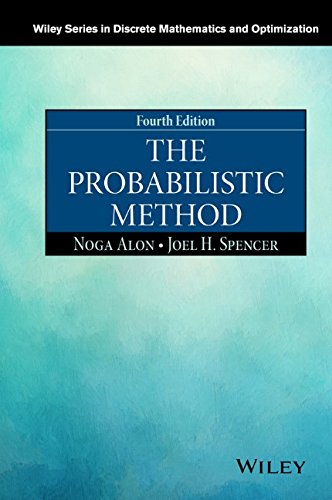
The Probabilistic Method 4th Edition by Noga Alon, Joel H Spencer ISBN 1119061954 9781119061953


Original price was: $50.00.$35.00Current price is: $35.00.
The Probabilistic Method 4th Edition by Noga Alon, Joel H Spencer – Ebook PDF Instant Download/Delivery: 1119061954, 9781119061953
Full download The Probabilistic Method 4th Edition after payment
Product details:
ISBN 10: 1119061954
ISBN 13: 9781119061953
Author: Noga Alon, Joel H Spencer
The Probabilistic Method 4th Table of contents:
PART 1 METHODS
1 The Basic Method
1.1 The Probabilistic Method
Proposition 1.1.1
1.2 Graph Theory
Theorem 1.2.1
Theorem 1.2.2
Lemma 1.2.3
1.3 Combinatorics
Proposition 1.3.1 [Erdős (1963a)]Theorem 1.3.2
Theorem 1.3.3
1.4 Combinatorial Number Theory
Theorem 1.4.1 [Erdős (1965a)]1.5 Disjoint Pairs
Theorem 1.5.1
1.6 Independent Sets and List Coloring
Containers
Theorem 1.6.1
List Coloring
Theorem 1.6.2
1.7 Exercises
The Probabilistic Lens: The Erdős–Ko–Rado Theorem
Lemma 1
2 Linearity of Expectation
2.1 Basics
Theorem 2.1.1
2.2 Splitting Graphs
Theorem 2.2.1
Theorem 2.2.2
Theorem 2.2.3
Lemma 2.2.4
2.3 Two Quickies
Theorem 2.3.1
Theorem 2.3.2
2.4 Balancing Vectors
Theorem 2.4.1
Theorem 2.4.2
2.5 Unbalancing Lights
Theorem 2.5.1
2.6 Without Coin Flips
2.7 Exercises
The Probabilistic Lens: Brégman’s Theorem
Claim 1
Lemma 2
3 Alterations
3.1 Ramsey Numbers
Theorem 3.1.1
Theorem 3.1.2
Theorem 3.1.3
3.2 Independent Sets
Theorem 3.2.1
3.3 Combinatorial Geometry
Theorem 3.3.1
3.4 Packing
Theorem 3.4.1
3.5 Greedy Coloring
Theorem 3.5.1
Corollary 3.5.2
Proof [Theorem 3.5.1]3.6 Continuous Time
Theorem 3.6.1 Spencer (1995)
Example
Remark
Corollary 3.6.2
3.7 Exercises
The Probabilistic Lens: High Girth and High Chromatic Number
Theorem 1 Erdős (1959)
4 The Second Moment
4.1 Basics
Theorem 4.1.1 [Chebyshev’s Inequality]4.2 Number Theory
Theorem 4.2.1
Theorem 4.2.2
4.3 More Basics
Theorem 4.3.1
Corollary 4.3.2
Corollary 4.3.3
Corollary 4.3.4
Corollary 4.3.5
4.4 Random Graphs
Theorem 4.4.1
Definition 1
Example
Theorem 4.4.2
Theorem 4.4.3
Theorem 4.4.4
Theorem 4.4.5
4.5 Clique Number
Theorem 4.5.1
Corollary 4.5.2
4.6 Distinct Sums
Theorem 4.6.1
4.7 The Rödl nibble
Theorem 4.7.1
Lemma 4.7.2
Proof
Theorem 4.7.3 [Rödl]4.8 Exercises
The Probabilistic Lens: Hamiltonian Paths
Theorem 1
Lemma 2
Corollary 3
Proposition 4
5 The Local Lemma
5.1 The Lemma
Lemma 5.1.1 [The Local Lemma; General Case]Corollary 5.1.2 [The Local Lemma; Symmetric Case]5.2 Property B and Multicolored Sets of Real Numbers
Theorem 5.2.1
Theorem 5.2.2
5.3 Lower Bounds for Ramsey Numbers
Proposition 5.3.1
5.4 A Geometric Result
Theorem 5.4.1
5.5 The Linear Arboricity of Graphs
Conjecture 5.5.1 [The Linear Arboricity Conjecture]Conjecture 5.5.2
Proposition 5.5.3
Theorem 5.5.4
Lemma 5.5.5
Theorem 5.5.6
Theorem 5.5.7
5.6 Latin Transversals
Theorem 5.6.1
5.7 Moser’s Fix-It Algorithm
Theorem 5.7.1
Theorem 5.7.2
Theorem 5.7.3
Theorem 5.7.4
Theorem 5.7.5
Theorem 5.7.6 [Grytczuk et al. (2013)]5.8 Exercises
The Probabilistic Lens: Directed Cycles
Theorem 1 [Alon and Linial (1989)]6 Correlation Inequalities
6.1 The Four Functions Theorem of Ahlswede and Daykin
Theorem 6.1.1 [The Four Functions Theorem]Corollary 6.1.2
Corollary 6.1.3
Corollary 6.1.4
6.2 The FKG Inequality
Theorem 6.2.1 [The FKG inequality]6.3 Monotone Properties
Proposition 6.3.1
Theorem 6.3.2
Theorem 6.3.3
6.4 Linear Extensions of Partially Ordered Sets
Theorem 6.4.1
6.5 Exercises
The Probabilistic Lens: Turán’s Theorem
Theorem 1
Theorem 2
7 Martingales and Tight Concentration
7.1 Definitions
7.2 Large Deviations
Theorem 7.2.1 [Azuma’s Inequality]Corollary 7.2.2
Theorem 7.2.3
Theorem 7.2.4 Shamir and Spencer (1987)
7.3 Chromatic Number
Lemma 7.3.1
Theorem 7.3.2
Theorem 7.3.3
Lemma 7.3.4
7.4 Two General Settings
Theorem 7.4.1
Theorem 7.4.2
Theorem 7.4.3
7.5 Four Illustrations
Theorem 7.5.1
Theorem 7.5.2
Theorem 7.5.3
7.6 Talagrand’s Inequality
Definition 1
Theorem 7.6.1
Theorem 7.6.2
7.7 Applications of Talagrand’s Inequality
Definition 2
Theorem 7.7.1
7.8 Kim–VU Polynomial Concentration
Theorem 7.8.1 [Kim–Vu Polynomial Concentration]7.9 Exercises
The Probabilistic Lens: Weierstrass Approximation Theorem
Theorem 1
8 The Poisson Paradigm
8.1 The Janson Inequalities
Theorem 8.1.1 [The Janson Inequality]Theorem 8.1.2 [The Extended Janson Inequality]8.2 The Proofs
Proof [Theorem 8.1.1.]Proof [Theorem 8.1.2.]8.3 Brun’s Sieve
Theorem 8.3.1
Theorem 8.3.2
8.4 Large Deviations
Lemma 8.4.1
Lemma 8.4.2
8.5 Counting Extensions
Theorem 8.5.1
Theorem 8.5.2
Theorem 8.5.3
Theorem 8.5.4
8.6 Counting Representations
Lemma 8.6.1 [The Borel–Cantelli Lemma]Theorem 8.6.2 Erdős (1956)
Theorem 8.6.3 Erdős and Tetali (1990)
8.7 Further Inequalities
Theorem 8.7.1 [Suen]Theorem 8.7.2 Janson
8.8 Exercises
The Probabilistic Lens: Local Coloring
Theorem 1
9 Quasirandomness
9.1 The Quadratic Residue Tournaments
Theorem 9.1.1
Lemma 9.1.2
Proof [Theorem 9.1.1]9.2 Eigenvalues and Expanders
Theorem 9.2.1
Corollary 9.2.2
Theorem 9.2.3
Theorem 9.2.4
Corollary 9.2.5
Corollary 9.2.6
Theorem 9.2.7
Corollary 9.2.8
9.3 Quasirandom Graphs
Theorem 9.3.1
Theorem 9.3.2
Definition 4
9.4 Szemerédi’s Regularity Lemma
Theorem 9.4.1 The Regularity Lemma [Szemerédi (1978)]Lemma 9.4.2
Proposition 9.4.3
Theorem 9.4.4
9.5 Graphons
Definition 5
Definition 6
Theorem 9.5.1
Theorem 9.5.2
Theorem 9.5.3
9.6 Exercises
The Probabilistic Lens: Random Walks
Theorem 1
Claim 1
PART II TOPICS
10 Random Graphs
10.1 Subgraphs
Definition 7
Theorem 10.1.1
10.2 Clique Number
10.3 Chromatic Number
Theorem 10.3.1 [Bollobás (1988)]10.4 Zero–One Laws
Theorem 10.4.1
Theorem 10.4.2
Lemma 10.4.3
Theorem 10.4.4
Theorem 10.4.5
Lemma 10.4.6 [Generic Extension]Lemma 10.4.7 (Finite Closure)
10.5 Exercises
The Probabilistic Lens: Counting Subgraphs
11 The Erdős–Rényi Phase Transition
11.1 An Overview
Definition 1
11.2 Three Processes
11.3 The Galton–Watson Branching Process
11.4 Analysis of the Poisson Branching Process
Theorem 11.4.1
Theorem 11.4.2
11.5 The Graph Branching Model
Abbreviation
Theorem 11.5.1
An Alternate Analysis
11.6 The Graph and Poisson Processes Compared
Theorem 11.6.1
Theorem 11.6.2
Theorem 11.6.3
The Poisson Approximation
11.7 The Parametrization Explained
11.8 The Subcritical Regions
11.9 The Supercritical Regimes
11.10 The Critical Window
An Overview
11.11 Analogies to Classical Percolation Theory
11.12 Exercises
The Probabilistic Lens: Long paths in the supercritical regime
Theorem 1 [Ajtai, Komlós and Szemerédi (1981)]12 Circuit Complexity
12.1 Preliminaries
Figure 12.1 A Boolean circuit.
12.2 Random Restrictions and Bounded-Depth Circuits
Lemma 12.2.1 [The Switching Lemma]Theorem 12.2.2
Corollary 12.2.3
12.3 More on Bounded-Depth Circuits
Lemma 12.3.1
Lemma 12.3.2
Corollary 12.3.3
12.4 Monotone Circuits
Theorem 12.4.1
Lemma 12.4.2
Proof [Theorem 12.4.1]12.5 Formulae
Lemma 12.5.1
Corollary 12.5.2
Corollary 12.5.3
12.6 Exercises
The Probabilistic Lens: Maximal Antichains
Theorem 1
Corollary 2 (Sperner’s Theorem)
13 Discrepancy
13.1 Basics
Theorem 13.1.1
13.2 Six Standard Deviations Suffice
Theorem 13.2.1
Theorem 13.2.2
Theorem 13.2.3
Theorem 13.2.4
Theorem 13.2.5
13.3 Linear and Hereditary Discrepancy
Theorem 13.3.1
Example
Theorem 13.3.2
Corollary 13.3.3
Corollary 13.3.4
13.4 Lower Bounds
Theorem 13.4.1
13.5 The Beck–Fiala Theorem
Theorem 13.5.1
Conjecture 13.5.2
13.6 Exercises
The Probabilistic Lens: Unbalancing Lights
14 Geometry
14.1 The Greatest Angle Among Points in Euclidean Spaces
Theorem 14.1.1
Proof [Theorem 14.1.1]Theorem 14.1.2
14.2 Empty Triangles Determined by Points in the Plane
Theorem 14.1.2
Theorem 14.2.2
14.3 Geometrical Realizations of Sign Matrices
Theorem 14.3.1
Lemma 14.3.2
Lemma 14.3.3
Proof
14.4 ε-Nets and Vc-Dimensions of Range Spaces
Lemma 14.4.1
Corollary 14.4.2
Corollary 14.4.3
Theorem 14.4.4
Theorem 14.4.5
Proof [Theorem 14.4.5]Claim 14.4.6
Claim 14.4.7
14.5 Dual Shatter Functions and Discrepancy
Theorem 14.5.1
Lemma 14.5.2
Proof
Theorem 14.5.3
14.6 Exercises
The Probabilistic Lens: Efficient Packing
Theorem 1
15 Codes, Games, and Entropy
15.1 Codes
Theorem 15.1.1 [Shannon’s Theorem]Theorem 15.1.2
15.2 Liar Game
Theorem 15.2.1
Corollary 15.2.2
15.3 Tenure Game
Theorem 15.3.1
Lemma 15.3.2
Theorem 15.3.1
15.4 Balancing vector game
Theorem 15.4.1
Corollary 15.4.2
Theorem 15.4.3
Corollary 15.4.4
15.5 Nonadaptive Algorithms
15.6 Half Liar Game
Theorem 15.6.1 [Dumitriu and Spencer (2004)]15.7 Entropy
Lemma 15.7.1
Proposition 15.7.2
Corollary 15.7.3
Proposition 15.7.4
Corollary 15.7.5
Corollary 15.7.6
Corollary 15.7.7 [Chung et al. (1986)]Corollary 15.7.8
15.8 Exercises
The Probabilistic Lens: An Extremal Graph
16 Derandomization
16.1 The Method of Conditional Probabilities
Proposition 16.1.1
Theorem 16.1.2
Claim 16.1.3
Claim 16.1.4
16.2 d-Wise Independent Random Variables in Small Sample Spaces
Theorem 16.2.1
Lemma 16.2.2
Proposition 16.2.3
16.3 Exercises
The Probabilistic Lens: Crossing Numbers, Incidences, Sums and Products
Theorem 1
Theorem 2
Theorem 3
17 Graph Property Testing
17.1 Property Testing
17.2 Testing Colorability
Theorem 17.2.1
Claim 17.2.2
Claim 17.2.3
Claim 17.2.4
Claim 17.2.5
Claim 17.2.6
17.3 Testing Triangle-Freeness
Lemma 17.3.1
Corollary 17.3.2
17.4 Characterizing the Testable Graph Properties
Lemma 17.4.1
Theorem 17.4.2 Alon and Shapira (2005)
Theorem 17.4.3
Corollary 17.4.4
Definition (Oblivious Tester)
Definition (Semi-Hereditary)
Theorem 17.4.5
17.5 Exercises
The Probabilistic Lens: Turán Numbers and Dependent Random Choice
Lemma 1
Theorem 2
Back Matter
Appendix A Bounding of Large Deviations
A.1 Chernoff Bounds
Theorem A.1.1
Proof [A.1.1]Corollary A.1.2
Assumptions A,1.3
Remark
Theorem A.1.4
Lemma A.1.5
Lemma 1.6
Proof [Theorem A.1.4]Corollary A.1.7
Lemma A.1.8
Theorem A.1.9
Remark
Corollary A.1.10
Theorem A.1.11
Theorem A.1.12
Theorem A.1.13
Corollary A.1.14
Theorem A.1.15
Theorem A.1.16
Theorem A.1.17
Theorem A.1.18
Theorem A.1.19
A.2 Lower Bounds
Theorem A.2.1
Theorem A.2.2
Remark
Theorem 2.3
Remark
Remark
A.3 Exercises
The Probabilistic Lens: Triangle-Free Graphs Have Large Independence Numbers
Proposition 1
Theorem 2 Ajtai et al. (1980)
Appendix B Paul Erdős
B.1 Papers
B.2 Conjectures
B.3 On Erdős
B.4 Uncle Paul
The Probabilistic Lens: The Rich Get Richer
Theorem 1
Appendix C Hints to Selected Exercises
CHAPTER 1
CHAPTER 2
CHAPTER 3
CHAPTER 4
CHAPTER 5
CHAPTER 6
CHAPTER 7
CHAPTER 8
CHAPTER 9
CHAPTER 10
CHAPTER 11
CHAPTER 12
CHAPTER 13
CHAPTER 14
CHAPTER 15
CHAPTER 16
CHAPTER 17
Appendix A
Reference
Author Index
Subject Index
WILEY END USER LICENSE AGREEMENT
People also search for The Probabilistic Method 4th:
ten lectures on the probabilistic method
graph colouring and the probabilistic method
graph coloring and the probabilistic method
ten lectures on the probabilistic method pdf
the probabilistic method 4th edition pdf
Tags: Noga Alon, Joel H Spencer, Probabilistic