

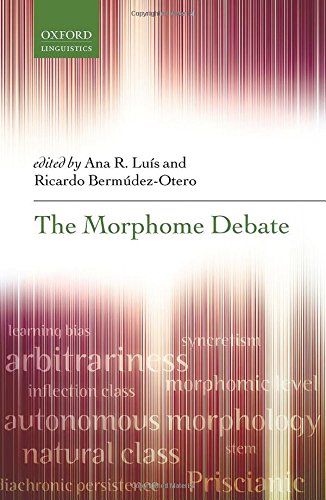
The morphome debate 1st Edition by Ana R Luis, Ricardo BermudezOtero ISBN 0198702108 9780198702108

Original price was: $50.00.$35.00Current price is: $35.00.
The morphome debate 1st Edition by Ana R Luis, Ricardo BermudezOtero – Ebook PDF Instant Download/Delivery: 0198702108, 9780198702108
Full download The morphome debate 1st Edition after payment
Product details:
ISBN 10: 0198702108
ISBN 13: 9780198702108
Author: Ana R Luis, Ricardo BermudezOtero
The morphome debate 1st Table of contents:
1. Introduction
Part I: Morphomic or not? Diagnosing morphomicity
-
Unnatural kinds
2.1 Natural kinds and natural language
2.1.1 Natural kinds
2.1.2 Natural languages
2.1.3 Natural syntax
2.1.4 Natural phonology and binary phonological features
2.2 Embodied categories
2.2.1 Person, Number, and Gender
2.2.2 Gender assignment and semantics
2.2.3 Using PNG
2.2.4 PNG and natural kinds
2.3 Culture and unnatural acts
2.3.1 Inflectional classes and other purely morphological kinds
2.3.2 Morphomes
2.4 Some sign language categories
2.4.1 Sign language verb agreement
2.4.2 Object vs. handling
2.5 Conclusion
Acknowledgements -
Some lessons from history: Morphomes in diachrony
3.1 Introduction
3.2 Diachrony and psychological reality of morphomes
3.3 Diachrony as diagnostic for morphomic alternation
3.4 Typological comparison as falsification
3.5 Speaker preferences and morphomic patterns
3.6 Phonologically conditioned but still morphomic
3.7 Conclusions -
Morphomic splits
4.1 Introduction
4.1.1 Recognizing motivated and morphomic splits
4.1.2 Key distinctions
4.2 Nesting of morphomic within motivated splits
4.2.1 Definitions
4.2.2 Schema Transition Hypothesis
4.2.3 Privileged Category Restriction
4.2.4 Singletons example
4.2.5 No nesting
4.3 Semantic splits
4.4 Optionality and diachrony
4.5 Internal vs. external splits
4.5.1 Gaelic
4.5.2 Marsalese
4.6 Summary definitions
4.6.1 Motivation
4.6.2 Regularity
4.7 Conclusion
Acknowledgements -
Diagnosing morphomicity: A case study from Ulwa
5.1 Introduction
5.2 Historical distribution of ka
5.3 Is ka a morphome?
5.4 Cross-linguistic comparisons
5.4.1 “Have” strategy
5.4.2 Existentials
– Hausa (prepositional strategy 1 & 2)
– Bisa (possessive NP pivot)
5.4.3 Interim summary
5.5 Syntactic and semantic analysis
5.6 Conclusion
Acknowledgements -
The morphome vs. similarity-based syncretism: Latin t-stem derivatives
6.1 Introduction
6.2 Latin t-stem syncretism
6.2.1 Overview
6.2.2 Morphomes
6.2.3 Verbal bases
6.2.4 Shared exponence
6.2.5 Stem syncretism analysis
– Theme vowels, root consonants, vocalism, suffixes
6.2.6 Directionality
6.2.7 Syntactic influences
6.2.8 T-suffixes structure and history
6.3 -tor noun phonology
6.4 The linking condition
6.5 Other cases of similarity-based syncretism
6.6 Conclusions
6.7 Appendix: t-derivatives
Acknowledgements
Part II: Autonomous or not? Analyzing morphomic patterns
-
Morphomic categories and morphosyntactic properties
7.1 Introduction
7.2 Four types of inflection classes
7.3 Analysis of each type
7.4 Sanskrit verb inflection properties
7.5 Summary
Acknowledgements -
Stems, morphomes, and meaning
8.1 Introduction
8.2 Two definitions of “morphomic”
8.3 Morphomic stems
8.4 Non-morphomic stems
8.5 Inherent vs. contextual inflection
8.6 Stems with meaning?
8.7 Conclusion -
Kayardild morphotactics
9.1 Introduction
9.2 Inflectional system
9.3 Morphomes in Kayardild
9.4 Thematic elements
9.5 Syntax–inflection interface
9.6 Feature realization constraints
9.7 Meromorphome linearization
– Oblique shifts, deletion patterns
9.8 Allomorphy constraints
9.9 Discussion
Acknowledgements -
German n-declension and stem extension
10.1 Introduction
10.2 German noun morphology
10.3 N-declension analysis
10.4 The special case of -en
10.5 Case system differences
10.6 Case and [class] in DP
10.7 Conclusion
Acknowledgements -
Distribution of stem alternants
11.1 Introduction
11.2 Separation theories
11.3 Morphophonological locality
11.4 Case studies: Latin, Italian, Spanish
11.5 Morphomic distribution issues
11.6 Discussion
Acknowledgements
People also search for The morphome debate 1st:
the morphodite
the morpholinos
the morphological approach
the morphoses
debate mormon