

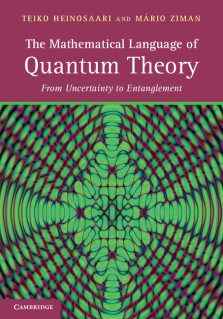
The Mathematical Language of Quantum Theory From Uncertainty to Entanglement 1st Edition by Teiko Heinosaari, Mario Ziman ISBN 1139210475 9781139210478

Original price was: $50.00.$35.00Current price is: $35.00.
The Mathematical Language of Quantum Theory From Uncertainty to Entanglement 1st Edition by Teiko Heinosaari, Mário Ziman – Ebook PDF Instant Download/Delivery: 1139210475, 9781139210478
Full download The Mathematical Language of Quantum Theory From Uncertainty to Entanglement 1st Edition after payment
Product details:
ISBN 10: 1139210475
ISBN 13: 9781139210478
Author: Teiko Heinosaari, Mário Ziman
The Mathematical Language of Quantum Theory From Uncertainty to Entanglement 1st Table of contents:
1: Hilbert space refresher
1.1: Hilbert spaces
1.1.1 Finite- and infinite-dimensional Hilbert spaces
1.1.2 Basis expansion
1.1.3 Example: L2(Ω)
1.2: Operators on Hilbert spaces
1.2.1 The C*-algebra of bounded operators
1.2.2 Partially ordered vector space of selfadjoint operators
1.2.3 Orthocomplemented lattice of projections
1.2.4 Group of unitary operators
1.2.5 Ideal of trace class operators
1.3: Additional useful mathematics
1.3.1 Weak operator topology
1.3.2 Dirac notation and rank-1 operators
1.3.3 Spectral and singular-value decompositions
1.3.4 Linear functionals and dual spaces
1.3.5 Tensor product
2: States and effects
2.1: Duality of states and effects
2.1.1 Basic statistical framework
2.1.2 State space
2.1.3 State space for a finite-dimensional system
2.1.4 From states to effects
2.1.5 From effects to states
2.1.6 Dispersion-free states and Gleason’s theorem
2.2: Superposition structure of pure states
2.2.1 Superposition of two pure states
2.2.2 Interference
2.3: Symmetry
2.3.1 Unitary and antiunitary transformations
2.3.2 State automorphisms
2.3.3 Pure state automorphisms and Wigner’s theorem
2.4: Composite systems
2.4.1 System versus subsystems
2.4.2 State purification
3: Observables
3.1: Observables as positive operator-valued measures
3.1.1 Definition and basic properties of observables
3.1.2 Observables and statistical maps
3.1.3 Discrete observables
3.1.4 Real observables
3.1.5 Mixtures of observables
3.1.6 Coexistence of effects
3.2: Sharp observables
3.2.1 Projection-valued measures
3.2.2 Sharp observables and selfadjoint operators
3.2.3 Complementary observables
3.3: Informationally complete observables
3.3.1 Informational completeness
3.3.2 Symmetric informationally complete observables
3.3.3 State estimation
3.4: Testing quantum systems
3.4.1 Complete versus incomplete information
3.4.2 Unambiguous discrimination of states
3.4.3 How distinct are two states?
3.5: Relations between observables
3.5.1 State distinction and state determination
3.5.2 Coarse-graining
3.6: Example: photon-counting observables
3.6.1 Single-mode electromagnetic field
3.6.2 Nonideal photon-counting observables
4: Operations and channels
4.1: Transforming quantum systems
4.1.1 Operations and complete positivity
4.1.2 Schrödinger versus Heisenberg picture
4.2: Physical model of quantum channels
4.2.1 Isolated versus open systems
4.2.2 Stinespring’s dilation theorem
4.2.3 Operator-sum form of channels
4.3: Elementary properties of quantum channels
4.3.1 Mixtures of channels
4.3.2 Concatenating channels
4.3.3 Disturbance and noise
4.3.4 Conjugate channels
4.4: Parametrizations of quantum channels
4.4.1 Matrix representation
4.4.2 The χ-matrix representation
4.4.3 Choi–Jamiolkowski isomorphism
4.5: Special classes of channels
4.5.1 Strictly contractive channels
4.5.2 Random unitary channels
4.5.3 Phase-damping channels
4.6: Example: qubit channels
5: Measurement models and instruments
5.1: Three levels of description of measurements
5.1.1 Measurement models
5.1.2 Instruments
5.1.3 Compatibility of the three descriptions
5.2: Disturbance caused by a measurement
5.2.1 Conditional output states
5.2.2 No information without disturbance
5.2.3 Disturbance in a rank-1 measurement
5.2.4 Example: BB84 quantum key distribution
5.3: Lüders instruments
5.3.1 Von Neumann’s measurement model
5.3.2 Lüders instrument for a discrete observable
5.3.3 Lüders’ theorem
5.3.4 Example: mean king’s problem
5.4: Repeatable measurements
5.4.1 Repeatability
5.4.2 Wigner–Araki–Yanase theorem
5.4.3 Approximate repeatability
5.5: Programmable quantum processors
5.5.1 Programming of observables and channels
5.5.2 Universal processor for channels
5.5.3 Probabilistic programming
6: Entanglement
6.1: Entangled bipartite systems
6.1.1 Entangled vectors
6.1.2 Entangled positive operators
6.1.3 Nonlocal channels
6.2: Entanglement and LOCC
6.2.1 LOCC ordering and separable states
6.2.2 Maximally entangled states
6.2.3 Majorization criterion for LOCC
6.3: Entanglement detection
6.3.1 Entanglement witnesses
6.3.2 Quantum nonlocal realism
6.3.3 Positive but not completely positive maps
6.3.4 Negative partial transpose (NPT) criterion
6.3.5 Range criterion
6.4: Additional topics in entanglement theory
6.4.1 Entanglement teleportation and distillation
6.4.2 Multipartite entanglement
6.4.3 Evolution of quantum entanglement
People also search for The Mathematical Language of Quantum Theory From Uncertainty to Entanglement 1st:
the mathematical language of quantum theory pdf
who said mathematics is the language of physics
language of quantum mechanics
what is quantum mathematics
who said mathematics is the language of the universe
Tags: Teiko Heinosaari, Mario Ziman, Mathematical Language, Entanglement