

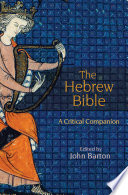


The Hebrew Bible A Critical Companion 1st Edition by John Barton – Ebook PDF Instant Download/Delivery: 0691154716, 9780691154718
Full download The Hebrew Bible A Critical Companion 1st Edition after payment

Product details:
ISBN 10: 0691154716
ISBN 13: 9780691154718
Author: John Barton
This book brings together some of the world’s most exciting scholars from across a variety of disciplines to provide a concise and accessible guide to the Hebrew Bible. It covers every major genre of book in the Old Testament together with in-depth discussions of major themes such as human nature, covenant, creation, ethics, ritual and purity, sacred space, and monotheism. This authoritative overview sets each book within its historical and cultural context in the ancient Near East, paying special attention to its sociological setting. It provides new insights into the reception of the books and the different ways they have been studied, from historical-critical enquiry to modern advocacy approaches such as feminism and liberation theology. It also includes a guide to biblical translations and textual criticism and helpful suggestions for further reading.
Featuring contributions from experts with backgrounds in the Jewish and Christian faith traditions as well as secular scholars in the humanities and social sciences, The Hebrew Bible is the perfect starting place for anyone seeking a user-friendly introduction to the Old Testament, and an invaluable reference book for students and teachers.
The Hebrew Bible A Critical Companion 1st Table of contents:
Introduction
-
1. The Hebrew Bible: Origins, Development, and Reception
1.1 Defining the Hebrew Bible
1.2 Historical Context and Ancient Israel
1.3 The Role of the Hebrew Bible in Jewish Tradition
1.4 The Hebrew Bible’s Influence in Christianity and Islam
Part I: The Hebrew Bible as Literature
-
2. The Structure and Composition of the Hebrew Bible
2.1 The Canon of the Hebrew Bible
2.2 Understanding the Division: Torah, Nevi’im, and Ketuvim
2.3 The Development of Biblical Texts
2.4 The Concept of the “Author” in Biblical Studies -
3. Genre and Literary Forms in the Hebrew Bible
3.1 Narrative and Storytelling Techniques
3.2 Poetry, Hymns, and Laments
3.3 Wisdom Literature and Proverbs
3.4 Law Codes and Decrees -
4. Biblical Language: Hebrew, Aramaic, and Translation
4.1 The Semitic Roots of Biblical Hebrew
4.2 Aramaic Texts in the Hebrew Bible
4.3 Translation Issues and Challenges
4.4 Major Bible Translations and their Impact
Part II: Historical and Cultural Context
-
5. Ancient Israel: Archaeological and Historical Insights
5.1 Israel’s Place in the Ancient Near East
5.2 Archaeological Evidence and the Bible
5.3 The Emergence of the Israelite Kingdoms
5.4 Biblical History vs. Archaeological Findings -
6. The Social and Political World of the Hebrew Bible
6.1 Ancient Israelite Society and Government
6.2 Law, Justice, and Ethics in Biblical Society
6.3 Religion, Cult, and Temple Worship
Part III: Interpretation of the Hebrew Bible
-
7. Approaches to Biblical Interpretation
7.1 Classical Jewish Exegesis
7.2 Christian Interpretations of the Hebrew Bible
7.3 Modern and Postmodern Approaches
7.4 Feminist, Liberation, and Queer Readings of the Text -
8. The Role of Prophecy and Prophetic Literature
8.1 The Major and Minor Prophets
8.2 Prophecy and Divine Authority
8.3 The Prophetic Message: Hope, Judgment, and Redemption -
9. The Psalms and Poetry of the Hebrew Bible
9.1 Psalms as Poetry and Worship
9.2 The Structure and Themes of Biblical Poetry
9.3 Theological and Emotional Dimensions of the Psalms -
10. Biblical Law: Ethics and Society
10.1 The Code of Hammurabi vs. Israelite Law
10.2 The Laws of the Torah: Covenant and Holiness
10.3 The Social and Moral Teachings of the Law
Part IV: Theological Themes in the Hebrew Bible
-
11. God in the Hebrew Bible
11.1 The Nature of God: Transcendent and Immanent
11.2 The God of Israel and Other Ancient Gods
11.3 Divine Action in History and the Problem of Evil -
12. Creation and the Human Condition
12.1 Creation Narratives in Genesis
12.2 Humanity’s Role in the Divine Order
12.3 The Fall, Sin, and Redemption -
13. The Covenant: Divine Promise and Human Response
13.1 The Covenant with Abraham and Israel
13.2 The Conditional and Unconditional Nature of the Covenant
13.3 The Role of Covenant in Biblical Theology -
14. The Afterlife, Judgment, and Eschatology
14.1 Concepts of the Afterlife in Ancient Israel
14.2 Resurrection and the Hope for the Future
14.3 The Day of Judgment in the Prophets
Part V: The Hebrew Bible and Its Legacy
-
15. The Hebrew Bible and Western Thought
15.1 The Influence of the Hebrew Bible on Philosophy
15.2 The Bible’s Role in Shaping Western Legal Systems
15.3 Biblical Themes in Art, Literature, and Music -
16. The Hebrew Bible in Modern Judaism
16.1 The Role of the Hebrew Bible in Jewish Liturgy
16.2 The Hebrew Bible and Jewish Identity
16.3 Interpretive Traditions and the Talmudic Perspective -
17. The Hebrew Bible in Christianity and Islam
17.1 The Hebrew Bible and Early Christianity
17.2 The Hebrew Bible in the Qur’an
17.3 Shared and Divergent Views in the Abrahamic Faiths
People also search for The Hebrew Bible A Critical Companion 1st:
Introduction to the Hebrew Bible
Hebrew Bible historical context
Critical perspectives on the Hebrew Bible
Hebrew Bible scholarship
Biblical criticism and the Hebrew Bible


