

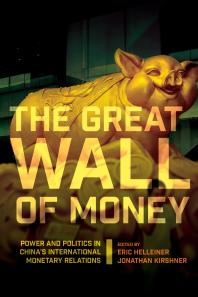
The Great Wall of Money Power and Politics in China’s International Monetary Relations 1st Edition by Eric Helleiner ,Jonathan Kirshner ISBN 0801479592 978-0801479595
Original price was: $50.00.$35.00Current price is: $35.00.
The Great Wall of Money Power and Politics in China’s International Monetary Relations 1st Edition by Eric Helleiner ,Jonathan Kirshner – Ebook PDF Instant Download/Delivery: 0801479592 978-0801479595
Full download The Great Wall of Money Power and Politics in China s International Monetary Relations 1st Edition after payment
Product details:
ISBN 10:0801479592
ISBN 13:978-0801479595
Author:Eric Helleiner ,Jonathan Kirshner
As an economic superpower, China has become an increasingly important player in the international monetary system. Its foreign exchange reserves are the largest in the world and its exchange rate policy has become a major subject of international economic diplomacy. The internationalization of the renminbi (RMB) raises critical questions in international policy circles: What kinds of power is China acquiring in international monetary relations? What are the priorities of the Chinese government? What explains its preferences?
In The Great Wall of Money, a distinguished group of contributors addresses these questions from distinct perspectives, revealing the extent to which China’s choices, and global monetary affairs, will be shaped by internal political factors and affect world politics. The RMB is a likely competitor for the dollar in the next couple of decades; its emergence as an important international currency would have substantial effects on the balance of power between the United States and China. By illuminating the politics of China’s international monetary relations, this book provides a timely account of the global economy, the role of the renminbi in international relations, and the trajectory of China’s continuing ascendency in the coming decades.
Table of contents:
-
The Chinese government has become an increasingly important player in international monetary relations in recent years. Once the IMF’s latest quota review is implemented, China’s voting share in this institution at the center of global monetary governance will be the third largest after those of the United States and Japan. Its foreign exchange reserves have become the largest in the world—ever—at a staggering $3.5 trillion by mid-2013. Its exchange rate policy has become a major subject of international economic diplomacy and is closely scrutinized, and often shadowed, by countries around the world. The internationalization of the renminbi is…
-
Whether measured by the size of its reserves, the role of its exchange rate, or the use of its currency, Beijing’s growing influence in the international monetary system is unmistakable. The issue to be addressed in this chapter is: Can the proverbial Middle Kingdom be smoothly absorbed into the leadership ranks of the global system, or could it instead become a force for instability or even conflict? Call it the China question.
The answer to the China question depends, in particular, on two critical factors. First is the issue of systemic flexibility. How adaptable are the institutions and procedures of…
China’s growing monetary influence has generated much speculation about the future of the international monetary system. In this volume, Benjamin Cohen recalls how other emerging monetary powers in the postwar period were all successfully accommodated within the existing system. Like many other analysts, however, he is less sure about the consequences of China’s rise because of uncertainties about “the attitude of the newcomer.” In particular, he wonders about the extent to which Chinese policymakers may be more inclined to challenge both US leadership and the system itself.
This chapter offers a historical perspective on Chinese official attitudes toward the institution…
China currently holds an unprecedented quantity of foreign exchange reserves. Figure 3.1 shows that China held over $3 trillion of foreign reserves by 2011, which was equivalent to almost half of the country’s entire gross domestic product.¹ Although numerous countries have acquired large volumes of foreign reserves in recent decades, China holds far more foreign reserves than any other country. Its arsenal of foreign reserves is more than two and a half times larger than any other country’s—the second largest reserve holder, Japan, had $1.3 trillion in reserves in 2011—and more than fifty times bigger than those of…
In the first decade of the twenty-first century, large and growing current account imbalances emerged among the major economies in the world. The United States saw its deficit balloon while oil-producing countries, Germany, Japan, and China accumulated large surpluses. Many economists worried that such imbalances would not be sustainable; at some point the correction would come in a way that would disrupt the international financial system and lead to economic recession.¹ After 2004 China became especially salient in the global imbalance because of the dramatic increase in its current account surplus. In the late 1990s, China’s surplus was 2–5…
China’s relationship with the process of international economic policy surveillance associated with the International Monetary Fund¹ evolved from relative passivity in its early phase toward growing tension by the mid-2000s. When the Chinese authorities blocked the annual Article IV consultation process with the IMF in 2007, it appeared that Beijing’s relationship with the surveillance regime had reached the point of breakdown. Some prominent commentators, especially in the United States, accused China of holding down the value of its currency for mercantilist purposes and of an abrogation of its responsibilities as an IMF member.² in a broader sense, the controversy could…
-
There is now a widespread expectation that China will become a global monetary power. Such expectations arise not only from China’s economic weight, but also from its active monetary diplomacy. The latter is defined here as the use of monetary measures to pursue foreign policy objectives, or the use of diplomacy—intergovernmental talks and arrangements—to pursue monetary objectives. Chinese official rhetoric emphasizes China’s international contribution as a “responsible great power,” resonating with Robert Zoellick’s expectation for China to be a “responsible stakeholder.”¹ Pursuing the status of a global monetary power with a global currency seems clearly on Beijing’s agenda….
4.The study of power in China’s international monetary relations is at a rudimentary stage. Direct forms of power are better understood. “Direct power” can be defined as the ability of one state to get another state to do what it would not otherwise do, either by persuasion or coercion. Scholars have focused on China’s ability to influence US policy behavior, or lack thereof. Sester and Drezner, for example, each examine whether China has been able to convert its large holdings of US debt into influence over US policymaking. They each run different tests; and reach different conclusions. Sester suggests there…
Unless something goes terribly wrong with China’s economy (a possibility not to be casually dismissed, even if it is not the most likely outcome), China will look to increase the international use of the RMB and eventually seek to establish its currency as the international money of East Asia. Over the coming years and decades the RMB will grow into this role at a rate determined by the shape of China’s financial sector, the aggregate performance of its economy, and the pace and style of its financial liberalization. But these factors will influence the contours of the RMB’s emergence; its…
People also search for:
what are the benefits of the great wall of china
what does the great wall of china represent
6th grade great wall of china project
6th grade great wall of china project
why the great wall of china is important
Tags:
Eric Helleiner,Jonathan Kirshner,The Great Wall,f Money