

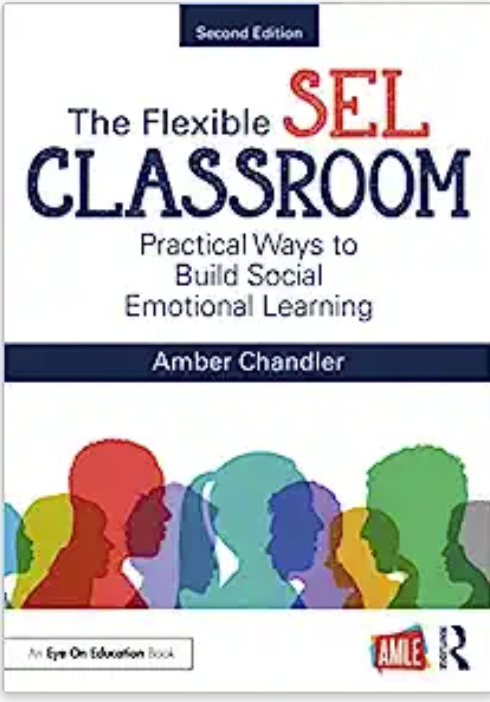
The Flexible SEL Classroom 1st Edition by Amber Chandler ISBN 1138302562 978-1138302563

Original price was: $50.00.$35.00Current price is: $35.00.
The Flexible SEL Classroom 1st Edition by Amber Chandler – Ebook PDF Instant Download/Delivery:1138302562 ,978-1138302563
Full download The Flexible SEL Classroom 1st Edition after payment
Product details:
ISBN 10:1138302562
ISBN 13:978-1138302563
Author:Amber Chandler
Help middle school students tackle daily challenges both in and out of the classroom. In this new co-publication from Eye On Education and AMLE, author Amber Chandler offers practical strategies for incorporating social emotional learning into your instruction so students can learn to successfully manage their emotions, set goals, build relationships, and make good decisions. Grounded in classroom experience, her advice can be adapted to suit different needs, so you can create a Flexible Classroom and reach all learners. Topics include:
- Encouraging academic risk-taking without causing stress or fear of failure;
- Helping students to self-manage through technology and other tools;
- Teaching self-awareness through solution statements, metacognition, and effective communication;
- Modeling responsible decision-making and empathy to create a more tolerant classroom environment;
- Building relationship skills and encouraging students to be Upstanders; and
- Emboldening students to become more socially aware and cognizant of bias.
Bonus: Downloadable versions of some of the handouts in this book are available on the Routledge website at www.routledge.com/9781138302563, so you can print and distribute them for immediate classroom use.
Table of contents:
chapter 1
This chapter investigates the relationship between grades and GPA, and considers the role of academic risk-taking in student success. It makes us recognize that students need more than academic learning. GPA and grades are stories about compliance and the ability to play the game of school. The most amazing conversations occur around reflection process because students compliment one another on risk-taking—an underappreciated mindset. There are reputable studies that do link GPA and grades to academic success, such as the “Indicators of Success: GPA and Noncognitive Skills” put out by the National Education Association in the Backgrounder. GPA not only captures mastery of content knowledge, but also skills not usually captured in tests—self-control, for example. Self-control is an example of a non-cognitive skill. Non-cognitive skills consist of the skills not captured in cognitive tests such as aptitude tests, standardized tests, or course exams.
chapter 2
chapter 3
This chapter makes us learn how to empower students with “solution statements” instead of “problem statements.” It investigates how slang, swearing, and register are critical considerations for our students as they learn to communicate effectively. The chapter emboldens students to take charge of their own learning by thinking metacognitively. If a child who failed a test or didn’t make the team is ever consoled, one of the things to be noticed is that students are not very self-aware. The Center for Academic, Social, and Emotional Learning (CASEL) defines self-awareness this way: “The ability to accurately recognize one’s emotions and thoughts and their influence on behavior. This includes accurately assessing one’s strengths and limitations and possessing a well-grounded sense of confidence and optimism.” One of the most difficult things when talking about education is to acknowledge that experiences as teachers are so wildly different, that it can seem that teachers don’t have the same job at all.
chapter 4
chapter 5
chapter 6
This chapter investigates how to discuss bias and stereotyping through film, helps us to learn how to intentionally model the message of empathy, and emboldens students to take control of their narrative. Talking about social awareness brings important issues to the forefront, and these are issues that most people have sometimes tiptoed around. Social awareness isn’t simply understanding the world around us, but rather also knowing that the people around us are going to make assumptions about us. Those assumptions might be right, or they might be wrong, and very little can be done to change their minds. However, it is crucial that we control our own narrative, tell our own stories, and don’t let anyone define our path except for us. When students are confronted with a social reality that doesn’t meet their personal vision of themselves, they are often swayed by the social reality because they don’t know how to stay the course
chapter 7
Chapter 7 addresses the very real need for restoration. Students have lost their way forward, their faith in themselves, and their faith in the adults in the world to make sure that everything is OK. I’ve provided a layman’s guide to implementing Restorative Circles, and “bubbles,” as well as questions to get you started right away. It is not necessarily possible for everyone to use full Restorative Circles in their day-to-day, but the chapter will help everyone get started on the work of restoration, and it provides the justification and guidance to begin seeing our students, which is ultimately the point of Social Emotional Learning (SEL). “Bubbles,” or small restorative groupings, are explained, and these can be used to supplement other SEL activities.
chapter 8
Chapter 8 explains the role we will play as educators in helping our students recognize and develop their resilience. This chapter allows readers a lens to view the experiences our students have lived during the pandemic, as well as practical advice about how to leverage pandemic gains and stop the deficit analysis of our students. The chapter will help educators navigate the “losses” while helping reframe thinking to focus on the gains. We all know that assessments aren’t going anywhere, but in this chapter, I’ll suggest some ways that formative and summative assessments can help students gain resilience.
chapter3
This past summer, I was a participant in the New York State United Teachers’ Future Forward Taskforce. Our goal was to gather many voices and perspectives to discuss a way forward—through and post-pandemic. I’d been asked to participate due to my background and passion for Social Emotional Learning (SEL). Every few weeks we’d have an hour-and-a-half conversation about topics like poverty, technology, and community schools. Finally, the day came when Social Emotional Learning was on the agenda. I could hardly wait! What happened next has left me a bit bewildered, while also, I think, seeing more clearly than I have before the complexities of implementing SEL.
People also search for:
the flexible sel classroom
flexible class 5
the flexible ela classroom chapter 1
z the alien
amazon classroom flexible seating
Tags:
Amber Chandler,The Flexible,SE,Classroom