

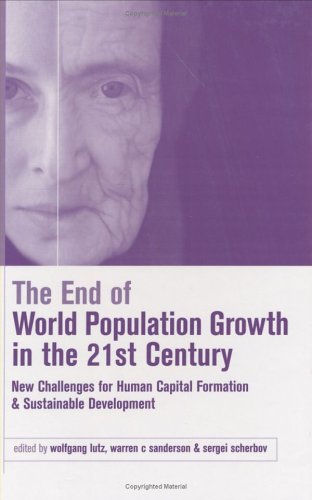
The End of World Population Growth in the 21st Century New Challenges for Human Capital Formation and Sustainable Development 1st Edition by Wolfgang Lutz, Warren Sandersen, Sergei Scherbov ISBN 1844070891 9781844070893

Original price was: $50.00.$35.00Current price is: $35.00.
The End of World Population Growth in the 21st Century New Challenges for Human Capital Formation and Sustainable Development 1st Edition by Wolfgang Lutz, Warren Sandersen, Sergei Scherbov – Ebook PDF Instant Download/Delivery: 1844070891, 9781844070893
Full download The End of World Population Growth in the 21st Century New Challenges for Human Capital Formation and Sustainable Development 1st Edition after payment
Product details:
ISBN 10: 1844070891
ISBN 13: 9781844070893
Author: Wolfgang Lutz, Warren Sandersen, Sergei Scherbov
The End of World Population Growth in the 21st Century New Challenges for Human Capital Formation and Sustainable Development 1st Table of contents:
1 Introduction
1.1 Contrasting Perceptions of the Demographic Future: From “Population Explosion” to “Gray Dawn”
1.2 The Continuing Demographic Transition
1.3 Antecedents
1.4 Structure of the Volume
References
2 The End of World Population Growth
2.1 Why Do We Need New Forecasts?
2.1.1 Uncertainty of population forecasts
2.1.2 Assumptions on fertility, mortality, and migration
2.1.3 Challenging out-of-date views
2.2 Our Approach to Population Forecasting
2.3 Summary of Arguments and Specific Assumptions
2.3.1 Future fertility in today’s high fertility countries
2.3.2 Future fertility in today’s low fertility countries
2.3.3 Fertility in China
2.3.4 Future mortality in today’s higher mortality countries
2.3.5 Future AIDS mortality in Africa
2.3.6 Future mortality in today’s low mortality countries
2.3.7 Future international migration
2.3.8 Generating 2,000 different simulations
2.4 The Future Population of the World and Its Uncertainty
2.5 The Population of World Regions and Their Uncertainties
2.6 Regional Population Shares
2.7 Comparison with Other World Population Forecasts
Postscript: The latest UN long-range projections
2.8 Conclusions
Appendix 2.1:
Definition of World Regions
Appendix 2.2:
Assumed Matrix of Inter-regional Migration Flows (in Thousands)
Appendix 2.3:
Methods
Documentation and Sensitivity Analyses for “The End of World Population Growth”
5 References
References
3 Applications of Probabilistic Population Forecasting
3.1 Massive Population Aging
3.2 Conditional Probabilistic Forecasting3
3.3 Conditional Probabilistic Forecasts with Future Jump-Off Dates
3.4 Conclusions
References
4 Future Human Capital: Population Projections by Level of Education
4.1 The Multistate Approach
4.2 Data on Education
4.3 Regional Education Levels in 2000
4.4 Scenarios
4.4.1 Regional Shifts in Human Capital
Appendix 4.1:
Sources of Data and Methods of Estimation
Sources of Input Data on Population by Education and by Education Used in Multistate Educational Projections
Appendix 4.2:
Results of the Projections
References
Bibliography for Data Sources
General
Fertility and Family Surveys
Demographic and Health Surveys
5 Literate Life Expectancy: Charting the Progress in Human Development
5.1 A Clear and Meaningful Indicator of Social Development
5.2 What Does Literate Life Expectancy Represent?
5.3 Calculations with Empirical Data
5.4 Trends in Literate Life Expectancy since 1970
Subnational differentials in literate life expectancy
5.5 Projections of Literate Life Expectancy to 2030
5.6 Conclusions
Appendix 5.1:
Data Sources, Differences in Country Rankings, and Comparison of “No Education” and “Illiterate” Categories
References
6 Population–Environment–Development–Agriculture Interactions in Africa: A Case Study on Ethiopia
6.1 Background
6.1.1 PEDA in brief
6.1.2 Theoretical inspiration for PEDA
6.2 The Structure of the PEDA Model
6.2.1 Vicious versus virtuous circle dynamics
6.2.2 The population segment
6.2.3 Land and water
6.2.4 Agricultural production segment
6.2.5 HIV and AIDS in PEDA
6.3 PEDA Projections for Ethiopia
6.3.1 The Ethiopian population–environment–agriculture nexus: Beyond the threshold of a sustainable livelihood?
6.3.2 The policy response
6.3.3 PEDA applied to Ethiopia
6.3.4 Simulation results for the baseline scenario
6.3.5 Other scenarios: HIV/AIDS, drought, and migration
6.3.6 What needs to be done to break the vicious circle?
6.4 Conclusions
Acknowledgment
Appendix 6.1:
Model and Parameter Specifications
Hiv/Aids
References
Web sites
7 Interactions between Education and HIV: Demographic Examples from Botswana
7.1 Introduction
7.2 Some Tidbits of Evidence
7.3 Overview of the Methodology
7.3.1 Population states
7.3.2 Population flows
7.4 Examples from Botswana
7.4.1 The scenarios
7.4.2 The results
7.5 Previous Findings
7.6 Conclusions
Appendix 7.1:
Transition Rates between States
Appendix 7.2:
The Prevalence Rate Data and Their Correction
References
8 China’s Future Urban and Rural Population by Level of Education
8.1 Introduction
8.2 Salient Demographic Features in Contemporary China
8.2.1 Development of education
8.2.2 Eradication of illiteracy and implementation of the nine-year education policy
8.2.3 Education of women
8.2.4 Regional disparity
8.2.5 Fertility differentials by rural or urban place of residence
8.2.6 Fertility differentials by level of education
8.2.7 Fast-growing rural–urban migration
8.3 Alternative Scenarios for China’s Future
8.4 Conclusions
References
9 Population, Greenhouse Gas Emissions, and Climate Change
9.1 Introduction
9.2 Climate Change and Greenhouse Gas Emissions
9.2.1 The distribution of current greenhouse gas emissions
9.2.2 Future greenhouse gas emissions
9.3 Population and Greenhouse Gas Emissions
9.3.1 I=PAT decompositions
9.3.2 Identity versus explanation
9.3.3 Decompositions
9.3.4 Population and emissions scenarios
9.3.5 Population and emissions in the SRES
9.3.6 Population sensitivity analysis
9.3.7 A linear model
9.3.8 Aging and households
9.3.9 Relationships between variables
9.3.10 Population and adaptation
9.4 Conclusions and Policy Implications
References
10 Conceptualizing Population in Sustainable Development: From “Population Stabilization” to “Population Balance”
10.1 Changing Population Policy Rationales
10.1.1 The geopolitical rationale
10.1.2 The macroeconomic rationale
10.1.3 The social welfare rationale: Externalities to childbearing
10.1.4 The ecological rationale: Scale and ecological concerns
10.1.5 The individual welfare rationale
10.2 Population Balance
10.3 A Highly Simplified, Quantitative Population Balance Model
10.4 Conclusions
People also search for The End of World Population Growth in the 21st Century New Challenges for Human Capital Formation and Sustainable Development 1st:
the end of world population growth in the 21st century
world population growth over last 200 years
world population growth graph last 100 years
world population growth in the last 10 years
the growth of world population
Tags: Wolfgang Lutz, Warren Sandersen, Sergei Scherbov, World Population, Human Capital, Sustainable Development