

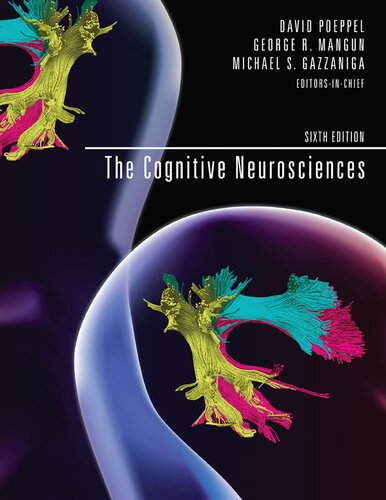
The Cognitive Neurosciences 6th Edition by David Poeppel, George R Mangun, Michael S Gazzaniga ISBN 0262043254 9780262043250
Original price was: $50.00.$35.00Current price is: $35.00.
The Cognitive Neurosciences 6th Edition by David Poeppel, George R Mangun, Michael S Gazzaniga – Ebook PDF Instant Download/Delivery: 0262043254, 9780262043250
Full download The Cognitive Neurosciences 6th Edition after payment
Product details:
ISBN 10: 0262043254
ISBN 13: 9780262043250
Author: David Poeppel, George R Mangun, Michael S Gazzaniga
The Cognitive Neurosciences 6th Table of contents:
chapter one: introduction to bilingualism and the brain
1.1 introduction
1.2 theoretical and empirical issues of bilingualism research
1.2.1 bilingualism research: who is a bilingual?
1.2.1.1 dimensions for classifying bilinguals
1.2.1.2 what the classification of bilinguals means for research on bilingualism
1.2.2 language and language domains relevant for bilingualism research
1.3 methodological considerations
1.3.1 focus on neuroimaging methods
1.3.1.1 techniques to assess brain anatomy: smri and dti
1.3.1.2 techniques to detect current brain activity: fmri, pet, and nirs
1.3.1.3 techniques which record electromagnetic changes in relation to language: eeg and meg
1.3.2 real-life bilinguals and the laboratory setting: questioning ecological validity
1.4 summary
review questions
further reading
chapter two: neural representations and language processing in the bilingual brain
learning objectives
2.1 introduction
2.2 key language areas and lateralization in bilinguals
2.3 language comprehension among bilinguals
2.3.1 word recognition in isolation
2.3.2 word recognition in context
2.4 language production among bilinguals
2.4.1 word production
2.4.2 picture naming
2.4.2.1 simple picture naming
2.4.2.2 picture naming with word distracters
2.4.2.3 phoneme monitoring
2.4.2.4 mixed-language picture naming
2.4.3 word translation
2.5 summary
review questions
further reading
chapter three: bilingualism, language development, and brain plasticity
learning objectives
3.1 introduction
3.2 brain plasticity and learning
3.3 language acquisition and language learning in the brain
3.3.1 learning languages
3.3.2 on (variability in) the ability to discriminate nonnative contrasts
3.3.3 early (simultaneous and sequential) and late bilinguals
3.4 factors interacting with acquisition and learning
3.4.1 learning environment, interaction, and culture
3.4.2 focus on input
3.4.3 toward a more holistic view of child-internal factors
3.5 critical and sensitive periods
3.6 summary
review questions
further reading
chapter four: aphasia and the bilingual brain
learning objectives
4.1 introduction
4.2 theoretical approaches of bilingual aphasia
4.3 lesion sites and the classification of aphasia subtypes
4.3.1 lesion sites and their clinical manifestations
4.3.2 tasks that explore lesion sites and impairment
4.3.3 impairments specific to reading and writing
4.4 factors that influence language impairment
4.4.1 frequency of language use, l2 proficiency, and aoa
4.5 assessment of bilingual aphasia
4.5.1 the bilingual aphasia test
4.6 rehabilitation of languages in bilingual aphasia
4.6.1 the language(s) in which treatment is provided
4.6.2 cross-language generalization
4.7 patterns of language recovery in bilingual aphasia
4.7.1 lesion factors affecting recovery
4.7.2 nonlesion factors affecting recovery
4.8 primary progressive aphasias
4.9 summary
review questions
further reading
chapter five: cross-linguistic effects of bilingualism
learning objectives
5.1 introduction
5.2 cross-linguistic influence and transfer
5.3 phonological transfer
5.4 lexical transfer
5.5 morphological transfer
5.6 syntactic transfer
5.7 discursive, pragmatic, and sociolinguistic transfer
5.8 factors affecting transfer
5.8.1 language dominance and proficiency
5.8.2 input frequency
5.8.3 cross-linguistic similarity and cognates
5.9 code-switching
5.9.1 modeling language switching and control
5.9.2 code-switching and the brain
5.10 dreaming
5.10.1 what determines the language in which bilinguals dream?
5.10.2 dreaming in a second language among less-proficient bilinguals
5.11 summary
review questions
further reading
chapter six: bilingual lexical and conceptual memory
learning objectives
6.1 introduction
6.2 the bilingual mental lexicon as the default
6.3 conceptual and lexical representation in bilinguals
6.4 modeling word-to-concept mapping and mediation
6.4.1 word association and concept mediation models
6.4.2 revised hierarchical model
6.5 modeling the degree of overlap of conceptual representations
6.5.1 distributed feature model
6.5.2 shared distributed asymmetrical model
6.5.3 bilingual and trilingual modified hierarchical models
6.5.4 the sense model
6.6 connectionist models of bilingual memory
6.6.1 bia models
6.6.2 the multilink model
6.7 summary
review questions
further reading
chapter seven: cognitive and neurocognitive effects of bilingualism
learning objectives
7.1 introduction
7.2 effects of bilingualism and necessary adaptations
7.3 effects of bilingualism on attentional abilities and perceptual learning
7.4 effects of bilingualism on processing and domain-general control
7.5 effects of bilingualism on brain structure and functioning
7.6 summary
review questions
further reading
chapter eight: conclusion
learning objectives
8.1 introduction
8.2 complexity as the main issue
8.3 summary
People also search for The Cognitive Neurosciences 6th:
the cognitive neurosciences pdf
the cognitive neurosciences sixth edition pdf
the cognitive neurosciences gazzaniga
the cognitive neuroscience fifth edition
the cognitive neurosciences 6th edition
Tags: David Poeppel, George R Mangun, Michael S Gazzaniga, Cognitive Neurosciences