

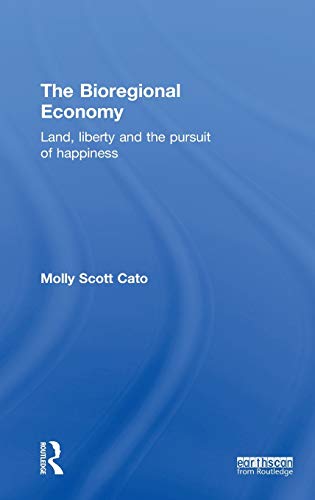
The Bioregional Economy Land Liberty and the Pursuit of Happiness 1st Edition by Molly Scott Cato ISBN 1849714584 9781849714587
Original price was: $50.00.$35.00Current price is: $35.00.
The Bioregional Economy Land Liberty and the Pursuit of Happiness 1st Edition by Molly Scott Cato – Ebook PDF Instant Download/Delivery: 1849714584, 9781849714587
Full download The Bioregional Economy Land Liberty and the Pursuit of Happiness 1st Edition after payment
Product details:
ISBN 10: 1849714584
ISBN 13: 9781849714587
Author: Molly Scott Cato
In a world of climate change and declining oil supplies, what is the plan for the provisioning of resources? Green economists suggest a need to replace the globalised economy, and its extended supply chains, with a more ‘local’ economy. But what does this mean in more concrete terms? How large is a local economy, how self-reliant can it be, and what resources will still need to be imported? The concept of the ‘bioregion’ ― developed and popularised within the disciplines of earth sciences, biosciences and planning ― may facilitate the reconceptualisation of the global economy as a system of largely self-sufficient local economies.
A bioregional approach to economics assumes a different system of values to that which dominates neoclassical economics. The global economy is driven by growth, and the consumption ethic that matches this is one of expansion in range and quantity. Goods are defined as scarce, and access to them is a process based on competition. The bioregional approach challenges every aspect of that value system. It seeks a new ethic of consumption that prioritises locality, accountability and conviviality in the place of expansion and profit; it proposes a shift in the focus of the economy away from profits and towards provisioning; and it assumes a radical reorientation of work from employment towards livelihood.
The Bioregional Economy Land Liberty and the Pursuit of Happiness 1st Table of contents:
Part I Making sense of the bioregion
1 Why Bioregional Economics?
1.1 Finding our place in space
1.2 Where did we go wrong?
1.3 We have taken leave of our senses
1.4 Conclusion: re-enchanting the world
2 Visioning the Bioregional Economy
2.1 So long and thanks for all the fish
2.2 Defining and mapping the bioregional economy
2.3 The journey home
2.4 The raw and the cooked
Balkanisation
Parochialism
Stagnation
2.5 Conclusion
3 The Economist as Shaman
Introduction
3.1 Losing my religion
3.2 Losing our way
3.3 Losing our mojo
3.4 Losing our minds
3.5 Conclusion: economist as guide and mediator
Part II Bioregional resourcing
4 Firms, Farms and Factories
4.1 The impact of the fictitious commodities and shadow markets
4.2 Local economies and human scale
4.3 Co-operative theory of the firm
4.4 Back to the land (ethic)
4.5 Conclusion
5 Provenance and Provisioning
5.1 Coming down to earth
5.2 A self-provisioning economy
5.3 What’s eating us?
5.4 Sustainable livelihoods
5.5 The Somerset Levels: a prototype bioregion
5.6 Conclusion: abundance without exploitation
6 Work as Craft
6.1 Adam Smith vs. Adam Bede
6.2 The body of the artisan and the spirit of place
6.3 The role of the guild and the apprentice
6.4 The Woodlanders
6.5 Conclusion: a community built of craftspeople
7 What about My iPad?1
7.1 The pecuniary standard of living
7.2 Shopping for an identity
7.3 I seem to find the happiness I seek
7.4 An embarrassment of riches
7.5 Conclusion
Part III Policies for a bioregional economy
8 Sharing Our Common Wealth
8.1 The lowland clearances and the duty of England
8.2 Sustainability and equity
8.3 A twenty-first-century Domesday
8.4 Participatory planning for bioregional resources
8.5 Conclusion: a commonwealth of all beings?
9 Provisioning, Exchange and Sufficiency
9.1 The vulnerability of complexity
9.2 Workshop of the world or nation of shopkeepers?
9.3 Trade, climate change and global justice
9.4 Bioregional specialisation and cosmopolitanism
9.5 Conclusion
10 Space, Limits and Boundaries
10.1 Economies of scale; diseconomies of hope
10.2 Ideal and idealised communities
10.3 Establishing our boundaries
10.4 Transitional policy – transitional politics
10.5 Conclusion: a rural idyll for all?
11 Living the Full Circle of Life
11.1 Falling in love with your native soil
11.2 Learning to be reasonable
11.3 Learning to know our place
11.4 The matters of life and death
11.5 Conclusion: living the full circle
Notes
1 Why bioregional economics?
2 Visioning the bioregional economy
3 The economist as shaman
4 Firms, farms and factories
5 Provenance and provisioning
6 Work as craft
7 What about my iPad?
8 Sharing our common wealth
9 Provisioning, exchange and sufficiency
10 Space, limits and boundaries
11 Living the full circle of life
People also search for The Bioregional Economy Land Liberty and the Pursuit of Happiness 1st:
the economy of liberia
the economy of libya is based on
explain the local/regional economy for liberty county
economy of liberia
economic liberty
Tags: Molly Scott Cato, Bioregional Economy, Happiness