

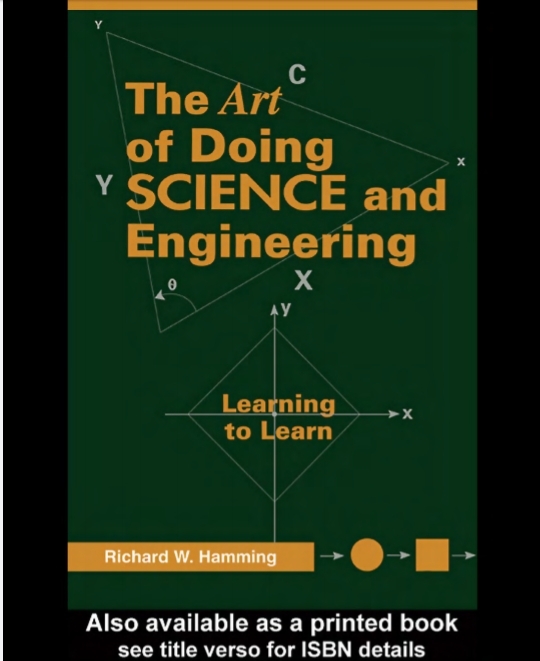
The Art of Doing Science and Engineering Learning to Learn 1st Edition by Richard W Hamming ISBN 9056995014 9789056995010


Original price was: $50.00.$35.00Current price is: $35.00.
The Art of Doing Science and Engineering Learning to Learn 1st Edition by Richard W Hamming – Ebook PDF Instant Download/Delivery: 9056995014, 9789056995010
Full download The Art of Doing Science and Engineering Learning to Learn 1st Edition after payment
Product details:
ISBN 10: 9056995014
ISBN 13: 9789056995010
Author: Richard W Hamming
The Art of Doing Science and Engineering Learning to Learn 1st Table of contents:
-
Foundations of the Digital (Discrete) Revolution
Explores the origins and impact of digital technologies on modern science and engineering. -
History of Computers—Hardware
A look into the development of computer hardware and its evolution over time. -
History of Computers—Software
Discusses the progression of software development and its integral role in computing. -
History of Computer Applications
Examines how computers have been applied across various fields and industries. -
Limits of Computer Applications—AI I
Analyzes the capabilities and limitations of artificial intelligence in practical applications. -
Limits of Computer Applications—AI II
Continues the discussion on AI, focusing on its constraints and potential. -
Limits of Computer Applications—AI III
Further exploration of AI’s boundaries and the challenges faced in its implementation. -
n-Dimensional Space
Introduces the concept of higher-dimensional spaces and their relevance in various scientific contexts. -
Coding Theory I
An overview of coding theory and its applications in error detection and correction. -
Coding Theory II
Continues the discussion on coding theory, delving deeper into its complexities. -
Error-Correcting Codes
Focuses on the development and importance of error-correcting codes in digital communication. -
Information Theory
Explores the principles of information theory and its significance in data transmission and processing. -
Digital Filters I
Introduces digital filters and their role in signal processing. -
Digital Filters II
Continues the discussion on digital filters, examining their applications and design. -
Digital Filters III
Further exploration of digital filters, focusing on advanced topics and techniques. -
Digital Filters IV
Concludes the series on digital filters, summarizing key concepts and developments. -
Simulation I
Discusses the principles and methodologies of simulation in scientific and engineering contexts. -
Simulation II
Continues the exploration of simulation, emphasizing its applications and challenges. -
Simulation III
Further examines simulation, focusing on advanced techniques and case studies. -
Fiber Optics
Introduces the field of fiber optics and its impact on communication technologies. -
Computer-Aided Instruction (CAI)
Explores the use of computer technology in educational settings to enhance learning experiences. -
Mathematics
Discusses the role of mathematics as a foundational tool in science and engineering. -
Quantum Mechanics
Introduces the principles of quantum mechanics and their applications in modern science. -
Creativity
Examines the importance of creativity in scientific and engineering endeavors. -
Experts
Discusses the characteristics and contributions of experts in various fields. -
Unreliable Data
Addresses the challenges posed by unreliable data and strategies for managing them. -
Systems Engineering
Explores the principles and practices of systems engineering in complex projects. -
You Get What You Measure
Discusses the importance of measurement in achieving desired outcomes. -
You and Your Research
Concludes with a personal reflection on the relationship between individuals and their research endeavors.
People also search for The Art of Doing Science and Engineering Learning to Learn 1st:
borrow the art of doing science and engineering
synopsis of the art of doing science and engineering
the art of doing science and engineering pdf
the art of doing science and engineering barnes and noble
the art of doing science and engineering reddit
Tags: Richard W Hamming, Science, Engineering