

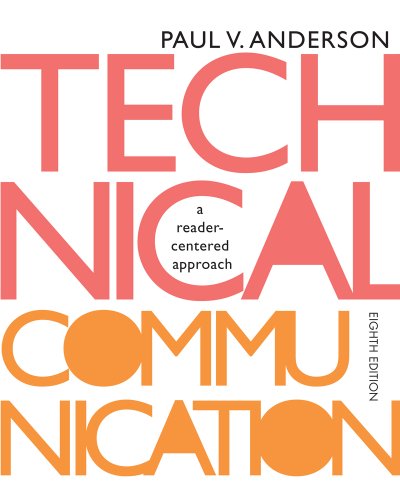
Technical Communication 8th Edition by Paul Anderson 113330981X 9781133309819

Original price was: $50.00.$35.00Current price is: $35.00.
Technical Communication 8th Edition by Paul V. Anderson – Ebook PDF Instant Download/Delivery: 113330981X, 9781133309819
Full download Technical Communication 8th Edition after payment
Product details:
ISBN 10: 113330981X
ISBN 13: 9781133309819
Author: Paul V. Anderson
Thousands of students have successfully improved their writing and design skills using Anderson’s TECHNICAL COMMUNICATION: A READER-CENTERED APPROACH. Known for its treatment of the rhetorical situation and coverage of usefulness and persuasion, this edition renews the focus on the reader-centered approach and includes new learning outcomes at the start of each chapter to help students gain more from their reading.
Technical Communication 8th Table of contents:
Part I. Introduction
1. Communication, Your Career, and This Book
Communication Expertise will be Critical to your Success
Learning Objectives for this Chapter
Characteristics of Workplace Writing
At Work, Writing is an Action
At Work, Writing Supports the Reader’s Action
The Two Essential Qualities of Effective Writing at Work: Usefulness and Persuasiveness
The Main Advice of this Book: Think Constantly About Your Readers
The Dynamic Interaction Between Your Communication and Your Readers
Six Reader-Centered Strategies You Can Begin Using Now
Communicating Ethically
How to Gain the Most from this Book
2. Overview of the Reader-Centered Communication Process: Obtaining a Job
How to Gain the Most from this Chapter
How to Write an Effective Résumé
Guideline 1. Define Your Résumé’s Objectives by Learning What Your Reader Wants
Guideline 2. Plan Your Résumé by Thinking Creatively About Your Qualifications, Deciding How Long Your Résumé Should Be, and Choosing the Type of Résumé You will Prepare
Guideline 3. Draft Your Résumé’s Text to Highlight the Qualifications That will Most Appeal to the Employer
Guideline 4. Design Your Résumé’s Appearance to Support Rapid Reading, Emphasize Your Qualifications, and Look Attractive
Writer’s Tutorial. Using Tables to Design a Résumé
Guideline 5. Revise Your Résumé to Increase its Impact and to Eliminate Errors and Inconsistencies
A Reader-Centered Approach to Writing Your Job Application Letter
Guideline 1. Define Your Letter’s Objectives by Identifying the Questions the Employer wants it to Answer, Including “Why us?” and “What would you Contribute”?
Guideline 2. Plan Ways to Answer the Employer’s Questions about Your Interest and Potential Contributions Persuasively
Guideline 3. Draft a Letter that Answers the Employer’s Questions Clearly and with Details
Guideline 4. Revise Your Letter to Increase its Impact and Assure that You Project a Favorable Image of Yourself
Ethical Issues in the Job Search
Writing for Employment in Other Countries
Interviewing Effectively and Displaying Your Work
Social Media and Employer’s Judgments About You
Conclusion
Part II. Defining Your Communication’s Goals
3. Defining Your Communication’s Goals
Your Goal: To Envision Your Reader’s Response to Each Specific Aspect of Your Communication
How to Determine What Your Communication Must Do to Be Useful
Guideline 1. Describe Your Reader’s Task
Guideline 2. Identify the Major Kinds of Information Your Reader wants from Your Communication
Guideline 3. Describe the Way Your Reader will Look for the Information
Guideline 4. Describe the Way Your Reader will Use the Information
How to Determine What Your Communication Must Do to Be Persuasive
Guideline 1. Describe Your Reader’s Current Attitudes and what You want them to be after Reading Your Communication
Guideline 2. Find Out why Your Reader Holds his or her Current Attitudes
How to Create a Profile of Your Reader
Guideline 1. Describe Your Reader’s Professional Role and Characteristics
Guideline 2. Describe Your Reader’s Relevant Personal Characteristics
Guideline 3. Global Guideline: Describe Your Reader’s Cultural Characteristics
Guideline 4. Learn who all Your Readers will be
How to Identify Relevant Elements of the Context for Your Communication
Guideline 1. Describe the Context in which Your Reader will Read
Guideline 2. Identify any Constraints on the Way You Write
How to Identify Your Communication’s Stakeholders: A First Step in Writing Ethically
Guideline 1. Ethics Guideline: Identify Your Communication’s Stakeholders
Guideline 2. Determine how Your Communication’s Stakeholders will View its Impact on them
How to Gather All This Information About Your Communication’s Purpose, Reader, and Context
Guideline 1. Ask Others for Help
Guideline 2. Ask Your Readers
Putting Your Definition into Action: An Example
Conclusion
Part III. Planning
4. Planning for Usefulness
What to Learn About How to Create Useful Communications
How to Provide the Exact Content Your Readers Need
Guideline 1. Identify Your Readers’ Questions and Subquestions
Guideline 2. Go Beyond Your Readers’ Questions
Guideline 3. Find a Superstructure that Suggests Questions Your Readers will Ask
Guideline 4. Avoid Including Information Your Readers Don’t Need
How to Organize in a Way That Helps Your Readers Perform Their Tasks
Guideline 1. Group Together the Items Your Readers will Use Together
Guideline 2. Organize Hierarchically
Guideline 3. Give the Bottom Line First
Guideline 4. Adapt an Appropriate Superstructure
Guideline 5. Outline, if This will be Helpful
How to Help Your Readers Quickly Find What They Want
Guideline 1. Create Pathways and Signposts that Direct Readers to the Content They Want
Guideline 2. Create a Modular Design if You have a Complex Audience
How to Help Your Readers Quickly Understand What You are Saying
Guideline 1. Identify the Background Your Readers Need About the Topic
Guideline 2. Identify the Background Your Readers Need About the Situation
Guideline 3. Identify Your Readers’ Cultural Expectations
Guideline 4. Plan Your Graphics
How to Treat Your Communication’s Stakeholders Ethically
Guideline 1. Ask Stakeholders Directly
Guideline 2. Imagine What Your Communication’s Stakeholders would Say
How to Test the Likelihood that Your Plans will Succeed
Conclusion
5. Planning Your Persuasive Strategies
The Competitive and Collaborative Uses of Persuasion
What to Concentrate on When Reading this Chapter
How Persuasion Works
How to Focus on Your Readers’ Goals and Values
Guideline 1. Listen—and Respond Flexibly to What You Hear
Guideline 2. Identify Business-Related Goals You Can Help Your Readers Achieve
Guideline 3. Identify Values-Based Goals You Can Help Your Readers Achieve
Guideline 4. Identify Achievement and Growth Goals You Can Help Your Readers Reach
How to Reason Soundly
Guideline 1. Present Sufficient and Reliable Evidence
Guideline 2. Explicitly Justify Your Line of Reasoning Where Necessary
Guideline 3. Respond to—and Learn from—Your Readers’ Concerns and Counterarguments
How to Build an Effective Relationship with Your Readers
Guideline 1. Establish Your Credibility
Guideline 2. Present Yourself as a Partner, not a Critic
How to Organize to Create a Favorable Response
Guideline 1. Choose Carefully Between Direct and Indirect Organizational Patterns
Guideline 2. Create a Tight Fit Among the Parts of Your Communication
How to Appeal to Your Readers’ Emotions
How to Adapt to Your Readers’ Cultural Background
How to Persuade Ethically
Guideline 1. Don’t Mislead
Guideline 2. Don’t Manipulate
Guideline 3. Open Yourself to Your Readers’ Viewpoint
Guideline 4. Argue from Human Values
Conclusion
Part IV. Conducting Research
6. Conducting Reader-Centered Research: Gathering, Analyzing, and Thinking Critically About Information
What to Focus on Learning in this Chapter
Interdependence of Research and Writing
How to Define Reader-Centered Goals for Research
Guideline 1. Identify the Information and Ideas Your Readers Want, Need, and will Find Persuasive
Guideline 2. Identify the Criteria by which Your Readers will Judge the Quality of Your Research
How to Gather Information and Ideas Your Readers Want and Need
Guideline 1. Identify the Full Range of Sources and Methods that May Provide Helpful Information
Guideline 2. Use Secondary Sources Your Readers will Find Credible and Unbiased
Guideline 3. Use Primary Research Methods in a Credible and Unbiased Way
Guideline 4. Gather Information that can be Analyzed in Subgroups
Guideline 5. Take Careful Notes
Intermission
How to Analyze Your Results for Relationships and Patterns Your Readers will Find Useful
Guideline 1. Review Your Research Objectives
Guideline 2. Arrange Your Information in an Analyzable Form
Guideline 3. Look for Meaningful Relationships in Your Results
How to Draw Conclusions that are Focused on Your Readers’ Needs
Guideline 1. Choose Conclusions that Align with Your Readers’ Decisions and Actions
Guideline 2. Acknowledge Uncertainty
How to Explain the Significance of Your Conclusions to Your Readers
How to Recommend Actions Based on Your Conclusions that will Benefit Your Readers
How to Think Critically Throughout Your Research Process
Guideline 1. Let Go of Your Anchor
Guideline 2. Value Counterarguments, Counterevidence, and Exceptions
Guideline 3. Avoid Personal or Organizational Biases
Guideline 4. Thinking Critically About Your Sources
How to Observe Intellectual Property Law and Document Your Sources
Ethical Guidelines for Documenting Sources
Conclusion
7. Using Five Reader-Centered Research Methods
How to Conduct Research Using Your Memory and Creativity
How to Research on the Internet
How to Use the Library Effectively
Writer’s Tutorial. Three Ways to Search Efficiently on the Internet
How to Conduct Effective Interviews
Writer’s Tutorial. Conducting Efficient Library Research
How to Conduct a Survey
Part V. Drafting Prose Elements
8. Drafting Reader-Centered Paragraphs, Sections, and Chapters
The Similarities Among Paragraphs, Sections, and Chapters
What to Focus on When Reading this Chapter
How to Start a Segment
Guideline 1. Begin by Announcing Your Topic
Guideline 2. Present Your Generalizations Before Your Details
How to Arrange the Parts of Your Communication to Create Clarity, Coherence, and Persuasivness
Guideline 1. Move from Most Important to Least Important
Guideline 2. Consult Conventional Strategies When Having Difficulties Organizing
Guideline 3. Global Guideline: Consider Your Readers’ Cultural Background When Organizing
How to Help Your Readers See the Organization of Your Communication
Guideline 1. Provide Signposts that Create a Map of Your Communication
Guideline 2. Smooth the Flow of Thought from Sentence to Sentence
Ethics Guideline: Examine the Human Consequences of What You’re Drafting
Conclusion
9. Using Nine Reader-Centered Patterns for Organizing Paragraphs, Sections, and Chapters
How to Group Items Formally (Formal Classification)
How to Group Items Informally (Informal Classification)
Comparison
How to Describe an Object (Partitioning)
How to Describe a Process (Segmenting)
How to Describe a Cause-and-Effect Relationship
How to Persaude Readers that a Cause-and-Effect Relationship Exists
Describing a Problem and Its Solution
Combination of Patterns
10. Developing an Effective, Professional Style
How to Create an Effective, Professional Voice
Guideline 1. Find Out What’s Expected
Guideline 2. Consider the Roles Your Voice Creates for Your Readers and You
Guideline 3. Consider How Your Attitude Toward Your Subject Will Affect Your Readers
Guideline 4. Say Things in Your Own Words
Guideline 5. Global Guideline: Adapt Your Voice to Your Readers’ Cultural Background
Guideline 6. Ethics Guideline: Avoid Stereotypes
How to Construct Sentences Your Reader Will Find Easy to Understand, Easy to Remember, and Interesting
Guideline 1. Simplify Your Sentences
Guideline 2. Put the Action in Your Verbs
Guideline 3. Use the Active Voice Unless You Have a Good Reason to Use the Passive Voice
Guideline 4. Emphasize What’s Most Important
Guideline 5. Vary Your Sentence Length and Structure
Guideline 6. Global Guideline: Adapt Your Sentences for Readers Who are Not Fluent in Your Language
Choose Words that Convey Your Meaning Clearly and Precisely
Guideline 1. Use Concrete, Specific Words
Guideline 2. Use Specialized Terms When—and Only When—Your Readers will Understand Them
Guideline 3. Use Words Accurately
Guideline 4. Choose Plain Words over Fancy Ones
Guideline 5. Choose Words with Appropriate Associations
Guideline 6. Global Guideline: Consider Your Readers’ Cultural Background when Choosing Words
Guideline 7. Ethics Guideline: Use Inclusive Language
Conclusion
11. Beginning a Communication
How to Motivate Your Readers to Pay Attention
Guideline 1. Provide an Informative Subject Line for E-mails and Memos
Guideline 2. Refer to Your Readers’ Request
Guideline 3. Offer to Help Your Readers Solve a Problem
How to Help Your Readers Find What They Need
Guideline 1. State Your Main Point
Guideline 2. Provide a Forecasting Statement
Guideline 3. Include a Summary
How to Encourage Readers to Read your Message with an Open Mind
How to Identify the Background Information Your Readers Need
How to Pick the Right Length for Your Introduction
How to Adapt Your Beginning to Your Readers’ Cultural Background
Ethics Guideline: How to Address Unethical Practices
Conclusion
12. Ending a Communication
How to Define the Goals for a Communication’s Ending
How to Select the Appropriate Strategy or Group of Strategies for Ending Your Communication
Guideline 1. After You’ve Made Your Last Point, Stop
Guideline 2. Repeat Your Main Point
Guideline 3. Summarize Your Key Points
Guideline 4. Refer to a Goal Stated Earlier in Your Communication
Guideline 5. Focus on a Key Feeling
Guideline 6. Tell Your Readers How to Get Assistance or More Information
Guideline 7. Tell Your Readers What to Do Next
Guideline 8. Identify Any Further Study that is Needed
Guideline 9. Follow Applicable Social Conventions
Conclusion
13. Writing Reader-Centered Front and Back Matter
How to Plan Front and Back Matter for a Communication You are Writing
Guideline 1. Review the Ways Your Readers will Use the Communication
Guideline 2. Review Your Communication’s Persuasive Goals
Guideline 3. Find Out What’s Required
Guideline 4. Find Out What’s Expected
A Word About Conventions and Local Practice
How to Write a Reader-Centered Transmittal Letter
How to Write Reader-Centered Front Matter
How to Write Reader-Centered Back Matter
Part VI. Drafting Visual Elements
14. Creating Reader-Centered Graphics
How to Identify Places where Graphics would Increase Your Communication’s Usefulness and Persuasiveness
Guideline 1. Find Places Where Graphics Would Make Your Communication Easier for Your Reader to Use
Guideline 2. Find places where graphics can increase your communication’s persuasiveness
Writer’s Tutorial. Graphics Help Readers Understand and Use Information
How to Choose the Type of Graphic Best Matched to Your Objectives
Guideline 1. Consider Your Readers’ Tasks
Guideline 2. Consider Your Readers’ Attitudes
How to Make Your Graphics Easy for Your Readers to Understand and Use
Guideline 1. Design Your Graphics to Support Your Readers’ Tasks
Guideline 2. Consider Your Readers’ Knowledge and Expectations
Guideline 3. Simplify Your Graphics
Guideline 4. Label the Important Content Clearly
Guideline 5. Provide Informative Titles
How to Use Color to Support Your Message
How to Use Graphics Software and Existing Graphics Effectively
How to Integrate Your Graphics with Your Text
Guideline 1. Introduce Your Graphics in Your Text
Guideline 2. Place Your Graphics Near Your References to Them
Guideline 3. State the Conclusions You Want Your Readers to Draw
Guideline 4. When Appropriate, include Explanations in Your Figures
How to Determine Whether You Need to Obtain Permission and Cite the Sources for Your Graphics
Global Guideline: Adapt Your Graphics When Writing to Readers in Other cultures
Ethics Guideline: Avoid Graphics that Mislead
Conclusion
15. Creating Eleven Types of Reader-Centered Graphics
Writer’s Tutorial. Tables
How to Create Formal Tables
How to Create Informal Tables
How to Create Tables that Contain Only Text
Writer’s Tutorial. Line graphs
How to Create Line Graphs
How to Create Line Graphs Comparing Trends
How to Create Line Graphs Showing Interactions among Variables
Writer’s Tutorial. Bar Graphs
How to Create Bar Graphs
How to Create Bar Graphs Showing Trends
How to Create Multibar Graphs Showing Several Comparisons
More Types of Bar Graphs
Writer’s Tutorial. Pictographs
How to Create Pictographs
Writer’s Tutorial. Pie Charts
How to Create Pie Charts
How to Avoid Distortion in Pie Charts
Writer’s Tutorial. Photographs
How to Create Photographs That Are Useful to Your Readers
How to Use Software to Create Reader-Centered Photographs
Writer’s Tutorial. Drawings
How to Create Drawings
How to Create Drawings That Show How to Do Something
How to Create Drawings Showing Appearance and Structure
Writer’s Tutorial. Screen Shots
How to Create Screen Shots
Helping Readers Locate an On-screen Item
Guiding Your Readers Through a Sequence of Steps
Writer’s Tutorial. Flowcharts
How to Create Flowcharts
Writer’s Tutorial. Organizational Charts
How to Create Organizational Charts
How to Create Organizational Charts That Show Reporting Lines
Writer’s Tutorial. Schedule Charts
How to Create Schedule Charts
How to Create Gantt Charts
16. Designing Reader-Centered Pages and Documents
A Reader-Centered Approach to Design
Design Elements of a Communication
How to Help Your Reader See How Your Communication Is Organized
Guideline 1. Create a Grid to Serve as the Visual Framework for Your Page
Writer’s Tutorial. Designing Grid Patterns for Print
Guideline 2. Align Related Elements with One Another
Guideline 3. Group Related Items Visually
Guideline 4. Use Contrast to Establish Hierarchy and Focus
Using Word Processors to Create Page Designs
How to Use Page Design to Unify a Long Communication Visually
How to Select Type that is Easy for Your Readers to Read
How to Choose the Physical Characteristics that Support Your Communication’s Goals
Conclusion
Part VII. Revising
17. Revising Your Drafts
The Three Activities of Revising
How to Identify the Possible Ways to Improve Your Draft
Guideline 1. Check from Your Readers’ Point of View
Guideline 2. Check from Your Employer’s Point of View
Guideline 3. Distance Yourself from Your Draft
Guideline 4. Read Your Draft More than Once, Changing Your Focus Each Time
Guideline 5. Use Computer Aids to Find (But Not to Cure) Possible Problems
Guideline 6. Ethics Guideline: Consider the Stakeholders’ Perspective
How to Obtain Truly Helpful Advice from People Who Review Your Drafts—and How to Give Good Advice When You are Reviewing Someone Else’s Draft
Guideline 1. Discuss the Objectives of the Communication and the Review
Guideline 2. Build a Positive Interpersonal Relationship With Your Reviewers or Writer
Guideline 3. Rank Suggested Revisions—and Distinguish Matters of Substance from Matters of Taste
Guideline 4. Explore Fully the Reasons for all Suggestions
Guideline 5. Present Your Suggestions in the Way that will be Most Helpful to the Writer
Guideline 6. Ethics Guideline: Review from the Stakeholders’ Perspective
How to Produce the Maximum Improvement in Limited Time
Guideline 1. Adjust Your Effort to the Situation
Guideline 2. Make the Most Significant Revisions First
Guideline 3. Be Diplomatic
Guideline 4. To Revise Well, Follow the Guidelines for Writing Well
Guideline 5. Revise to Learn
Conclusion
18. Testing Drafts for Usefulness and Persuasiveness
The Logic of Testing
How to Define the Goals of Your Test
How to Choose the People who will be Your Test Users
How to Test Your Draft’s Usefulness
Guideline 1. Ask your Test Readers to use your Draft the Same way your Target Readers will
Guideline 2. Interview Your Test Readers After They Have Used Your Draft
Guideline 3. Keep as Small as Possible the Difference Between Your Test Readers’ and Your Target Readers’ Experience with Your Communication
How to Test the Persuasiveness of Your Draft
Guideline 1. Use Likert-Scale Questions to Evaluate Persuasiveness
Guideline 2. Avoid Biasing Your Test Results
How to Interpret the Results of Your Test
How to Test Communications You Write to Readers in Another Culture
How to Treat Test Readers
Conclusion
Part VIII. Applications of the Reader-Centered Approach
19. Creating Communications with a Team
Varieties of Team Structures
Keys to Team Success
How to Develop a Shared Understanding of Team Goals and Procedures
Guideline 1. Create a Shared Understanding of the Communication’s Objectives
Guideline 2. Develop and Share a Detailed Plan for the Finished Communication
Guideline 3. Make a Project Schedule
Guideline 4. Establish Shared Responsibility for Team Progress and Cohesion
How to Obtain the Commitment and Effort Needed from All Team Members to Maintain Steady Progress
How to Make Team Meetings Efficient and Highly Productive
Guideline 1. Set and Follow an Agenda
Guideline 2. Encourage Discussion, Debate, and Diversity of Ideas
Guideline 3. Global Guideline: Help Your Team Work Across Cultural Differences
How to Use Technology to Your Advantage
Guideline 1. Choose the Computer Technology Best Suited to Your Team’s Project
Guideline 2. For Virtual Teams, Foster Personal Relationships and Conversational Interchanges
Learning Team Skills Through Feedback
20. Creating and Delivering Listener-Centered Oral Presentations
How to Define Your Presentation’s Objectives
Guideline 1. Determine Who Your Listeners are, What Task they Want to Perform, What they Need, and What they Expect
Guideline 2. Define Your Persuasive Goals
How to Select the Oral and Visual Media Most Likely to Achieve Your Objectives
Guideline 1. Choose the Type of Oral Delivery by Considering Your Audience and Purpose
Guideline 2. Choose Your Visual Medium by Considering Your Audience, Topic, and Purpose
Writer’s Tutorial. Creating a Listener-Centered Presentation
How to Help Your Listeners Fully Understand and Remember Your Main Points
Guideline 1. Identify the Main Points You Want to Make
Guideline 2. Create a Simple Structure Built Around Your Major Points
Guideline 3. Help Your Listeners Follow the Structure of Your Presentation
Guideline 4. Make Easy-to-Understand Visuals
Guideline 5. Plan the Verbal and Visual Parts of Your Presentation as a Single Package
Guideline 6. Adapt to Your Listeners’ Cultural Background
How to Maintain Your Listeners’ Attention and Goodwill
Guideline 1. Speak in a Conversational Style
Guideline 2. Establish and Maintain a Personal Connection With Your Audience
Guideline 3. Respond Effectively to Your Audience’s Comments and Questions
Guideline 4. Rehearse
Guideline 5. Accept Your Nervousness—and Work With It
How to Make Effective Team Presentations
Guideline 1. Plan Thoroughly as a Team
Guideline 2. Maintain Overall Consistency while Allowing for Individual Differences
Guideline 3. Make Smooth Transitions Between Speakers
Guideline 4. Rehearse Together
Conclusion
21. Managing Client and Service-Learning Projects
Overall Project Management Strategy
How to Establish a Detailed, Mutual Understanding of All Important Aspects of the Project
Guideline 1. Determine What Your Client Wants and Why
Guideline 2. Develop Your Own Assessment of the Situation
Guideline 3. Define What You will do for Your Client and How You will do it
Guideline 4. Give Your Client a Written Proposal—and Ask for a Written Agreement
How to Maintain a Productive Relationship with Your Client Throughout Your Project
Guideline 1. Communicate Candidly with Your Client During the Project
Guideline 2. Advocate and Educate, but Defer to Your Client
How to Hand off Your Project in a Way Your Client Will Find Helpful
Conclusion
22. Creating Reader-Centered Websites
How to Gain the Most Value from this Chapter
This Chapter’s Example: Digital Portfolio Websites
Writer’s Tutorial. Creating a Website Using Tables
How to Develop Reader-Centered Content for Your Website
How to Help Your Readers Quickly Find What They are Looking for
Guideline 1. Organize Your Website to Match Your Readers’ Search Strategies
Guideline 2. Include a Variety of Navigational Guides in Your Web Pages and Website
How to Design Web Pages that are Easy to Read and Attractive
Guideline 1. Help Your Readers Immediately Understand the Organization of Your Web Pages
Guideline 2. Make Your Text Easy to Read
Writer’s Tutorial. Designing Grid Patterns for Web Pages
Guideline 3. Give Your Pages Order, Harmony, and Proportion
Guideline 4. Unify Your Website Verbally and Visually
How to Design Your Website for Diverse Readers
Guideline 1. Ethics Guideline: Construct Your Website for Use by Readers with Disabilities.
Guideline 2. Global Guideline: Design Your Website to Serve International and Multicultural Readers
How to Follow Ethical and Legal Practices Concerning Your Website’s Content
Guideline 1. Observe Copyright Law and Acknowledge Your Sources
Guideline 2. Treat Your Readers and Your Website’s Stakeholders Ethically
Writer’s Guide and Other Resources
Part IX. Superstructures
23. Writing Reader-Centered Letters, Memos, E-mails, and Digital Exchanges
How to Use the Appropriate Level of Formality
How to Take a Reader-Centered “You Attitude”
Help Your Readers Find What They Want Quickly
Guideline 1. State Your Main Point Up Front—Unless You Expect Your Readers to React Negatively
Guideline 2. Keep it Short
Guideline 3. Use Headings and Lists
Give Your Readers the Background Information They Need
Global Guideline: Learn the Customs of Your Readers’ Culture
Follow Format Conventions and Other Customs
Writing Reader-Centered Letters
Writer’s Tutorial. Writing Letters
Writing Reader-Centered Memos
Writing Reader-Centered E-Mail
Writing Reader-Centered Instant Messages
Writer’s Tutorial. Writing Memos
Writer’s Tutorial. Writing E-mail
Writing Reader-Centered Blog Entries
24. Writing Reader-Centered Proposals
How to Get the Most Value from this Chapter
The Two Goals of a Proposal
The Variety of Proposal-Writing Situations
Features of Proposals that Help You
The Questions Readers Ask Most Often
Superstructure for Proposals
Guiding You Through the Process of Writing Proposals
Crafting the Major Elements of a Proposal
Sample Proposals
Writer’s Guides and Other Resources
25. Writing Reader-Centered Empirical Research Reports
How to Get the Most Value from this Chapter
Typical Writing Situations
Features of Empirical Research Reports that Help You
The Questions Readers Ask Most Often
Superstructure for Empirical Research Reports
Guiding You through the Process of Preparing Empirical Research Reports
Crafting the Major Elements of an Empirical Research Report
Conclusions
Sample Empirical Research Reports
Writer’s Guides and Other Resources
People also search for Technical Communication 8th:
technical communication paul v anderson
technical writing textbook
technical communication principles
professional technical writing
technical documents and design
Tags: Technical, Communication, Paul Anderson