

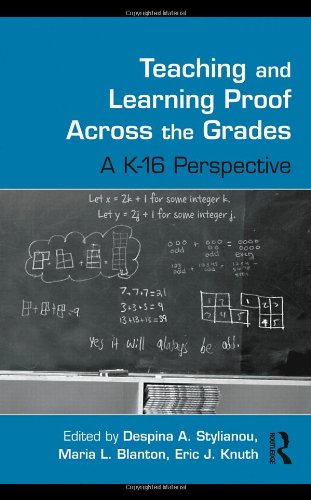
Teaching and learning proof across the grades a K 16 perspective 1st Edition by Despina Stylianou, Maria Blanton, Eric Knuth 0415989841 9780415989848

Original price was: $50.00.$35.00Current price is: $35.00.
Teaching and learning proof across the grades a K 16 perspective 1st Edition by Despina A. Stylianou, Maria L. Blanton, Eric J. Knuth – Ebook PDF Instant Download/Delivery: 0415989841, 9780415989848
Full download Teaching and learning proof across the grades a K 16 perspective 1st Edition after payment
Product details:
ISBN 10: 0415989841
ISBN 13: 9780415989848
Author: Despina A. Stylianou, Maria L. Blanton, Eric J. Knuth
A Co-Publication of Routledge for the National Council of Teachers of Mathematics (NCTM) In recent years there has been increased interest in the nature and role of proof in mathematics education; with many mathematics educators advocating that proof should be a central part of the mathematics education of students at all grade levels. This important new collection provides that much-needed forum for mathematics educators to articulate a connected K-16 “story” of proof. Such a story includes understanding how the forms of proof, including the nature of argumentation and justification as well as what counts as proof, evolve chronologically and cognitively and how curricula and instruction can support the development of students’ understanding of proof. Collectively these essays inform educators and researchers at different grade levels about the teaching and learning of proof at each level and, thus, help advance the design of further empirical and theoretical work in this area. By building and extending on existing research and by allowing a variety of voices from the field to be heard, Teaching and Learning Proof Across the Grades not only highlights the main ideas that have recently emerged on proof research, but also defines an agenda for future study.
Teaching and learning proof across the grades a K 16 perspective 1st Table of contents:
Section I Theoretical Considerations on the Teaching and Learning of Proof
1 What I Would Like My Students to Already Know About Proof
2 Exploring Relationships Between Disciplinary Knowledge and School Mathematics: Implications for Understanding the Place of Reasoning and Proof in School Mathematics
From the Literature on the Teaching and Learning of Proof
Exploring Typical Algebra Instruction
A Classroom Interlude: Justification of Steps in a Method
An Initial Interpretation of this Thought Experiment
Instructional Situations: A Useful Construct
A Model of Who Does What and When in Solving Equations
Reasoning in Algebra Classrooms: A Return to the Dialogue
A Design Experiment in US Elementary School Instruction (Didactical Engineering by Another Name?)
Conclusion
Notes
3 Proving and Knowing in Public: The Nature of Proof in a Classroom
Classroom Mathematical Performances
Four Constraints that Shape Mathematical Activity in School Classrooms
Institutional
Instructional
Individual
Interpersonal
Three Timescales
The Possible Place of Proof in the Custom of a Class
Proof as a Regulatory Structure for a Conception
C-proof
Proof as a Tool to Know with
What can an Observer do with the Theoretical Elements Provided?
Notes
Section II Teaching and Learning of Proof in the Elementary Grades
4 Representation-based Proof in the Elementary Grades
The Context of Our Work
Students’ Responses to the Challenge of All
What Constitutes Proof at the Elementary Level?
Studying Computation and Representation-based Proof
Proof as an Aid to Understanding: An Example from a Grade 4 Classroom
Proof as a Route to Conviction: An Example from a Grade 1–2 Classroom5
Conclusion
Notes
5 Representations that Enable Children to Engage in Deductive Argument
A Dilemma
Representing Generality
Example 1: The Part–Whole Schematic
Using the Part–Whole Representation to Prove
From Quantitative Reasoning to Arithmetic Reasoning
Example 2: The Multiplicative Schematic
Using the Multiplicative Schematic to Prove
Can Young Children Engage in Deductive Argument?
Conclusion
Notes
6 Young Mathematicians at Work: The Role of Contexts and Models in the Emergence of Proof
Grade 2
Building an Understanding of Equivalence
Representation: The Open Number Line as a Tool
Extending the Use of Variables and Solving for them
Discussion
Grade 5
The California Frog Jumping Contest: A Context to Introduce the Number Line in Grade 5
Discussion
Implications for Proof
Notes
7 Children’s Reasoning: Discovering the Idea of Mathematical Proof
Theoretical View
Background
Data and Analysis
Results
Classroom Sharing
Discussion
Conclusion
Implications
Notes
8 Aspects of Teaching Proving in Upper Elementary School1
Research on Children’s Reasoning
What We Mean by “Proof” and “Proving”
Aspects of Teaching Proving in Vicki Zack’s Classroom
Background
Problem Solving
The “Problem of the Week” Tasks
Time
Conjecturing
Transcript 1
Expectations
Transcript 2
Expertise
Transcript 3
Conclusion
Note
Section III Teaching and Learning of Proof in Middle Grades and High School
9 Middle School Students’ Production of Mathematical Justifications1
Proof Production Framework
Proof Production Levels
Methods
Participants
Data Collection
Data Analysis
Results and Discussion
Middle School Students’ Production of Justifications: Patterns, Questions, and Implications
Patterns in Students’ Production of Justifications
Questions Concerning Students’ Understandings of Proof
Implications Concerning the Teaching and Learning of Proof
Concluding Remarks
Notes
10 From Empirical to Structural Reasoning in Mathematics: Tracking Changes Over Time
Learning to Prove: A Perspective From the English Curriculum
The Longitudinal Proof Project
Generalizing a Number Pattern
Pattern Spotting and Structural Reasoning
Expressing Structure in Algebra
From Calculating to Structural Reasoning
Conclusions
Note
11 Developing Argumentation and Proof Competencies in the Mathematics Classroom
Students’ Competencies in Reasoning and Proof
Mathematical Competency
Motivational Aspects and the Learning of Mathematics
An Empirical Study on Reasoning and Proof in the Mathematics Classroom
Research Questions
Method and Sample
Developing Proof Competencies
Interest, Motivation, and Emotions
Relations Between Cognitive and Affective Variables in the Mathematics Classroom
Conclusion
12 Formal Proof in High School Geometry: Student Perceptions of Structure, Validity, and Purpose1
Theoretical Considerations
Exploring Understanding and Thinking
Framing Understanding and Thinking
Methodology and Analysis
Results
Conclusions
Notes
Appendix A Interview Questions
13 When is an Argument Just an Argument? The Refinement of Mathematical Argumentation
Data
Analysis of Classroom Episodes
Batteries Episode
Transition to AIDS Episode
AIDS Episode
Discussion
Notes
14 Reasoning-and-Proving in School Mathematics: The Case of Pattern Identification1
Introduction
A Conceptualization of Reasoning-and-Proving
Analytic Framework
Identifying a Pattern
Using the Analytic Framework to Support Inquiry on Reasoning-and-Proving from Mathematical, Psychological, and Pedagogical Perspectives
Using the Analytic Framework to Analyze and Discuss an Episode from a Professional Development Session
The Professional Development Program and the Focal Episode
Analysis and Discussion of the Focal Episode
Conclusion
Note
15 “Doing Proofs” in Geometry Classrooms
Geometry Instruction at Midwest High School
Teachers’ Views on the Role of Proof in Geometry
What Proof Practice Looks Like in Geometry Classrooms
The Situation of “Doing Proofs”
Instances of “Doing Proofs” in Midwest High School
Practicing Proof at Lucille Vance’s Regular Geometry Class
Proving a Theorem in Megan Keating’s Accelerated Geometry Class
Reviewing a Homework Problem in Cecilia Marton’s Accelerated Geometry Class
“Doing Proofs”
Conclusion
Notes
Section IV Teaching and Learning of Proof in College
16 College Instructors’ Views of Students Vis-à-Vis Proof
Basics in the DNR Framework1
Proof Versus Proof Scheme
Way of Understanding Versus Way of Thinking
A Desirable Knowledge Base for Mathematics Instructors
Current Knowledge Base of Some Mathematics Instructors
Assumptions about Students’ Proof Backgrounds
Students and Their Difficulty with Definitions
More About Definitions
What Do Instructors Do to Help?
Is It Just a Matter of Experience?
Closing Statement
Notes
17 Understanding Instructional Scaffolding in Classroom Discourse on Proof1
The Social Aspect of Proof
Using a Sociocultural Perspective to Study Teaching and Learning Proof
Discourse as a Lens for Understanding Teaching and Learning Proof
Conceptualizing Teaching and Learning through Instructional Scaffolding and the ZPD
Background
Data Analysis for the Development of the Framework
Description and Discussion of the Framework
Frequency and Structure of Teacher Utterances
Student Development within the ZPD: Establishing the “Scaffolding” in Teacher Utterances
Small Group Discourse: Moving Beyond the Teacher’s Guidance
Conclusion
Notes
18 Building a Community of Inquiry in a Problem-based Undergraduate Number Theory Course: The Role of the Instructor
Relevant Background
The “Modified” Moore Method and Inquiry-based Learning
Role of the Instructor
September: Mark Encourages Student Response to Presented Proofs
October: Mark Focuses and Supports Mathematical Critique
November: Mark as an Expert Participant
Concluding Remarks
Notes
19 Proof in Advanced Mathematics Classes: Semantic and Syntactic Reasoning in the Representation System of Proof
The Representation System of Proof
Representation Systems
Syntactic and Semantic Understanding and Reasoning in a Representation System
The Representation System of Mathematical Proof
Syntactic and Semantic Proof Productions
Syntactic Reasoning and Proof Productions
Opportunities Afforded by Syntactic Reasoning
Difficulties with Syntactic Reasoning
Semantic Reasoning
Oportunities Afforded by Semantic Reasoning
Difficulties with Semantic Reasoning
Discussion
20 Teaching Proving by Coordinating Aspects of Proofs with Students’ Abilities
Three Structures of Proofs
The Hierarchy of a Proof and a Possible Construction Path
The Formal–Rhetorical and Problem-Centered Parts of a Proof
Coordinating Aspects of Proofs with Students’ Abilities
Kinds of Proof
Formal–Rhetorical Reasoning Versus Problem-Centered Reasoning
Comparing the Difficulty of Proofs
Sets and Functions
Logic
Problem-Centered Reasoning
Informal Observations
The Genre of Proof
Convince Yourself
Logic
Teaching
Conclusion
Notes
21 Current Contributions Toward Comprehensive Perspectives on the Learning and Teaching of Proof
Section I: Theoretical Considerations on the Teaching and Learning of Proof
What I would Like My Students to Already Know About Proof
Exploring Relationships Between Disciplinary Knowledge and School Mathematics: Implications for Understanding the Place of Reasoning and Proof in School Mathematics
Proving and Knowing in Public: The Nature of Proof in a Classroom
Section II: Teaching and Learning of Proof in the Elementary Grades
Representation-based Proof in the Elementary Grades
Representations that Enable Children to Engage in Deductive Argument
Young Mathematicians at Work: The Role of Contexts and Models in the Emergence of Proof
Children’s Reasoning: Discovering the Idea of Mathematical Proof
Aspects of Teaching Proving in Upper Elementary School
Section III: Teaching and Learning of Proof in Middle Grades and High School
Middle School Students’ Production of Mathematical Justifications
From Empirical to Structural Reasoning in Mathematics: Tracking Changes Over Time
Developing Argumentation and Proof Competencies in the Mathematics Classroom
Formal Proof in High School Geometry: Student Perceptions of Structure, Validity, and Purpose
When is an Argument Just an Argument? The Refinement of Mathematical Argumentation
Reasoning-and-Proving in School Mathematics: The Case of Pattern Identification
“Doing Proofs” in Geometry Classrooms
Section IV: Teaching and Learning of Proof in College
College Instructors’ Views of Students Vis-à-Vis Proof
Understanding Instructional Scaffolding in Classroom Discourse on Proof
Building a Community of Inquiry in a Problem-based Undergraduate Number Theory Course: The Role of the Instructor
Proof in Advanced Mathematics Classes: Semantic and Syntactic Reasoning in the Representation System of Proof
Teaching Proving by Coordinating Aspects of Proofs with Students’ Abilities
People also search for Teaching and learning proof across the grades a K 16 perspective 1st:
what are the hardest grades to teach
teaching proofs in geometry
teacher proof curriculum
teaching proofs
proof grades
Tags: Teaching, learning proof, the grades, Despina Stylianou, Maria Blanton, Eric Knuth