

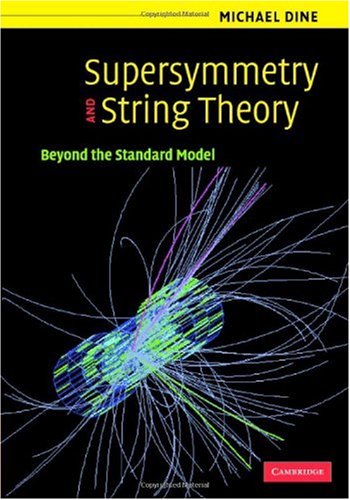
Supersymmetry and string theory beyond the standard model 1st Edition by Michael Dine ISBN 9780521858410 0521858410


Original price was: $50.00.$35.00Current price is: $35.00.
Supersymmetry and string theory beyond the standard model 1st Edition by Michael Dine – Ebook PDF Instant Download/Delivery: 9780521858410 ,0521858410
Full download Supersymmetry and string theory beyond the standard model 1st Edition after payment
Product details:
ISBN 10: 0521858410
ISBN 13: 9780521858410
Author: Michael Dine
Supersymmetry and string theory beyond the standard model 1st Edition Table of contents:
Part 1 Effective field theory: the Standard Model, supersymmetry, unification
1 Before the Standard Model
Suggested reading
2 The Standard Model
2.1 Yang–Mills theory
2.2 Realizations of symmetry in quantum field theory
2.2.1 The Goldstone phenomenon
2.2.2 Aside: choosing a vacuum
2.2.3 The Higgs mechanism
2.2.4 Goldstone and Higgs phenomena for non-Abelian symmetries
2.2.5 Confinement
2.3 The quantization of Yang–Mills theories
2.3.1 Gauge fixing in theories with broken gauge symmetry
2.4 The particles and fields of the Standard Model
2.5 The gauge boson masses
2.6 Quark and lepton masses
Suggested reading
Exercises
3 Phenomenology of the Standard Model
3.1 The weak interactions
3.2 The quark and lepton mass matrices
3.3 The strong interactions
3.3.1 Asymptotic freedom
3.4 The renormalization group
3.5 Calculating the beta function
3.6 The strong interactions and dimensional transmutation
3.7 Confinement and lattice gauge theory
3.7.1 Wilson’s formulation of lattice gauge theory
3.8 Strong interaction processes at high momentum transfer
3.8.1 e+e Annihilation
3.8.2 Jets in e+e annihilation
3.8.3 Deep inelastic scattering
3.8.4 Other high momentum processes
Suggested reading
Exercises
4 The Standard Model as an effective field theory
4.0.1 Integrating out the W and Z bosons
4.0.2 What might the Standard Model come from?
4.1 Lepton and baryon number violation
4.1.1 Dimension five: lepton number violation and neutrino mass
4.1.2 Other symmetry-breaking dimension-five operators
4.1.3 Irrelevant operators and high-precision experiments
4.1.4 Dimension-six operators: proton decay
4.2 Challenges for the Standard Model
4.2.1 A puzzle at the renormalizable level
4.3 The hierarchy problem
4.4 Dark matter and dark energy
4.5 Summary: successes and limitations of the Standard Model
Suggested reading
5 Anomalies, instantons and the strong CP problem
5.1 The chiral anomaly
5.1.1 Applications of the anomaly in four dimensions
5.1.2 Return to QCD
5.2 A two-dimensional detour
5.2.1 The anomaly in two dimensions
5.2.2 Path integral computation of the anomaly
5.2.3 The CPN model: an asymptotically free theory
5.2.4 The large-N limit
5.2.5 The role of instantons
5.3 Real QCD
5.3.1 The theory and its symmetries
5.3.2 Instantons in QCD
5.3.3 Physical interpretation of the instanton solution
5.3.4 QCD and the U(1) problem
5.4 The strong CP problem
5.4.1 The θ-dependence of the vacuum energy
5.4.2 The neutron electric dipole moment
5.5 Possible solutions of the strong CP problem
5.5.1 When mu = 0
5.5.2 Spontaneous CP violation
5.5.3 The axion
Suggested reading
Exercises
6 Grand unification
6.1 Cancellation of anomalies
6.2 Renormalization of couplings
6.3 Breaking to SU(3) × SU(2) × U(1)
6.4 SU(2) × U(1) breaking
6.5 Charge quantization and magnetic monopoles
6.6 Proton decay
6.7 Other groups
Suggested reading
Exercises
7 Magnetic monopoles and solitons
7.1 Solitons in 1 + 1 dimensions
7.2 Solitons in 2 + 1 dimensions: strings or vortices
7.3 Magnetic monopoles
7.4 The BPS limit
7.5 Collective coordinates for the monopole solution
7.6 The Witten effect: the electric charge in the presence of Theta
7.7 Electric–magnetic duality
Suggested reading
Exercises
8 Technicolor: a first attempt to explain hierarchies
8.1 QCD in a world without Higgs fields
8.2 Fermion masses: extended technicolor
8.3 Precision electroweak measurements
Suggested reading
Exercises
Part 2 Supersymmetry
9 Supersymmetry
9.1 The supersymmetry algebra and its representations
9.2 Superspace
9.3 N = 1 Lagrangians
9.4 The supersymmetry currents
9.5 The ground-state energy in globally supersymmetric theories
9.6 Some simple models
9.6.1 The Wess–Zumino model
9.6.2 A U(1) gauge theory
9.7 Non-renormalization theorems
9.8 Local supersymmetry: supergravity
Suggested reading
Exercises
10 A first look at supersymmetry breaking
10.1 Spontaneous supersymmetry breaking
10.1.1 The Fayet–Iliopoulos D term
10.2 The goldstino theorem
10.3 Loop corrections and the vacuum degeneracy
10.4 Explicit, soft supersymmetry breaking
10.5 Supersymmetry breaking in supergravity models
Suggested reading
Exercises
11 The Minimal Supersymmetric Standard Model
11.1 Soft supersymmetry breaking in the MSSM
11.1.1 Cancellation of quadratic divergences in gauge theories
11.2 SU(2) × U(1) breaking
11.3 Why is one Higgs mass negative?
11.4 Radiative corrections to the Higgs mass limit
11.5 Embedding the MSSM in supergravity
11.6 The term
11.7 Constraints on soft breakings
11.7.1 Direct searches for supersymmetric particles
11.7.2 Constraints from rare processes
Suggested reading
Exercises
12 Supersymmetric grand unification
12.1 A supersymmetric grand unified model
12.2 Coupling constant unification
12.3 Dimension-five operators and proton decay
Suggested reading
Exercises
13 Supersymmetric dynamics
13.1 Criteria for supersymmetry breaking: the Witten index
13.2 Gaugino condensation in pure gauge theories
13.3 Supersymmetric QCD
13.4 N < N: a non-perturbative superpotential
13.4.1 The Lambda -dependence of the superpotential
13.5 The superpotential in the case N < N – 1
13.6 N = N – 1: the instanton-generated superpotential
13.6.1 An application of the instanton result: gaugino condensation
Suggested reading
Exercises
14 Dynamical supersymmetry breaking
14.1 Models of dynamical supersymmetry breaking
14.1.1 The (3, 2) model
14.2 Particle physics and dynamical supersymmetry breaking
14.2.1 Gravity mediation and dynamical supersymmetry breaking: anomaly mediation
14.2.2 Low-energy dynamical supersymmetry breaking: gauge mediation
Minimal Gauge Mediation (MGM)
Suggested reading
Exercises
15 Theories with more than four conserved supercharges
15.1 N = 2 theories: exact moduli spaces
15.2 A still simpler theory: N = 4 Yang–Mills
15.3 A deeper understanding of the BPS condition
15.3.1 N = 4 Yang–Mills theories and electric–magnetic duality
15.4 Seiberg–Witten theory
Suggested reading
Exercises
16 More supersymmetric dynamics
16.1 Conformally invariant field theories
16.2 More supersymmetric QCD
16.3 N = N
16.3.1 Supersymmetry breaking in quantum moduli spaces
16.3.2 N = N + 1
16.4 N > N + 1
16.5 N ≥ 3/2N
Suggested reading
Exercises
17 An introduction to general relativity
17.1 Tensors in general relativity
17.2 Curvature
17.3 The gravitational action
17.4 The Schwarzschild solution
17.5 Features of the Schwarzschild metric
17.6 Coupling spinors to gravity
Suggested reading
Exercises
18 Cosmology
18.1 A history of the universe
Suggested reading
Exercises
19 Astroparticle physics and inflation
19.1 Inflation
19.1.1 Fluctuations: the formation of structure
19.1.2 Models of Inflation
19.1.3 Constraints on reheating: the gravitino problem
19.2 The axion as dark matter
19.3 The LSP as the dark matter
19.4 The moduli problem
19.5 Baryogenesis
19.5.1 Baryogenesis through heavy particle decays
19.5.2 Electroweak baryogenesis
19.5.3 Leptogenesis
19.5.4 Baryogenesis through coherent scalar fields
19.6 Flat directions and baryogenesis
19.7 Supersymmetry breaking in the early universe
19.7.1 Appearance of the baryon number
19.8 The fate of the condensate
19.9 Dark energy
Suggested reading
Exercises
Part 3 String theory
20 Introduction
20.1 The peculiar history of string theory
Suggested reading
21 The bosonic string
21.1 The light cone gauge in string theory
21.1.1 Open strings
21.2 Closed strings
21.3 String interactions
21.3.1 String theory in conformal gauge
21.4 Conformal invariance
21.5 Vertex operators and the S-matrix
21.5.1 Vertex operators
21.5.2 The S-matrix
21.5.3 Factorization
21.6 The S-matrix vs. the effective action
21.7 Loop amplitudes
Suggested reading
Exercises
22 The superstring
22.1 Open superstrings
22.2 Quantization in the Ramond sector: the appearance of space-time fermions
22.3 Type II theory
22.4 World sheet supersymmetry
22.5 The spectra of the superstrings
22.5.1 The normal ordering constants
22.5.2 The different sectors of the Type II theory
22.5.3 Other possibilities: modular invariance and the GSO projection
22.5.4 More on the Type I theory: gauge groups
22.6 Manifest space-time supersymmetry: the Green–Schwarz formalism
22.7 Vertex operators
Suggested reading
Exercises
23 The heterotic string
23.1 The O(32) theory
23.2 The E × E theory
23.3 Heterotic string interactions
23.4 A non-supersymmetric heterotic string theory
Suggested reading
Exercises
24 Effective actions in ten dimensions
24.0.1 Eleven-dimensional supergravity
24.0.2 The IIA and IIB supergravity theories
24.0.3 Ten-dimensional Yang–Mills theory
24.1 Coupling constants in string theory
24.1.1 Couplings in closed string theories
24.1.2 The coupling is not a parameter in string theory
24.1.3 Effective Lagrangian argument
24.1.4 World sheet coupling of the dilaton
Suggested reading
Exercise
25 Compactification of string theory I. Tori and orbifolds
25.1 Compactification in field theory: the Kaluza–Klein program
25.1.1 Generalizations and limitations of the Kaluza–Klein program
25.2 Closed strings on tori
25.3 Enhanced symmetries
25.4 Strings in background fields
25.4.1 The beta function
25.4.2 More general tori
25.5 Bosonic formulation of the heterotic string
25.6 Orbifolds
25.6.1 Discrete symmetries
25.6.2 Modular invariance, interactions in orbifold constructions
25.7 Effective actions in four dimensions for orbifold models
25.7.1 Couplings and scales
25.8 Non-supersymmetric compactifications
Suggested reading
Exercises
26 Compacti.cation of string theory II. Calabi–Yau compactifications
26.1 Mathematical preliminaries
26.2 Calabi–Yau spaces: constructions
26.3 The spectrum of Calabi–Yau compactifications
26.4 World sheet description of Calabi–Yau compactification
26.5 An example: the quintic in CP4
26.6 Calabi–Yau compactification of the heterotic string at weak coupling
26.6.1 Features of Calabi–Yau compactifications of the heterotic string
26.6.2 Gauge groups: symmetry breaking
26.6.3 Massless Higgs fields, or the u problem
26.6.4 Continuous global symmetries
26.6.5 Discrete symmetries
26.6.6 Further symmetry breaking: the Standard Model gauge group
26.6.7 Gauge coupling unification
26.6.8 Calculating the parameters of the low-energy Lagrangian
26.6.9 Other perturbative heterotic string constructions
Suggested reading
Exercises
27 Dynamics of string theory at weak coupling
27.1 Non-renormalization theorems
27.1.1 Non-renormalization theorems for world sheet perturbation theory
27.1.2 Non-renormalization theorems for string perturbation theory
27.2 Fayet–Iliopoulos D-terms
27.3 Gaugino condensation
27.4 Obstacles to a weakly coupled string phenomenology
Suggested reading
28 Beyond weak coupling: non-perturbative string theory
28.1 Perturbative dualities
28.2 Strings at strong coupling: duality
28.3 D-branes
28.3.1 Brane charges
28.3.2 Brane actions
28.4 Branes from T-duality of Type I strings
28.4.1 Orientifolds
28.5 Strong–weak coupling dualities: the equivalence of different string theories
28.6 Strong–weak coupling dualities: some evidence
28.6.1 IIA→ eleven-dimensional supergravity (M theory)
28.6.2 IIB self-duality
28.6.3 Type I –O(32) duality
28.7 Strongly coupled heterotic string
28.7.1 Compactification of the strongly coupled heterotic string
28.8 Non-perturbative formulations of string theory
28.8.1 Matrix theory
28.8.2 The AdS/CFT correspondence
A little more general relativity: anti-de Sitter space
Maldacena’s conjecture
Suggested reading
Exercises
29 Large and warped extra dimensions
29.1 Large extra dimensions: the ADD proposal
29.2 Warped spaces: the Randall–Sundrum proposal
Suggested reading
Exercise
30 Coda: Where are We Headed?
Suggested reading
Part 4 The appendices
Appendix A Two-component spinors
Appendix B Goldstone’s theorem and the pi mesons
Exercises
Appendix C Some practice with the path integral in field theory
C.1 Path integral review
C.2 Finite-temperature field theory
C.3 QCD at high temperature
Instanton effects at high temperature
C.4 Weak interactions at high temperature
C.5 Electroweak baryon number violation
Suggested reading
Exercises
Appendix D The beta function in supersymmetric Yang–Mills theory
Exercise
References
Index
People also search for Supersymmetry and string theory beyond the standard model 1st Edition:
did sheldon solve string theory
quantum string theory explained
super-asymmetry string theory
superstring theory pdf
supersymmetry and string theory pdf
Tags: Michael Dine, Supersymmetry, string theory, standard model