

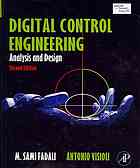
Solution Manual for Digital Control Engineering Analysis and Design 2nd Edition by Antonio Visioli, M Sami Fadali ISBN 0123943914 9780123943910

Original price was: $50.00.$35.00Current price is: $35.00.
Solution Manual for Digital Control Engineering Analysis and Design 2nd Edition by Antonio Visioli, M Sami Fadali – Ebook PDF Instant Download/Delivery: 0123943914, 9780123943910
Full download Solution Manual for Digital Control Engineering Analysis and Design 2nd Edition after payment
Product details:
ISBN 10: 0123943914
ISBN 13: 9780123943910
Author: Antonio Visioli, M Sami Fadali
Fadali and Visioli cover analysis and design of digitally controlled systems and describe applications of digital controls in a wide range of fields. With worked examples and Matlab applications in every chapter and many end-of-chapter assignments, this text provides both theory and practice for those coming to digital control engineering for the first time, whether as a student or practicing engineer.
Extensive Use of computational tools: Matlab sections at end of each chapter show how to implement concepts from the chapter.
Frees the student from the drudgery of mundane calculations and allows him to consider more subtle aspects of control system analysis and design.
An engineering approach to digital controls: emphasis throughout the book is on design of control systems. Mathematics is used to help explain concepts, but throughout the text discussion is tied to design and implementation. For example coverage of analog controls in chapter 5 is not simply a review, but is used to show how analog control systems map to digital control systems.
Review of Background Material: contains review material to aid understanding of digital control analysis and design. Examples include discussion of discrete-time systems in time domain and frequency domain (reviewed from linear systems course) and root locus design in s-domain and z-domain (reviewed from feedback control course).
Inclusion of Advanced Topics
In addition to the basic topics required for a one semester senior/graduate class, the text includes some advanced material to make it suitable for an introductory graduate level class or for two quarters at the senior/graduate level. Examples of optional topics are state-space methods, which may receive brief coverage in a one semester course, and nonlinear discrete-time systems.
Minimal Mathematics Prerequisites
The mathematics background required for understanding most of the book is based on what can be reasonably expected from the average electrical, chemical or mechanical engineering senior. This background includes three semesters of calculus, differential equations and basic linear algebra. Some texts on digital control require more mathematical maturity and are therefore beyond the reach of the typical senior.
Solution Manual for Digital Control Engineering Analysis and Design 2nd Table of contents:
1 Introduction to Digital Control
1.1 why digital control?
1.2 the structure of a digital control system
1.3 examples of digital control systems
1.3.1 closed-loop drug delivery system
1.3.2 computer control of an aircraft turbojet engine
1.3.3 control of a robotic manipulator
resources
2 Discrete-Time Systems
2.1 analog systems with piecewise constant inputs
2.2 difference equations
2.3 the z-transform
2.3.1 z-transforms of standard discrete-time signals
2.3.2 properties of the z-transform
linearity
time delay
time advance
multiplication by exponential
complex differentiation
2.3.3 inversion of the z-transform
long division
partial fraction expansion
2.3.4 the final value theorem
2.4 computer-aided design
2.5 z-transform solution of difference equations
2.6 the time response of a discrete-time system
2.6.1 convolution summation
2.6.2 the convolution theorem
2.7 the modified z-transform
2.8 frequency response of discrete-time systems
2.8.1 properties of the frequency response of discrete-time systems
2.8.2 matlab commands for the discrete-time frequency response
2.9 the sampling theorem
2.9.1 selection of the sampling frequency
resources
problems
computer exercises
3 Modeling of Digital Control Systems
3.1 adc model
3.2 dac model
3.3 the transfer function of the zoh
3.4 effect of the sampler on the transfer function of a cascade
3.5 dac, analog subsystem, and adc combination transfer function
3.6 systems with transport lag
3.7 the closed-loop transfer function
3.8 analog disturbances in a digital system
3.9 steady-state error and error constants
3.9.1 sampled step input
3.9.2 sampled ramp input
3.10 matlab commands
3.10.1 matlab
3.10.2 simulink
resources
problems
computer exercises
4 Stability of Digital Control Systems
4.1 definitions of stability
4.2 stable z-domain pole locations
4.3 stability conditions
4.3.1 asymptotic stability
4.3.2 bibo stability
4.3.3 internal stability
4.4 stability determination
4.4.1 matlab
4.4.2 routh-hurwitz criterion
4.5 jury test
4.6 nyquist criterion
4.6.1 phase margin and gain margin
resources
problems
computer exercises
5 Analog Control System Design
5.1 root locus
5.2 root locus using matlab
5.3 design specifications and the effect of gain variation
5.4 root locus design
5.4.1 proportional control
5.4.2 pd control
5.4.3 pi control
5.4.4 pid control
5.5 empirical tuning of pid controllers
resources
problems
computer exercises
6 Digital Control System Design
6.1 z-domain root locus
6.2 z-domain digital control system design
observation
6.2.1 z-domain contours
6.2.2 proportional control design in the z-domain
6.3 digital implementation of analog controller design
6.3.1 differencing methods
forward differencing
backward differencing
6.3.2 pole-zero matching
6.3.3 bilinear transformation
6.3.4 empirical digital pid controller tuning
6.4 direct z-domain digital controller design
6.5 frequency response design
6.6 direct control design
6.7 finite settling time design
resources
problems
computer exercises
7 State–Space Representation
7.1 state variables
7.2 state–space representation
7.2.1 state–space representation in matlab
7.2.2 linear versus nonlinear state–space equations
7.3 linearization of nonlinear state equations
7.4 the solution of linear state–space equations
7.4.1 the leverrier algorithm
leverrier algorithm
7.4.2 sylvester’s expansion
7.4.3 the state-transition matrix for a diagonal state matrix
properties of constituent matrices
7.4.4 real form for complex conjugate eigenvalues
7.5 the transfer function matrix
7.5.1 matlab commands
7.6 discrete-time state–space equations
7.6.1 matlab commands for discrete-time state–space equations
7.6.2 complex conjugate eigenvalues
7.7 solution of discrete-time state–space equations
7.7.1 z-transform solution of discrete-time state equations
7.8 z-transfer function from state–space equations
7.8.1 z-transfer function in matlab
7.9 similarity transformation
7.9.1 invariance of transfer functions and characteristic equations
resources
problems
computer exercises
8 Properties of State–Space Models
8.1 stability of state–space realizations
8.1.1 asymptotic stability
8.1.2 bibo stability
8.2 controllability and stabilizability
8.2.1 matlab commands for controllability testing
8.2.2 controllability of systems in normal form
8.2.3 stabilizability
8.3 observability and detectability
8.3.1 matlab commands
8.3.2 observability of systems in normal form
8.3.3 detectability
8.4 poles and zeros of multivariable systems
8.4.1 poles and zeros from the transfer function matrix
8.4.2 zeros from state–space models
8.5 state–space realizations
8.5.1 controllable canonical realization
systems with no input differencing
systems with input differencing
8.5.2 controllable form in matlab
8.5.3 parallel realization
parallel realization for mimo systems
8.5.4 observable form
8.6 duality
8.7 hankel realization
resources
problems
computer exercises
9 State Feedback Control
9.1 state and output feedback
9.2 pole placement
9.2.1 pole placement by transformation to controllable form
9.2.2 pole placement using a matrix polynomial
9.2.3 choice of the closed-loop eigenvalues
9.2.4 matlab commands for pole placement
9.2.5 pole placement for multi-input systems
9.2.6 pole placement by output feedback
9.3 servo problem
9.4 invariance of system zeros
9.5 state estimation
9.5.1 full-order observer
9.5.2 reduced-order observer
9.6 observer state feedback
9.6.1 choice of observer eigenvalues
9.7 pole assignment using transfer functions
resources
problems
computer exercises
10 Optimal Control
10.1 optimization
10.1.1 unconstrained optimization
10.1.2 constrained optimization
10.2 optimal control
10.3 the linear quadratic regulator
10.3.1 free final state
10.4 steady-state quadratic regulator
10.4.1 output quadratic regulator
10.4.2 matlab solution of the steady-state regulator problem
10.4.3 linear quadratic tracking controller
10.5 hamiltonian system
10.5.1 eigenstructure of the hamiltonian matrix
resources
problems
computer exercises
11 Elements of Nonlinear Digital Control Systems
11.1 discretization of nonlinear systems
11.1.1 extended linearization by input redefinition
11.1.2 extended linearization by input and state redefinition
11.1.3 extended linearization by output differentiation
11.1.4 extended linearization using matching conditions
11.2 nonlinear difference equations
11.2.1 logarithmic transformation
11.3 equilibrium of nonlinear discrete-time systems
11.4 lyapunov stability theory
11.4.1 lyapunov functions
11.4.2 stability theorems
11.4.3 rate of convergence
11.4.4 lyapunov stability of linear systems
11.4.5 matlab
11.4.6 lyapunov’s linearization method
11.4.7 instability theorems
11.4.8 estimation of the domain of attraction
11.5 stability of analog systems with digital control
11.6 state plane analysis
11.7 discrete-time nonlinear controller design
11.7.1 controller design using extended linearization
11.7.2 controller design based on lyapunov stability theory
11.8 input-output stability and the small gain theorem
11.8.1 absolute stability
resources
problems
computer exercises
12 Practical Issues
12.1 design of the hardware and software architecture
12.1.1 software requirements
12.1.2 selection of adc and dac
12.2 choice of the sampling period
12.2.1 antialiasing filters
12.2.2 effects of quantization errors
12.2.3 phase delay introduced by the zoh
12.3 controller structure
12.4 pid control
12.4.1 filtering the derivative action
12.4.2 integrator windup
12.4.3 bumpless transfer between manual and automatic mode
12.4.4 incremental form
12.5 sampling period switching
12.5.1 matlab commands
People also search for Solution Manual for Digital Control Engineering Analysis and Design 2nd:
solution manual for digital control engineering
digital control system analysis and design solution manual
control techniques digitax
manual solution
q-logic technical manual
Tags: Antonio Visioli, M Sami Fadali, Digital Control, Engineering Analysis