

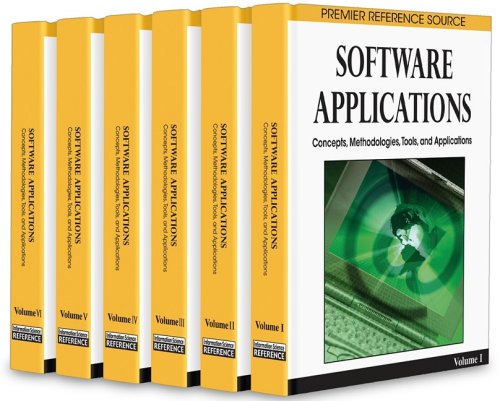
Software Applications Concepts Methodologies Tools and Applications Premier Refence Source 1st Edition by Pierre F Tiako ISBN 1605660612 9781605660615

Original price was: $50.00.$35.00Current price is: $35.00.
Software Applications Concepts Methodologies Tools and Applications Premier Refence Source 1st Edition by Pierre F. Tiako – Ebook PDF Instant Download/Delivery: 1605660612, 9781605660615
Full download Software Applications Concepts Methodologies Tools and Applications Premier Refence Source 1st Edition after payment
Product details:
ISBN 10: 1605660612
ISBN 13: 9781605660615
Author: Pierre F. Tiako
Numerous technological advancements have overwhelmingly redesigned and improved countless aspects of computer software applications, creating tools and functions that greatly benefit its users.
Software Applications: Concepts, Methodologies, Tools, and Applications contains an impressive collection of over 300 authoritative contributions from top influential experts in the field of software applications. This six-volume compilation includes articles by over 400 prominent international scholars in topic areas such as autonomic computing, operating system architectures, and open source software technologies and applications. Software Applications: Concepts, Methodologies, Tools, and Applications presents libraries with an excellent addition to their academic collection.
Table of contents:
Part I: Fundamental Concepts and Theories
-
A Historical Analysis of the Emergence of Free Cooperative Software Production
-
Introduction
-
Software in the History of the Computer Industry
-
The FLOSS Movement as a New Framework to Organize Industrial Cooperation
-
Conclusion
-
References
-
Key Terms
-
-
Free Software Philosophy and Open Source
-
Introduction
-
Sociohistorical Background of Free Software Philosophy
-
Stallman’s Arguments in the GNU Manifesto and Free Software Definition
-
Copyleft: The GPL as Legal and Social Device
-
Free Software as Apolitical Philosophy
-
Political Movement or Development Model? Comparing FS and OS Ideologies
-
Conclusion: FS as a Historical Backdrop of OS
-
References
-
Key Terms
-
Endnotes
-
-
Open Source Software Basics: An Overview
-
Open Source Software at a Glance
-
OSS as a Research Context
-
OSS Literature
-
Conclusion
-
References
-
Appendices: Useful URLs, Further Reading
-
-
Open-Source Software Issues
-
Introduction & Definition
-
Licensing, Business Models, Security, Government Strategies
-
Total Cost of Ownership (TCO)
-
Ethical Arguments
-
Conclusion, References, Key Terms
-
-
Open Source Software: Strengths, Weaknesses, and Evaluation
-
Abstract, Introduction, Background
-
Evaluation Literature
-
Future of OSS Evaluation
-
References, Key Terms, Endnotes
-
-
Public Policies Supporting Free/Open Source Software
-
Introduction, Background
-
Main Focus, Future Trends, Conclusion
-
Acknowledgment, References, Key Terms, Endnotes
-
-
FLOSSmole: A Collaborative Repository for FLOSS Research
-
Abstract, Introduction
-
Problem Background & Solution
-
System Requirements, Design, Results, Limitations
-
Conclusion, Acknowledgment, References, Endnotes
-
-
Free/Libre Open Source Software for Bridging the Digital Divide
-
Introduction: The Forgotten Users
-
FLOSS in Action
-
Democratizing Software Innovation
-
Conclusion, References, Key Terms
-
-
Community of Production
-
Evolution of the Internet: Net95 → Web 2.0 → Internet 2
-
E-Democracy: Social Software Perspective
-
Applications, Limitations, Contexts
-
Conclusion, References, Key Terms
-
-
Software Engineering and HCI
-
Integrated Usability
-
Software Agent Technology
-
Automated Software Testing
-
Software Metrics and Measurements
-
Documentation and Communicability
-
Software Maintenance Data
-
Software Quality Concepts & Agile Development
-
Software Configuration Management and Governance
-
-
Domain-Specific Language and Grid Applications
-
Web Server Performance Analysis
-
Software Modernization & High-Performance Web Applications
-
Semantic Web Service Development
-
Knowledge Management Software
-
Malicious Software & Intrusion Detection Systems
-
Data Mining Software & Intelligent User Preference Mining
-
Mining Software Specifications
Part II: Development and Design Methodologies
-
Ontology-Based Software Modeling & Design Patterns
-
Class Patterns, Component-Based Development, and Motivation
-
Multimodal Modeling and Conceptual Model Driven Software Development
-
Formal Modeling: RTPA, Design Patterns, and Software Agents
-
Learning Management Systems, High-Frequency Trading Software, and Personal Financial Planning Systems
-
ETIPS & Reusable Learning Objects
-
Knowledge Management Systems, Human-Centered Design, and Software Reuse
-
Constructivist Learning in Software Development
-
Service-Oriented Computing and Non-Functional Aspects
-
Free Software Development Methodologies, Agile Outsourcing, and Reuse Frameworks
-
Integrated Product Life Cycle Management, BROOD, and Bug-Fixing Practices
-
Software Architecture Models: Evaluation and Palladio Component Model
Part III: Tools and Technologies
-
Knowledge Management Toolkit & ICT Tools for Software Review
-
SurveyTracker, Text Mining Software, DICOM Tools
-
Tools for Libre Software Projects, Mobile Programming, Software Graphics
-
Ontology Extraction and Model-Driven Software Product-Line Architectures
-
Reverse Engineering & Logic Minimiser
-
Software Agents for Learning Adjustment, Costing Integration, and Game-Based Language Learning
-
VIPER, Pliant-Based Courseware Development Tools
Part IV: Utilization and Application
-
Intelligent Software Agents: Applications, E-Commerce, Semantic Web Integration
-
Electronic Commerce Strategies & IT Industry in Vietnam
-
Travel Support Systems, Online Software Training, and University Classroom Integration
-
Migration of Public Administrations to Open Source Desktop Software
-
Open Source Adoption in Public Sector, Hospitals, and E-Health
-
Patchwork Prototyping, Migration Evaluation, and Adoption Success Studies
-
Media-Centric Knowledge Sharing & Web 2.0
-
Knowledge Sharing in Software Development
-
Digital Library Structure and Software
-
Data Mining Software Comparisons, UML Diagram Usage, ERP Implementation
-
Teaching Operations Management with Enterprise Software
Part V: Organizational and Social Implications
-
Open Source Software Communities & User Communities
-
Social Network Structures in FLOSS Development
-
Ideology and Organizational Adoption of OSS
-
Volunteers in Large Libre Software Projects
-
Social Network Analysis in Community-Driven Projects
-
OSS Business Models & Venture Capital Perspective
-
Open Source in Developing Countries, Outsourcing, and Professional Practices
-
Software Engineering Program Development
-
eLearning and Social Software Usage
Part VI: Managerial Impact
-
Open Source Software and Corporate World
-
Tailoring & Evolutionary Software Development
-
Differentiated Process Support
-
Computer-Aided Software Management in Small Companies
-
Competency Management Software in HR
-
Learning Organizations, CMM, and Agile Practices
-
Project Management with Fuzzy Models
-
Leader Delegation in Virtual Teams
-
Cultural Diversity & Global Software Development
-
Business Process Modeling & Knowledge-Intensive Software Engineering
-
Supply Chain Management Software Comparison
-
e-Entrepreneurship, Channel Optimization, and Revenue Models
-
Knowledge Management and Organizational Performance
Part VII: Critical Issues
-
Object-Oriented Design Quality Improvement
-
Software Quality and the Open Source Process
-
Agile Software Development Quality Assurance
-
Teaching Agile Quality Assurance
-
Software Quality Modeling
-
Software Security Engineering & Trust in Safety-Critical Systems
-
Access Control Specification in UML
-
Ethics in Software Engineering
-
Free Access to Law and OSS
-
Software Piracy Determinants
-
Legal and Economic Justification for Software Protection
-
Trust in Multi-Agent Environments
-
Credibility of Machine Learning Models
-
Morality and Pragmatism in FLOSS
-
Metamorphic Testing of Service-Oriented Software
-
Deductive Semantics and RTPA
-
Measuring Efficiency of FLOSS Projects
-
OSS Licenses via Creative Commons
-
Integration of Libre Software Applications for Collaboration
-
Effects of Process Characteristics on OSS Product Quality
-
GUI Testing Methodology
-
Concept & System Algebra for Software Modeling
-
Cognitive Informatics Reference Model for Autonomous Agents
-
Genetic Algorithm-Based QoS Analysis
-
Fuzzy Logic Classifiers in Quantitative Software Engineering
People also search for:
what are the seven 7 software development methodologies
5 software programs
5 software applications
2 software programs
what is a method in software development
what are the software methodologies
what are software applications examples
Tags: Pierre F Tiako, Software, Applications, Concepts, Methodologies, Tools, Premier, Reference, Source