

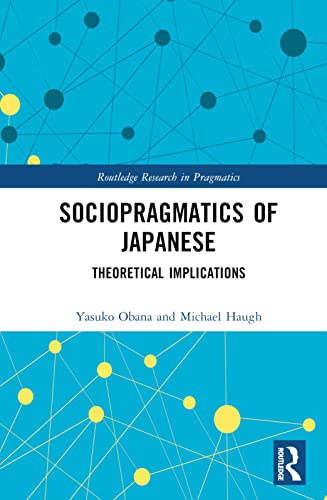
Sociopragmatics of Japanese Theoretical Implications 1st Edition Yasuko Obana, Michael Haugh ISBN 100080271X 9781000802719
Original price was: $50.00.$35.00Current price is: $35.00.
Sociopragmatics of Japanese Theoretical Implications 1st Edition by Yasuko Obana, Michael Haugh – Ebook PDF Instant Download/Delivery: 100080271X, 9781000802719
Full download Sociopragmatics of Japanese Theoretical Implications 1st Edition after payment
Product details:
ISBN 10: 100080271X
ISBN 13: 9781000802719
Author: Yasuko Obana, Michael Haugh
Obana and Haugh question the extent to which commonly accepted theories in pragmatics can readily explain sociopragmatic phenomena in Japanese. Studies of Japanese in pragmatics have often challenged the cross-linguistic relevance of dominant theories. However, they have also inadvertently perpetuated stereotypes about the Japanese. It is often been assumed, for instance, that Japanese people are less strategic, more polite and more reliant on tacit forms of communication than speakers of other languages. But the Japanese are not as polite as one might think. The aim of this book is thus to question those folk assumptions around politeness, impoliteness, irony and indirectness while at the same time emphasizing that close examination of sociopragmatic phenomena in Japanese yields important empirical insights that combat common theoretical assumptions in pragmatics. The content is structured in three parts, in which the authors highlight a key building block of a theory of sociopragmatics. Part I focuses on indexing through the lens of chapters on honorifics, routine formula and politeness strategies. Part II focuses on evaluating through the lens of chapters on giving/receiving expressions and honorific irony. Finally, Part III focuses on relating through the lens of chapters on joint utterances and off record requests. Throughout the chapters the authors draw attention to ways in which these three dimensions are invariably intertwined in various ways. This book is not simply a collection of studies that promotes our understanding of the sociopragmatics of a particular language, but goes deeper and challenges what many have taken for granted in pragmatics. It proposes a framework for exploring sociopragmatic phenomena, building on the key sociopragmatic axes of indexing, evaluating and relating, and offers fresh new perspectives on time-honoured phenomena in pragmatics. It will interest scholars and postgraduate students in pragmatics, particularly those specializing in: politeness, impoliteness, indirectness and irony. The book explains what Japanese terms mean, and all the Japanese examples are morphologically-glossed. Therefore, teachers (and advanced learners) of Japanese at all levels will benefit from the book as it will enrich their knowledge of the Japanese language.
Sociopragmatics of Japanese Theoretical Implications 1st Table of contents:
1 Introduction
1.1 Japanese language and pragmatic theory
1.2 Theorising sociopragmatics
1.3 Data and method
1.4 Aims and overview
Note
Part I Indexing
Introduction to Part I
2 Honorifics
2.1 Introduction
2.2 The classification of honorific forms1
2.3 Conventional honorifics and strategic honorifics
2.3.1 Overview
2.3.2 Conditions for the occurrence of conventional and strategic honorifics
2.3.3 Targets and effects
2.4 Conventional honorifics and politeness strategies – Different types of indexicality
2.4.1 Overview
2.4.2 The linguistic architecture of honorific utterances
2.4.3 Social differences manifested through strategic politeness and honorifics
2.5 Summary
Notes
3 Routine formulae
3.1 Introduction
3.2 The concept of tachiba
3.3 Yoroshiku onegaishimasu – Indexing the speaker’s tachiba entitlement
3.3.1 Overview – The meaning and basic functions of the formula
3.3.2 The formula as a greeting to mark the beginning of a new event or occasion
3.3.3 The formula as part of or standing for requests
3.3.4 The formula as confirmation of request
3.4 Thanking expressions, arigatoo and sumimasen – Assessing one’s perceptive tachiba
3.4.1 Overview
3.4.2 The origin of arigatoo and sumimasen
3.4.3 Thanking, ‘social familiarity’ (shinso), and tachiba domains – Survey results
3.5 Konnichiwa – Indexing the speaker’s sense of territorial familiarity
3.5.1 Overview
3.5.2 Survey results on the use of konnichiwa
3.6 Summary
Notes
4 Politeness strategies
4.1 Introduction
4.2 Prior studies of indirectness and politeness
4.3 The implementation of tachiba in the honorific world
4.3.1 Tachiba domains and (in)direct strategies
4.3.2 Tachiba constraints on juniors in relation to their seniors – The case of praising
4.4 The implementation of tachiba in the non-honorific world
4.5 Tachiba shifts and changes in (in)direct strategies
4.6 Summary
Notes
Part II Evaluating
Introduction to Part II
5 Giving/Receiving expressions
5.1 Introduction
5.2 Previous studies of te-kureru
5.3 Benefactive and neutral uses of te-kureru
5.4 Malefactive uses of te-kureru
5.4.1 Demanding, threatening and accusing the other through imposing one’s expectations
5.4.2 Criticising the other by deliberately degrading oneself
5.4.3 Displaying superiority and contempt by treating the other as inferior
5.5 Summary
Notes
6 Honorific irony
6.1 Introduction
6.2 Previous studies of honorifics in irony
6.3 Propositional and non-propositional types of irony
6.4 Propositional irony – Enhancing irony through honorifics
6.5 Non-propositional irony – Imbalance in and/or around the honorific utterance
6.5.1 Over-polite honorific irony
6.5.2 U-turn honorific irony
6.5.3 Honorific irony in impolite expressions
6.5.4 Discussion – Pragmatic functions of honorific irony
6.6 Rethinking the definition of irony
6.7 Summary
Notes
Part III Relating
Introduction to Part III
7 Joint utterances
7.1 Introduction
7.2 Prior studies of joint utterances
7.3 Joint utterances and participation
7.3.1 Collaborative joint utterances
7.3.2 Co-authored joint utterances
7.3.3 Transformative joint utterances
7.4 Summary
Notes
8 Off-record requests
8.1 Introduction
8.2 Prior research on off-record requests
8.3 Relating in Japanese
8.4 Prompting offers of assistance in Japanese
8.5 Summary
Notes
9 Concluding remarks
9.1 Overview
9.2 Enquiry 1 – Western views in pragmatic research
9.2.1 The status of conventional honorifics in politeness theory
9.2.2 Joint utterances
9.3 Enquiry 2 – Axiomatic concepts in extant theoretical assumptions
9.3.1 Face, its values and FTAs
9.3.2 Directness and indirectness
9.3.3 Formulae – Indebtedness, deferential imposition
9.3.4 Onkei for giving/receiving expressions
9.3.5 The definition of irony
9.4 Concluding remarks
People also search for Sociopragmatics of Japanese Theoretical Implications 1st:
sociopragmatics of japanese theoretical implications
sociopragmatics definition
sociopragmatics
sociopragmatics example
japanese sociolinguistics
Tags: Yasuko Obana, Michael Haugh, Sociopragmatics, Theoretical