

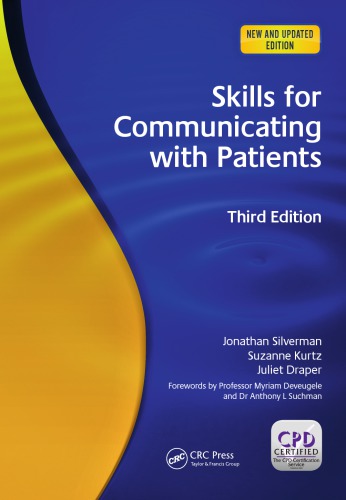
Skills for communicating with patients 3rd Edition by Juliet Draper 1908911162 9781908911162
Original price was: $50.00.$35.00Current price is: $35.00.
Skills for communicating with patients 3rd Edition by Juliet Draper – Ebook PDF Instant Download/DeliveryISBN: 1908911162, 9781908911162
Full download Skills for communicating with patients 3rd Edition after payment.
Product details:
ISBN-10 : 1908911162
ISBN-13 : 9781908911162
Author: Juliet Draper
Skills for Communicating with Patients, Third Edition is one of two companion books on improving communication in medicine, which together provide a comprehensive approach to teaching and learning communication skills throughout all levels of medical education in both specialist and family medicine. Since their publication, the first edition of thi
Skills for communicating with patients 3rd Table of contents:
1 Defining what to teach and learn: an overview of the communication skills curriculum
Introduction
More effective consultations
Improved health outcomes
A collaborative partnership
Plan of chapter
Types of communication skills and how they interrelate
Example 1
Example 2
Example 3
The problem of separating content and process skills in teaching and learning about the medical interview
Confusion over process
Confusion over content
Marrying content and process
An overall curriculum of doctor–patient communication skills
The Calgary–Cambridge Guide (as presented in the 1998 editions of our companion books)
The enhanced Calgary–Cambridge Guides*
Three diagrams: the framework of the enhanced Calgary–Cambridge Guides
The basic framework
The expanded framework
An example of the interrelationship between content and process
Calgary–Cambridge Guides: communication process skills
CALGARY–CAMBRIDGE GUIDES COMMUNICATION PROCESS SKILLS
Initiating the session
Preparation
Establishing initial rapport
Identifying the reason(s) for the consultation
Gathering information
Exploration of patient’s problems
Additional skills for understanding the patient’s perspective
Providing structure to the consultation
Making organisation overt
Attending to flow
Building relationship
Using appropriate non-verbal behaviour
Developing rapport
Involving the patient
Explanation and planning
Providing the correct amount and type of information
Aiding accurate recall and understanding
Achieving a shared understanding: incorporating the patient’s perspective
Planning: shared decision making
Closing the session
Forward planning
Ensuring appropriate point of closure
Options in explanation and planning (includes content and process skills)
If discussing opinion and significance of problem
If negotiating mutual plan of action
If discussing investigations and procedures
Calgary–Cambridge Guides: communication content
The need for a clear overall structure
Choosing the process skills to include in the communication curriculum
The research and theoretical basis that validates the inclusion of each individual skill
Underlying goals and principles of communication that helped in choosing the skills
Skills and individuality
Relating specific issues to core communication skills
Summary
2 Initiating the session
Introduction
Problems in communication
Objectives
Skills
‘What’ to teach and learn about the initiation: the evidence for the skills
PREPARATION
ESTABLISHING INITIAL RAPPORT
Greeting the patient and introducing yourself
Clarifying your role and the nature of the interview
Obtaining the patient’s name
Demonstrating interest and respect, attending to the patient’s physical comfort
IDENTIFYING THE REASON(S) FOR THE CONSULTATION
The opening question
New consultations
Follow-up visits
Listening to the patient’s opening statement
Learning how to listen at the beginning of the consultation is the first step to an efficient and accurate consultation
Listening rather than questioning allows doctors and patients to achieve more of their objectives for this part of the consultation
What is the evidence to support listening?
What are the specific skills of attentive listening?
What are the advantages of attentive listening?
Screening
The balance between listening and screening
Agenda setting
Summary
3 Gathering information
Introduction
Problems in communication
Objectives
The content of information gathering in medical interviews
The traditional medical history
Origins of the traditional method
Strengths
Weaknesses
The disease–illness model
Definition of disease and illness
Why doctors need to explore both perspectives
An alternative template for the content of the information-gathering section of the interview
The biomedical perspective
The patient’s perspective
Background information: context
The process skills of information gathering
Exploration of the Patient’s Problems
Questioning techniques
What are open and closed questions?
When should we use open and closed methods: the open-to-closed cone
What are the advantages of open questioning techniques?
Why is it important to move from open to closed questioning techniques?
What is the evidence for the value of open and closed questioning techniques?
Eliciting the patient’s narrative
Attentive listening
Facilitative response
Encouragement
Use of silence
Repetition or echoing
Paraphrasing
Sharing your thoughts
What is the theoretical evidence for facilitation?
Picking up verbal and non-verbal cues
Clarification of the patient’s story
Internal summary
Accuracy
Facilitation
Language
Additional Skills for Understanding the Patient’s Perspective
What is the evidence to support exploring the patient’s perspective of their illness?
Anthropological and cross-cultural studies
Outcome studies
Satisfaction and compliance studies
Understanding and recall studies
Are patient-centred interviews longer?
How to discover the patient’s perspective
Picking up and checking out cues
Asking specifically about the patient’s illness perspective
Feelings
Effect on life
Putting The Process Skills of Information Gathering together
The continuum of open to closed questioning techniques
The complete versus the focused history in information gathering
The effect of clinical reasoning on the process of information gathering
More advanced hypothetico-deductive reasoning
Schema-driven approach
Pattern recognition
How do these different clinical reasoning approaches influence the process of information gathering?
Summary
4 Providing structure to the interview
Introduction
Objectives
Skills
‘What’ to teach and learn about providing structure: the evidence for the skills
Making Organisation Overt
Summarising
What is summarising?
Why is internal summary a key skill in structuring the consultation?
What is the evidence for the value of summarising in the medical interview?
Signposting
What is signposting?
Attending to Flow
Sequencing
Timing
Summary
5 Building the relationship
Introduction
Problems in communication
Objectives
Skills
‘What’ to teach and learn about building the relationship: the evidence for the skills
Using Appropriate Non-Verbal Communication
What is the difference between verbal and non-verbal communication?
Why understanding non-verbal communication can make a difference in the consultation
What is the research evidence that non-verbal communication makes a difference to the consultation?
What then are the lessons for physicians?
Reading the non-verbal cues of patients
Transmitting your own non-verbal cues
Use of notes and computers
Developing Rapport
Acceptance
The accepting response
Functions of the accepting response
Skills of the accepting response
Responding to overt feelings and emotions
Responding to indirectly expressed feelings and emotions
Acceptance is not agreement
The problem of premature reassurance
Empathy
Understanding the patient’s predicament and feelings
Communicating empathy to the patient
Support
What is the research evidence that rapport-building skills make a difference to the medical consultation?
Involving the Patient
Sharing of thoughts
Providing rationale
Summary
6 Explanation and planning
Introduction
Problems in communication
Are there problems with the amount of information that doctors give?
Are there problems with the type of information that doctors give?
Can patients understand the language that doctors use?
Do patients recall and understand the information that we give?
Are patients involved in decision making and to the level that they would wish?
Do patients comply or adhere to the plans that we make?
Are there problems in the teaching and learning of explanation and planning in medical education?
Are these problems improving with time?
How does all of this relate to the growing field of health literacy?
Objectives
The content of explanation and planning
The process skills of explanation and planning
Communication process skills: the evidence
Providing the Correct Amount and Type of Information
Do patients and doctors disagree over the amount of information that should be imparted?
The traditional view of the doctor–patient relationship
An unbridgeable competence gap
The emotional nature of illness
Professional authority
Why has modern research been misinterpreted as confirming the traditional stereotype of information giving?
Early studies of recall of information
More recent studies
Confirmation of prejudices
What recent trends in society have influenced medical information giving?
Changes in society
Changes in medicine
Patient autonomy
What is the research evidence to suggest that giving more information is helpful?
Do all patients want more information?
What skills can learners use to help gauge the correct amount and type of information to give to each individual patient?
Chunking and checking
Assessing the patient’s starting point
Asking patients what other information would be helpful
Giving explanation at appropriate times
Aiding Accurate Recall and Understanding
Ley’s research into patient recall
Categorisation: an example of signposting
Labelling important information: another example of signposting
Chunking and checking
Repetition
Language
Making explanations or advice specific enough for the patient to understand or act upon
Using visual methods of conveying information
Achieving a Shared Understanding – Incorporating the Patient’s Perspective
Tuckett and colleagues’ research into patient understanding
The methodology of Tuckett and colleagues
What does the research of Tuckett and colleagues show about the information given by doctors?
What does the research of Tuckett and his colleagues show about the influence patients can have on their doctors’ information giving?
What are the combined effects of patients’ and doctors’ approaches to patient involvement in information giving?
Can doctors and patients more positively influence each other towards a shared understanding in information giving?
Does the research of Tuckett et al. about recall fit in with previous work?
Was correct sense made of the explanations?
Were patients committed to the doctor’s view?
What are the main conclusions of Tuckett and colleagues?
Other work to support shared understanding
What skills can we recommend to help learners achieve a shared understanding with their patients?
Relating explanations to the patient’s perspective
Providing opportunities and encouraging the patient to contribute
Picking up verbal and non-verbal cues
Eliciting the patient’s beliefs, reactions and concerns
Planning – Shared Decision Making
Theoretical concepts behind shared decision making
The mutuality model
The shared decision-making model
From compliance to concordance
The research evidence to support shared decision making
Do all patients want to be involved in shared decision making?
What skills can we recommend to learners to help them achieve shared decision making in planning?
Sharing own thinking as appropriate: ideas, thought processes and dilemmas
Involving the patient
Offering suggestions and choices rather than directives
Encouraging the patient to contribute their ideas and suggestions
Exploring management options with the patient
Risk communication
Decision aids
Establishing the level of involvement the patient wishes
Negotiating a mutually acceptable plan
Signposting position of equipoise or own preferences
Establishing the patient’s preferences
Negotiating differences
Checking with the patient
Options in Explanation and Planning
If offering opinion and discussing significance of problems
If negotiating a mutual plan of action
Discussing and offering options in management and treatment
Providing information on action or treatment offered
Obtaining the patient’s view of need for action, perceived benefits, barriers and motivation
Motivational interviewing
Accepting patient’s views and advocating an alternative viewpoint as necessary
Challenging and confronting patients
If discussing investigations and procedures
Summary: explanation and planning is an interactive process
7 Closing the session
Introduction
Objectives
The process skills for closing the session
‘What’ to teach and learn about endings: the evidence for the skills
What actually happens in the closing section of the interview?
What behaviours earlier in the visit prevent new problems from arising during closure?
What communication skills can we recommend in the earlier sections of the consultation that will aid efficient and satisfactory closure of the session?
What behaviours during closure are associated with inefficient endings?
What are the specific elements of closure itself (see Box 7.1)?
Forward planning
Contracting
Safety-netting
Ensuring appropriate point of closure
End summary
Final checking
Summary
8 Relating specific issues to core communication skills
Introduction
Specific issues
Breaking bad news
Key skills of the Calgary–Cambridge Guides to apply with greater depth, intention and intensity
Cultural and social diversity
Common issues and barriers in cross-cultural communication and social diversity
Key skills of the Calgary–Cambridge Guides that need applying with greater depth, intention and intensity
Age-related issues
Communicating with older patients
Key skills of the Calgary–Cambridge Guides to apply with greater depth, intention and intensity
Communicating with children and parents
Key skills of the Calgary–Cambridge Guides that need applying with greater depth, intention and intensity
The telephone interview
Key skills of the Calgary–Cambridge Guides that need applying with greater depth, intention and intensity
Patients with mental illness
Uncovering hidden depression and assessing suicidal risk
Key skills of the Calgary–Cambridge Guides that need applying with greater depth, intention and intensity
The psychotic patient
Key skills of the Calgary–Cambridge Guides that need applying with greater depth, intention and intensity
Examples of specific phrasing
The open-to-closed cone
Empathy without collusion
Combining advocacy and support with challenge
Gathering information from others
Interviewing the older patient with mental illness
Medically unexplained symptoms
Other communication issues
Further reading
People also search for Skills for communicating with patients 3rd:
skills for communicating with patients pdf
skills for communicating with patients (3rd ed.)
skills for communicating with patients 3rd edition
skills for communicating with patients 4th edition
skills for communicating with patients book
Tags: Skills, communicating, patients, Juliet Draper, Patients, companion books, communication