

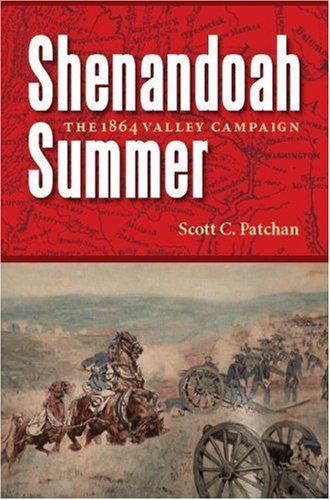
Shenandoah Summer The 1864 Valley Campaign 1st Edition by Scott C Patchan ISBN 0803218869 978-0803218864

Original price was: $50.00.$35.00Current price is: $35.00.
Shenandoah Summer The 1864 Valley Campaign 1st Edition by Scott C.Patchan – Ebook PDF Instant Download/Delivery:0803218869 ,978-0803218864
Full download Shenandoah Summer The 1864 Valley Campaign 1st Edition after payment
Product details:
ISBN 10:0803218869
ISBN 13: 978-0803218864
Author:Scott C.Patchan
Jubal A. Early’s disastrous battles in the Shenandoah Valley ultimately resulted in his ignominious dismissal. But Early’s lesser-known summer campaign of 1864, between his raid on Washington and Phil Sheridan’s renowned fall campaign, had a significant impact on the political and military landscape of the time. By focusing on military tactics and battle history, Scott C. Patchan uncovers the facts and actions of these little-understood battles and offers a new perspective on Early’s contributions to the Confederate war effort—and to Union battle plans and politicking.
Patchan details previously unexplored battles at Rutherford’s Farm and Kernstown (a pinnacle of Confederate operations in the Shenandoah Valley). He examines the campaign’s influence on President Lincoln’s reelection efforts and provides insights into the personalities, careers, and roles in Shenandoah of Confederate General John C. Breckinridge, Union General George Crook, and Union Colonel James A. Mulligan, with his “fighting Irish” brigade from Chicago. Finally, Patchan reconsiders the ever-colorful and controversial Early himself, whose importance in the Confederate military pantheon this book at last makes clear.
Table of contents:
Introduction
In the summer of 1864, Confederate Lt. Gen. Jubal Anderson Early’s successes in the Shenandoah Valley of Virginia caught Gen. Ulysses S. Grant off guard. They forced the Union commander to reallocate substantial military resources to quell the wily Virginian. This dedication of assets to the Shenandoah Valley hampered Grant’s operations against Gen. Robert E. Lee’s Army of Northern Virginia at Petersburg. The Confederate victories in the valley spelled political trouble for President Abraham Lincoln’s reelection hopes. Each Union defeat and an ever-growing casualty list diminished his chances.
Although a secondary theater of war, actions in the Shenandoah Valley radiated…
1. The Most Successful Expedition: Retreat from Washington,
So boasted Lt. Gen. Jubal Anderson Early after his Confederate army successfully raided Maryland and threatened the Federal capital in the early part of July 1864. Indeed, admitted Secretary of the Navy Gideon Welles, Lincoln showed signs of anxiety and soon became “enjoined to silence, while [Chief of Staff Henry W.] Halleck is in a perfect maze, without intelligent decision or self-reliance, and [Secretary of War Edwin M.] Stanton is wisely ignorant.” Although the immediate threat to Washington would soon recede, the eccentric but cunning Jubal Early would haunt Lincoln throughout that summer.
2. Who Has the Management: Union Pursuit
Although Jubal Early was back in Virginia, the ingredients for a Confederate setback were unwittingly falling into place. On the same day that Early arrived in front of Washington, July 11, the vanguard of Maj. Gen. David Hunter’s jaded Army of West Virginia reached Martinsburg, West Virginia, in Jubal’s rear. The balance of that army lay strung out between Cumberland, Maryland, and Parkersburg, West Virginia, and it would be more than ten days before the Army of West Virginia was completely reunited.
3. But Little Is Expected from Our Pursuit: Loudoun Valley to the Blue Ridge
In the cool morning air of July 16, Maj. Gen. Horatio Wright’s Sixth Corps decamped at Poolesville and moved to assist the Army of West Virginia. Two Sixth Corps divisions, the advance of the Nineteenth Corps and Col. Charles R. Lowell’s cavalry, in all no more than 12,000 troops, crossed the Potomac at Conrad’s Ferry.
4. Whipped Most Awfully: The Battle of Cool Spring
On July 18, Gen. George Crook determined that Jubal Early would not slip away as he had on the sixteenth. The Ohioan notified Gen. David Hunter that “he [Crook] intended to move forward and attack the rebels at Snickers Ferry.” Crook’s message reveals his aggressive approach toward his mission at Snickers Gap. The dispatch contained no qualifiers such as Horatio Wright’s “if practicable.”
5. The Panic Was Over: The Battle of Cool Spring
At first glance, the relative positions of Thoburn and Rodes offered a seeming advantage to the Confederates, who held the high ground and could fire down at the Federals on the riverbank. Yet, the stone wall and road cut behind it sheltered Thoburn’s men from Rodes’s rifle fire. Archaeological studies have located the stone wall on the immediate edge of the floodplain.
6. Rock Them Like All Creation: Berry’s Ferry and Kabletown
At Harpers Ferry on July 18, Hunter waited for information from Wright and Crook. Hoping to play a constructive role in the campaign, Hunter dispatched an infantry brigade to harass Jubal Early’s northern flank and rear from the Charlestown/Harpers Ferry area from his limited available force.
7. A Miracle of Execution: The Battle of Rutherford’s Farm
As the eastern sky grew orange hailing in another hot, humid day in the Shenandoah Valley, Stephen D. Ramseur’s tired veterans trudged into Winchester on the morning of July 20, 1864. They filed through town and stopped two miles north of it where they lay down in an orchard and fell fast asleep, exhausted by their night march from Berryville.
8. The Object of the Expedition Accomplished: Wright Leaves the Valley
Over at Snickers Gap, Horatio Wright had failed to detect Jubal Early’s departure from the Berryville area on the night of July 19. At sunrise on July 20, Wright ordered a reconnaissance across the Shenandoah River, assigning the task to Capt. Elisha Hunt Rhodes’s 2nd Rhode Island and Col. Oliver Edward’s 37th Massachusetts.
9. A Cavalry Scare: Prelude to Kernstown
July 23, 1864, dawned a cool and pleasant day in the Shenandoah Valley. Jubal Early’s footsore infantrymen used the respite to rest and nourish their tired, aching bodies. Some Southern soldirs simply relished a day of “undisturbed tranquility” on Fisher’s Hill.
10. Attack the Enemy at Once: The Second Battle of Kernstown
Generals Vaughn and Bradley Johnson arrived at Jubal Early’s headquarters with the surprising news that only George Crook’s small army remained in the Shenandoah Valley. Both cavalrymen urged Early to attack, saying, “Let us go in their rear [and] thrash them.”
11. A Perfect Stampede: The Second Battle of Kernstown
James Mulligan galloped back to the Pritchard farm where his division waited, passing by the 13th West Virginia along the way. His flair for the dramatic and his charismatic bearing radiated even amid the smoke and chaos of battle.
12. Bull Run Was Nothing in Comparison: Retreat to the Potomac
With the Union infantry on the run, Jubal Early hoped to capture or destroy “the greater part” of George Crook’s army. John Imboden and Mudwall Jackson advanced down the Cedar Creek Grade and Middle Roads, while John McCausland, Bradley Johnson, and John Vaughn took the Front Royal Road.
13. Defeat Was a Matter of Course: The Second Battle of Kernstown Analysis
“History talks about a Second Battle of Kernstown, but the shades of bluff old General Shields and of that pious fighter Stonewall Jackson might blush at the statement,” wrote John T. Duff, a newspaperman and veteran of the 1st West Virginia Infantry thirty-six years after the battle.
14. Burn the Entire Town: McCausland’s Chambersbrg Raid
At Valley District Headquarters on July 25, Jubal Early crafted plans for Brig. Gen. John C. McCausland to lead a cavalry raid into western Maryland and Pennsylvania. This would be no ordinary raid.
15. Like a Fiery Meteor: The Battle of Moorefield
Although John McCausland could have escaped into the Shenandoah Valley and safely rejoined Jubal Early’s army, he elected to carry out Jubal’s orders to “Break up the [Baltimore and Ohio Railroad] establishment at New Creek [now Keyser, West Virginia] and burn all the bridges within reach.”
16. L’Envoi: Conclusion
In late July of 1864, Jubal Early’s successful campaigns in the Shenandoah Valley altered the course of the war in Virginia and impacted political developments in the North.
People also search for:
shenandoah valley campaign significance
valley campaigns of 1864
shenandoah valley campaign summary
the shenandoah valley campaign of 1864
1864 shenandoah valley campaign
Tags: Scott C Patchan, Shenandoah, Summer