

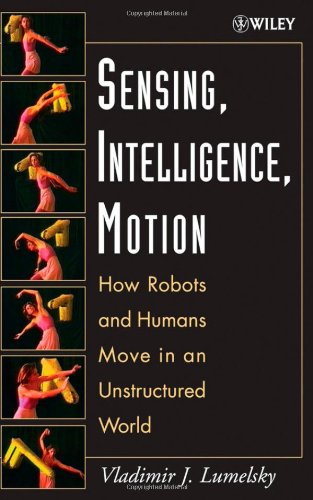
Sensing Intelligence Motion How Robots and Humans Move in an Unstructured World 1st Edition by Vladimir J Lumelsky ISBN 0471707406 9780471707400


Original price was: $50.00.$35.00Current price is: $35.00.
Sensing Intelligence Motion How Robots and Humans Move in an Unstructured World 1st Edition by Vladimir J Lumelsky – Ebook PDF Instant Download/Delivery: 0471707406, 9780471707400
Full download Sensing Intelligence Motion How Robots and Humans Move in an Unstructured World 1st Edition after payment
Product details:
ISBN 10: 0471707406
ISBN 13: 9780471707400
Author: Vladimir J Lumelsky
Sensing Intelligence Motion How Robots and Humans Move in an Unstructured World 1st Table of contents:
-
Motion Planning—Introduction
-
1.1 Introduction
-
1.2 Basic Concepts
-
1.2.1 Robot? What Robot?
-
1.2.2 Space. Objects.
-
1.2.3 Input Information. Sensing.
-
1.2.4 Degrees of Freedom. Coordinate Systems.
-
1.2.5 Motion Control
-
1.2.6 Robot Programming
-
1.2.7 Motion Planning
-
-
-
A Quick Sketch of Major Issues in Robotics
-
2.1 Kinematics
-
2.2 Statics
-
2.3 Dynamics
-
2.4 Feedback Control
-
2.5 Compliant Motion
-
2.6 Trajectory Modification
-
2.7 Collision Avoidance
-
2.8 Motion Planning with Complete Information
-
2.9 Motion Planning with Incomplete Information
-
2.9.1 The Beginnings
-
2.9.2 Maze-to-Graph Transition
-
2.9.3 Sensor-Based Motion Planning
-
-
2.10 Exercises
-
-
Motion Planning for a Mobile Robot
-
3.1 The Model
-
3.2 Universal Lower Bound for the Path Planning Problem
-
3.3 Basic Algorithms
-
3.3.1 First Basic Algorithm: Bug1
-
3.3.2 Second Basic Algorithm: Bug2
-
-
3.4 Combining Good Features of Basic Algorithms
-
3.5 Going After Tighter Bounds
-
3.6 Vision and Motion Planning
-
3.6.1 The Model
-
3.6.2 Algorithm VisBug-21
-
3.6.3 Algorithm VisBug-22
-
-
3.7 From a Point Robot to a Physical Robot
-
3.8 Other Approaches
-
3.9 Which Algorithm to Choose?
-
3.10 Discussion
-
3.11 Exercises
-
-
Accounting for Body Dynamics: The Jogger’s Problem
-
4.1 Problem Statement
-
4.2 Maximum Turn Strategy
-
4.2.1 The Model
-
4.2.2 Sketching the Approach
-
4.2.3 Velocity Constraints. Minimum Time Braking
-
4.2.4 Optimal Straight-Line Motion
-
4.2.5 Dynamics and Collision Avoidance
-
4.2.6 The Algorithm
-
4.2.7 Examples
-
-
4.3 Minimum Time Strategy
-
4.3.1 The Model
-
4.3.2 Sketching the Approach
-
4.3.3 Dynamics and Collision Avoidance
-
4.3.4 Canonical Solution
-
4.3.5 Near-Canonical Solution
-
4.3.6 The Algorithm
-
4.3.7 Convergence. Computational Complexity
-
4.3.8 Examples
-
-
-
Motion Planning for Two-Dimensional Arm Manipulators
-
5.1 Introduction
-
5.1.1 Model and Definitions
-
-
5.2 Planar Revolute–Revolute (RR) Arm
-
5.2.1 Analysis
-
5.2.2 Algorithm
-
5.2.3 Step Planning
-
5.2.4 Example
-
5.2.5 Motion Planning with Vision and Proximity Sensing
-
5.2.6 Concluding Remarks
-
-
5.3 Distinct Kinematic Configurations of RR Arm
-
5.4 Prismatic–Prismatic (PP, or Cartesian) Arm
-
5.5 Revolute–Prismatic (RP) Arm with Parallel Links
-
5.6 Revolute–Prismatic (RP) Arm with Perpendicular Links
-
5.7 Prismatic–Revolute (PR) Arm
-
5.8 Topology of Arm’s Free Configuration Space
-
5.8.1 Workspace; Configuration Space
-
5.8.2 Interaction Between the Robot and Obstacles
-
5.8.3 Uniform Local Connectedness
-
5.8.4 The General Case of 2-DOF Arm Manipulators
-
-
5.9 Appendix
-
5.10 Exercises
-
-
Motion Planning for Three-Dimensional Arm Manipulators
-
6.1 Introduction
-
6.2 The Case of the PPP (Cartesian) Arm
-
6.2.1 Model, Definitions, and Terminology
-
6.2.2 The Approach
-
6.2.3 Topology of W-Obstacles and C-Obstacles
-
6.2.4 Connectivity of C
-
6.2.5 Algorithm
-
6.2.6 Examples
-
-
6.3 Three-Link XXP Arm Manipulators
-
6.3.1 Robot Arm Representation Spaces
-
6.3.2 Monotonicity of Joint Space
-
6.3.3 Connectivity of Jf
-
6.3.4 Retraction of Jf
-
6.3.5 Configuration Space and Its Retract
-
6.3.6 Connectivity Graph
-
6.3.7 Lifting 2D Algorithms into 3D
-
6.3.8 Step Planning
-
6.3.9 Discussion
-
-
6.4 Other XXX Arms
-
-
Human Performance in Motion Planning
-
7.1 Introduction
-
7.2 Preliminary Observations
-
7.2.1 Moving in a Maze
-
7.2.2 Moving an Arm Manipulator
-
7.2.3 Conclusions and Plan for Experiment Design
-
-
7.3 Experiment Design
-
7.3.1 The Setup
-
7.3.2 Test Protocol
-
-
7.4 Results—Experiment One
-
7.4.1 Principal Components Analysis
-
7.4.2 Nonparametric Statistics
-
7.4.3 Univariate Analysis of Variance
-
7.4.4 Two-Way Analysis of Variance
-
7.4.5 Implementation: Two-Way Analysis for Path Length
-
7.4.6 Implementation: Two-Way Analysis for Completion Time
-
-
People also search for Sensing Intelligence Motion How Robots and Humans Move in an Unstructured World 1st:
how do robots sense their environment
sensing and perception robotics
sensing machines how sensors shape our everyday life
robotic sensing and manipulation
a robot that can sense changes in the environment is
Tags: Vladimir J Lumelsky, Sensing Intelligence, Robots, Unstructured World