

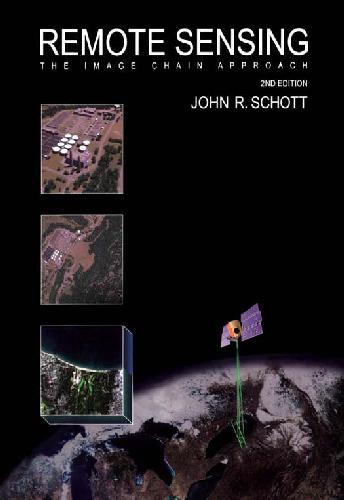
Remote Sensing The Image Chain Approach 2nd Edition by John Schott ISBN 0195178173 978-0195178173


Original price was: $50.00.$35.00Current price is: $35.00.
Remote Sensing The Image Chain Approach 2nd Edition by John Schott – Ebook PDF Instant Download/Delivery: 0195178173, 978-0195178173
Full download Remote Sensing The Image Chain Approach 2nd edition after payment
Product details:
ISBN 10: 0195178173
ISBN 13: 978-0195178173
Author: John Schott
Remote Sensing deals with the fundamental ideas underlying the rapidly growing field of remote sensing. John Schott explores energy-matter interaction, radiation propagation, data dissemination, and described the tools and procedures required to extract information from remotely sensed data using the image chain approach. Organizations and individuals often focus on one aspect of the remote sensing process before considering it as a whole, thus investigating unjustified effort, time, and expense to get minimal improvement. Unlike other books on the subject, Remote Sensing treats the process as a continuous flow. Schott examines the limitations obstructing the flow of information to the user, employing numerous applications of remote sensing to earth observation disciplines. For this second edition, in addition to a thorough update, there are major changes and additions, such as a much more complete treatment of spectroscopic imaging, which has matured dramatically in the last ten years, and a more rigorous treatment of image processing with an emphasis on spectral image processing algorithms. Remote Sensing is an ideal first text in remote sensing for advanced undergraduate and graduate students in the physical or engineering sciences, and will also serve as a valuable reference for practitioners.
Remote Sensing The Image Chain Approach 2nd Table of contents:
CHAPTER 1 INTRODUCTION
1.1 WHAT IS REMOTE SENSING (AS FAR AS WE’RE CONCERNED)?
1.2 WHY REMOTE SENSING?
1.3 WHAT KINDS OF REMOTE SENSING?
1.4 THE IMAGE CHAIN APPROACH
1.5 REFERENCES
CHAPTER 2 HISTORICAL PERSPECTIVE AND PHOTO MENSURATION
2.1 PHOTO INTERPRETATION
2.2 QUANTITATIVE ANALYSIS OF AIR PHOTOS
2.2.1 Photogrammetry
2.2.2 Camera as a Radiometer
2.3 EVOLUTION OF EO SYSTEMS
2.4 SPACE-BASED EO SYSTEMS
2.5 DIGITAL CONCEPTS
2.6 REFERENCES
CHAPTER 3 RADIOMETRY AND RADIATION PROPAGATION
3.1 ENERGY PATHS
3.1.1 Solar Energy Paths
3.1.2 Thermal Energy Paths
3.2 RADIOMETRIC TERMS
3.2.1 Definition of Terms
3.2.2 Blackbody Radiators
3.2.3 Polarization Concepts
3.3 RADIOMETRIC CONCEPTS
3.3.1 Inverse-Square Law for Irradiance from a Point Source
3.3.2 Projected Area Effects (cos θ)
3.3.3 Lambertian Surfaces
3.3.4 Magic π
3.3.5 Lens Falloff
3.4 ATMOSPHERIC PROPAGATION
3.4.1 Atmospheric Absorption
3.4.2 Atmospheric Scattering
3.5 CHARACTERISTICS OF THE EM SPECTRUM
3.6 REFERENCES
CHAPTER 4 THE GOVERNING EQUATION FOR RADIANCE REACHING THE SENSOR
4.1 IRRADIANCE ONTO THE EARTH’S SURFACE
4.1.1 Solar Irradiance
4.1.2 Downwelled Radiance (Skylight)
4.1.3 Reflected Background Radiance
4.2 REFLECTED SOLAR IRRADIANCE AND BIDIRECTIONAL REFLECTANCE
4.2.1 Ways to Characterize Reflectance
4.2.2 Reflected Solar Radiance
4.3 SOLAR RADIANCE REACHING THE SENSOR
4.3.1 Solar Scattered Upwelled Radiance (Path Radiance)
4.3.2 Cumulative Solar Effects
4.3.3 Multiple Scattering and Nonlinearity Effects
4.4 THERMAL RADIANCE REACHING THE SENSOR
4.4.1 Self-Emission
4.4.2 Thermal Emission from the Sky and Background Reflected to the Sensor
4.4.3 Self-Emitted Component of Upwelled Radiance
4.5 INCORPORATION OF SENSOR SPECTRAL RESPONSE
4.6 SIMPLIFICATION OF THE BIG EQUATION AND RELATIVE MAGNITUDE ASSESSMENT
4.6.1 Simplification
4.6.2 Sensitivity Analysis—Error Propagation
4.7 REFERENCES
CHAPTER 5 SENSING SYSTEMS
5.1 CAMERAS AND FILM SYSTEMS
5.1.1 Irradiance onto the Focal Plane
5.1.2 Sensitometric Analysis
5.2 SIMILARITIES BETWEEN SIMPLE CAMERAS AND MORE EXOTIC ELECTRO-OPTICAL IMAGING SYSTEMS
5.2.1 Optics and Irradiance at the Focal Plane
5.2.2 System Characterization
5.3 DETECTORS AND SENSOR PERFORMANCE SPECIFICATIONS
5.3.1 Detector Types
5.3.2 Detector Figures of Merit
5.3.3 Sensor Performance Parameters
5.4 DETECTOR-SENSOR PERFORMANCE CALCULATIONS
5.5 REFERENCES
CHAPTER 6 IMAGING SENSORS AND INSTRUMENTICALIBRATION
6.1 SINGLE-CHANNEL AND MULTISPECTRAL SENSORS
6.1.1 Line Scanners
6.1.2 Whisk-Broom and Bow-Tie Imagers
6.1.3 Push-Broom Sensors
6.1.4 Framing (2-D) Arrays
6.2 IMAGING SPECTROMETERS
6.2.1 Imaging Spectrometer Issues
6.2.2 Agile Spectrometers
6.3 LUMINESCENCE SENSORS
6.4 CALIBRATION ISSUES
6.5 SENSOR CASE STUDY
6.6 REFERENCES
CHAPTER 7 ATMOSPHERIC COMPENSATION: SOLUTIONS TO THE GOVERNING EQUATION
7.1 TRADITIONAL APPROACH: CORRELATION WITH GROUND-BASED MEASUREMENTS
7.2 APPROACHES TO ATMOSPHERIC COMPENSATION
7.3 APPROACHES TO MEASUREMENT OF TEMPERATURE
7.3.1 Ground Truth Methods (Temperature)
7.3.2 In-Scene Compensation Techniques (Temperature)
7.3.3 Atmospheric Propagation Models (Temperature)
7.3.4 Emissivity
7.3.5 Summary of Thermal Atmospheric Compensation
7.4. APPROACHES TO MEASUREMENT OF REFLECTIVITY
7.4.1 Ground Truth Methods (Reflectance), a.k.a. Empirical Line Method (ELM)
7.4.2 In-Scene Methods (Reflectance)
7.4.3 Atmospheric Propagation Models (Reflectance)
7.5 RELATIVE CALIBRATION (REFLECTANCE)
7.5.1 Spectral Ratio Techniques
7.5.2 Scene-to-Scene Normalization
7.6 COMPENSATION OF IMAGING SPECTROMETER DATA FOR ATMOSPHERIC EFFECTS
7.6.1 Inversion to Reflectance
7.6.2 Spectral Polishing
7.7 SUMMARY OF ATMOSPHERIC COMPENSATION ISSUES
7.8 REFERENCES
CHAPTER 8 DIGITAL IMAGE PROCESSING PRINCIPLES
8.1 POINT PROCESSING
8.2 NEIGHBORHOOD OPERATIONS-KERNEL ALGEBRA
8.3 STRUCTURE OR TEXTURE MEASURES
8.4 GLOBAL OPERATIONS
8.5 IMAGE RESTORATION
8.6 REFERENCES
CHAPTER 9 MULTISPECTRAL REMOTE SENSING ALGORITHMS: LAND COVER CLASSIFICATION
9.1 REVIEW OF MATRIX METHODS
9.1.1 Vector Algebra
9.1.2 Matrix Algebra
9.1.3 Eigenvectors and Singular Value Decomposition (SVD)
9.2 IMAGE CLASSIFICATION
9.2.1 Supervised Classification of a Single-Band Image
9.2.2 Supervised Multispectral Image Classification
9.2.3 Unsupervised Multivariate Classifier
9.2.4 Multivariate Classification Using Texture Metrics
9.2.5 Evaluation of Class Maps
9.2.6 Limitations of Conventional Multispectral Classification
9.3 IMAGE TRANSFORMS
9.4 HIERARCHICAL IMAGE PROCESSING
9.5 REFERENCES
CHAPTER 10 SPECTROSCOPIC IMAGE ANALYSIS
10.1 PERSPECTIVES ON SPECTRAL DATA
10.1.1 The Geometric or Deterministic Perspective
10.1.2 The Statistical Perspective
10.1.3 Spectral Feature Representation
10.2 ISSUES OF DIMENSIONALITY AND NOISE
10.2.1 Dimensionality Reduction
10.2.2 Noise Characterization: Noise versus Clutter
10.2.3 Noise-Sensitive Dimensionality Reduction
10.2.4 Estimation of the Dimensionality of a Data Set
10.3 GEOMETRIC OR DETERMINISTIC APPROACHES TO SPECTRAL IMAGE ANALYSIS
10.3.1 End Member Selection
10.3.2 Detection and Mapping Algorithms Using the Geometric or Structured Perspective
10.3.3 Linear Mixture Models and Fraction Maps
10.4 STATISTICAL APPROACHES TO SPECTRAL IMAGE ANALYSIS
10.4.1 Estimation of Relevant Statistical Parameters
10.4.2 Target Detection Using Statistical Characterization of the Image
10.5 SPECTRAL FEATURE APPROACHES TO SPECTRAL IMAGE ANALYSIS
10.6 HYBRID APPROACHES TO SPECTRAL IMAGE ANALYSIS
10.7 REFERENCES
CHAPTER 11 USE OF PHYSISCS-BASED MODELS TO SUPPORT SPECTRAL IMAGE ANALYSIS ALGORITHMS
11.1 SPECTRAL THERMAL INFRARED ANALYSIS METHODS
11.2 MODEL MATCHING USING RADIATIVE TRANSFER MODELS
11.2.1 Model Matching Applied to Atmospheric Compensation
11.2.2 Model Matching Applied to Water-Quality Parameter Retrieval
11.3 STATISTICAL INVERSION OF PHYSICAL MODELS
11.4 INCORPORATION OF PHYSICS-BASED MODELS INTO SPECTRAL ALGORITHM TRAINING
11.5 INCORPORATION OF PHYSICS-BASED SPATIAL SPECTRAL MODELS INTO ALGORITHM TRAINING
11.6 REFERENCES
CHAPTER 12 IMAGE/DATA COMBINATION ANDINFORMATION DISSEMINATION
12.1 IMAGE DISPLAY
12.2 THEMATIC AND DERIVED INFORMATION
12.3 OTHER SOURCES OF INFORMATION
12.3.1 GIS Concepts
12.3.2 Databases and Models
12.4 IMAGE FUSION
12.5 KNOW YOUR CUSTOMER
12.6 REFERENCES
CHAPTER 13 WEAK LINKS IN THE CHAIN
13.1 RESOLUTION EFFECTS (SPATIAL FIDELITY)
13.1.1 Spatial Image Fidelity Metrics
13.1.2 System MTF
13.1.3 Measurement of, and Correction for, MTF Effects
13.2 RADIOMETRIC EFFECTS
13.2.1 Noise
13.2.2 Noise Artifacts
13.2.3 Approaches for Correction of Noise and Periodic Structure in Images
13.3 SPECTRAL AND POLARIZATION EFFECTS
13.3.1 Feature/Spectral Band Selection
13.3.2 Polarization Issues
13.4 SPATIAL, SPECTRAL, AND RADIOMETRIC TRADEOFFS
13.5 IMAGE-QUALITY METRICS
13.6 SUMMARY OF IMAGE CHAIN CONCEPTS
13.7 REFERENCES
CHAPTER 14 IMAGE MODELING
14.1 SIMULATION ISSUES
14.2 APPROACHES TO SIMULATION
14.2.1 Physical Models
14.2.2 Fully Computerized Models
14.3 A MODELING EXAMPLE
14.4 APPLICATION OF SIG MODELS
14.5 SIG MODELING AND THE IMAGE CHAIN APPROACH
14.6 REFERENCES
People also search for Remote Sensing The Image Chain Approach 2nd :
remote sensing the image chain approach pdf
remote sensing technique
remote sensing types
remote sensing image stitching
remote sensing image correction
Tags: John Schott, Remote Sensing, The Image