

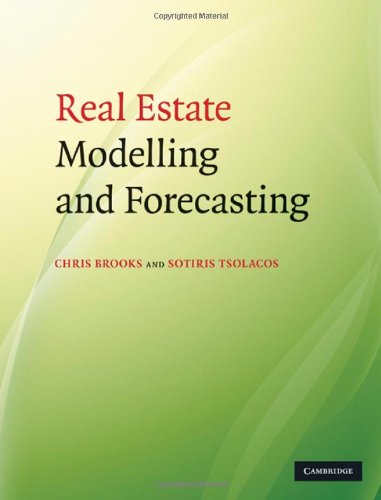
Real Estate Modelling and Forecasting 1st Edition by Chris Brooks, Sotiris Tsolacos ISBN 0521873398 9780521873390


Original price was: $50.00.$35.00Current price is: $35.00.
Real Estate Modelling and Forecasting 1st Edition by Chris Brooks, Sotiris Tsolacos – Ebook PDF Instant Download/Delivery: 0521873398, 9780521873390
Full download Real Estate Modelling and Forecasting 1st Edition after payment
Product details:
ISBN 10: 0521873398
ISBN 13: 9780521873390
Author: Chris Brooks, Sotiris Tsolacos
Real Estate Modelling and Forecasting 1st Table of contents:
1 Introduction
Learning outcomes
1.1 Motivation for this book
1.2 What is econometrics?
1.3 Steps in formulating an econometric model
1.4 Model building in real estate
1.5 What do we model and forecast in real estate?
Demand variables
Supply variables
Vacancy
Rents
Performance variables
1.6 Model categorisation for real estate forecasting
1.7 Why real estate forecasting?
1.8 Econometrics in real estate, finance and economics: similarities and differences
1.9 Econometric packages for modelling real estate data
1.9.1 What packages are available?
1.9.2 Choosing a package
1.10 Outline of the remainder of this book
Chapter 2
Chapter 3
Chapter 4
Chapter 5
Chapter 6
Chapter 7
Chapter 8
Chapter 9
Chapter 10
Chapter 11
Chapter 12
Chapter 13
Chapter 14
Appendix: Econometric software package suppliers
2 Mathematical building blocks for real estate analysis
2.1 Introduction
2.2 Constructing price index numbers
The equally weighted index
The base-weighted index
The current-weighted index
2.3 Real versus nominal series and deflating nominal series
Example 2.1
2.4 Properties of logarithms and the log transform
2.5 Returns
2.6 Matrices
2.7 The eigenvalues of a matrix
3 Statistical tools for real estate analysis
3.1 Types of data for quantitative real estate analysis
3.1.1 Time series data
Problems that can be tackled using time series data
3.1.2 Cross-sectional data
Problems that can be tackled using cross-sectional data
3.1.3 Panel data
3.1.4 Continuous and discrete data
3.1.5 Cardinal, ordinal and nominal numbers
3.2 Descriptive statistics
3.2.1 The population and the sample
3.2.2 Measures of central tendency
The geometric mean
3.2.3 Measures of spread
Example 3.1
3.2.4 Higher moments
3.2.5 Measures of association
Covariance
Correlation
3.3 Probability and characteristics of probability distributions
3.4 Hypothesis testing
3.4.1 Hypothesis testing: some concepts
3.4.2 A note on the t- and the normal distributions
3.4.3 The test of significance approach
3.4.4 The confidence interval approach
Carrying out a hypothesis test using confidence intervals
3.4.5 The test of significance and confidence interval approaches always give the same conclusion
Example 3.2 Testing a hypothesis about the mean rental yield
3.5 Pitfalls in the analysis of real estate data
3.5.1 Small samples and sampling error
3.5.2 Trends in the series and spurious relationships
3.5.3 Structural breaks
3.5.4 Non-normality
3.5.5 Parametric and non-parametric statistics
4 An overview of regression analysis
4.1 Chapter objectives
4.2 What is a regression model?
4.3 Regression versus correlation
4.4 Simple regression
4.5 Some further terminology
4.5.1 The data-generating process, the population regression function and the sample regression func
4.5.2 Estimator or estimate?
Example 4.1
4.6 Linearity and possible forms for the regression function
4.7 The assumptions underlying the classical linear regression model
4.8 Properties of the OLS estimator
4.8.1 Consistency
4.8.2 Unbiasedness
4.8.3 Efficiency
4.9 Precision and standard errors
4.9.1 Estimating the variance of the error term (σ2)
4.9.2 Some comments on the standard error estimators
Example 4.2
4.10 Statistical inference and the classical linear regression model
4.10.1 The probability distribution of the least squares estimators
Example 4.3
4.10.2 Some more terminology
4.10.3 Classifying the errors that can be made using hypothesis tests
4.10.4 The exact significance level
Example 4.4
Example 4.5
Appendix: Mathematical derivations of CLRM results for the bivariate case
4A.1 Derivation of the OLS coefficient estimator
4A.2 Derivation of the OLS standard error estimators for the intercept and slope
5 Further issues in regression analysis
5.1 Generalising the simple model to multiple linear regression
5.2 The constant term
5.3 How are the parameters (the elements of the vector) calculated in the generalised case?
Example 5.1
5.4 A special type of hypothesis test: the t-ratio
5.5 Goodness of fit statistics
5.5.1 R
Example 5.2 Measuring goodness of fit
5.5.2 Problems with R as a goodness of fit measure
5.5.3 Adjusted R
5.6 Tests of non-nested hypotheses
Example 5.3 A multiple regression in real estate
5.7 Data mining and the true size of the test
5.8 Testing multiple hypotheses: the F-test
Example 5.4
5.8.1 The relationship between the t- and the F-distributions
5.8.2 Determining the number of restrictions,
5.8.3 Hypotheses that cannot be tested with either an F- or a t-test
5.9 Omission of an important variable
Example 5.5
5.10 Inclusion of an irrelevant variable
Example 5.6
Appendix: Mathematical derivations of CLRM results for the multiple regression case
5A. 1 Derivation of the OLS coefficient estimator
5A.2 Derivation of the OLS standard error estimator
6 Diagnostic testing
6.1 Introduction
6.2 Violations of the assumptions of the classical linear regression model
6.3 Statistical distributions for diagnostic tests
6.4 Assumption 1: E(ut) = 0
6.5 Assumption 2: var…
6.5.1 Detection of heteroscedasticity
Example 6.1
6.5.2 Consequences of using OLS in the presence of heteroscedasticity
6.5.3 Dealing with heteroscedasticity
6.6 Assumption 3: cov…
6.6.1 The concept of a lagged value
6.6.2 Graphical tests for autocorrelation
6.6.3 Detecting autocorrelation: the Durbin–Watson test
6.7 Causes of residual autocorrelation
Example 6.2
6.7.1 Conditions that must be fulfilled for DW to be a valid test
6.7.2 Another test for autocorrelation: the Breusch–Godfrey test
Example 6.3
6.7.3 Dealing with autocorrelation
6.7.4 Dynamic models
6.7.5 Why might lags be required in a regression?
6.7.6 The long-run static equilibrium solution
Example 6.4
6.7.7 Problems with adding lagged regressors to ‘cure’ autocorrelation
Example 6.5
6.8 Assumption 4: the are non-stochastic (cov(ut, xt) = 0)
6.9 Assumption 5: the disturbances are normally distributed
6.9.1 Testing for departures from normality
Example 6.6
6.9.2 What should be done if evidence of non-normality is found?
6.10 Multicollinearity
6.10.1 Measuring near-multicollinearity
6.10.2 Problems if near-multicollinearity is present but ignored
6.10.3 Solutions to the problem of multicollinearity
6.11 Adopting the wrong functional form
6.11.1 What if the functional form is found to be inappropriate?
Example 6.7
6.12 Parameter stability tests
6.12.1 The Chow test
Example 6.8
6.12.2 The predictive failure test
Example 6.9
Example 6.10 The predictive failure test with dummy variables
6.12.3 Backward versus forward predictive failure tests
6.12.4 How can the appropriate sub-parts to use be decided?
6.12.5 The QLR test
6.12.6 Stability tests based on recursive estimation
6.13 A strategy for constructing econometric models
Appendix: Iterative procedures for dealing with autocorrelation
7 Applications of regression analysis
7.1 Frankfurt office rents: constructing a multiple regression model
7.1.1 Features of data in the Frankfurt example
7.1.2 Regression models for Frankfurt rents
7.1.3 Diagnostics
Normality
Serial correlation
Heteroscedasticity test
The RESET test
Structural stability tests
7.1.4 Additional regression models
7.2 Time series regression models from the literature
Example 7.1 Sydney office rents
Example 7.2 Helsinki office capital values
7.3 International office yields: a cross-sectional analysis
7.4 A cross-sectional regression model from the literature
8 Time series models
8.1 Introduction
8.2 Some notation and concepts
8.2.1 A strictly stationary process
8.2.2 A weakly stationary process
8.2.3 A white noise process
Example 8.1
8.3 Moving average processes
8.4 Autoregressive processes
8.4.1 The stationarity condition
Example 8.2
8.5 The partial autocorrelation function
8.5.1 The invertibility condition
8.6 ARMA processes
8.6.1 Sample acf and pacf plots for standard processes
8.7 Building ARMA models: the Box–Jenkins approach
Step 1
Step 2
Step 3
8.7.1 Information criteria for ARMA model selection
8.7.2 Which criterion should be preferred if they suggest different model orders?
8.7.3 ARIMA modelling
8.8 Exponential smoothing
8.9 An ARMA model for cap rates
8.10 Seasonality in real estate data
8.10.1 Slope dummy variables
8.10.2 An example of the use of seasonal dummy variables
8.11 Studies using ARMA models in real estate
Tse (1997)
Wilson et al. (2000)
Appendix: Some derivations of properties of ARMA models
8A.1 Deriving the autocorrelation function for an MA process
Solution
8A.2 Deriving the properties of AR models
Solution
9 Forecast evaluation
9.1 Forecast tests
9.1.1 The difference between in-sample and out-of-sample forecasts
9.2 Application of forecast evaluation criteria to a simple regression model
9.2.1 Forecast evaluation for Frankfurt rental growth
9.2.2 Comparative forecast evaluation
9.2.3 Rolling forecasts
9.2.4 Statistical versus ‘economic’ loss functions
9.3 Forecast accuracy studies in real estate
9.3.1 Evaluating central London forecasts
9.3.2 Model-based versus consensus forecasts
9.3.3 Evaluation of rolling forecasts for different horizons
10 Multi-equation structural models
10.1 Simultaneous-equation models
10.2 Simultaneous equations bias
10.3 How can simultaneous-equation models be estimated?
10.4 Can the original coefficients be retrieved from the πs?
10.4.1 What determines whether an equation is identified or not?
10.4.2 Statement of the order condition
Example 10.1 Determining whether equations are identified
10.5 A definition of exogeneity
10.5.1 Tests for exogeneity
10.6 Estimation procedures for simultaneous equations systems
10.6.1 Indirect least squares
10.6.2 Estimation of just identified and over-identified systems using 2SLS
Example 10.2
10.6.3 Instrumental variables
10.6.4 What happens if IV or 2SLS are used unnecessarily?
10.6.5 Other estimation techniques
10.7 Case study: projections in the industrial property market using a simultaneous equations system
10.7.1 Results
10.7.2 Simulations
10.8 A special case: recursive models
10.9 Case study: an application of a recursive model to the City of London office market
10.10 Example: a recursive system for the Tokyo office market
Rent equation
Completions equation
Absorption equation
11 Vector autoregressive models
11.1 Introduction
11.2 Advantages of VAR modelling
11.3 Problems with VARs
11.4 Choosing the optimal lag length for a VAR
11.4.1 Cross-equation restrictions for VAR lag length selection
11.4.2 Information criteria for VAR lag length selection
11.5 Does the VAR include contemporaneous terms?
11.6 A VAR model for real estate investment trusts
11.7 Block significance and causality tests
Example 11.1 Block F-tests and causality tests
Step 1: Lags of SPY do not cause ARPRET
Step 2: Lags of ARPRET do not cause SPY
11.8 VARs with exogenous variables
11.9 Impulse responses and variance decompositions
11.9.1 Impulse responses and variance decompositions for the REIT VAR
11.10 A VAR for the interaction between real estate returns and the macroeconomy
11.10.1 Background, data and variables
11.10.2 Methodology
11.10.3 Results
11.10.4 Conclusions
11.11 Using VARs for forecasting
11.11.1 Ex post forecasting and evaluation
12 Cointegration in real estate markets
12.1 Stationarity and unit root testing
12.1.1 Why are tests for non-stationarity necessary?
12.1.2 Two types of non-stationarity
12.1.3 Some more definitions and terminology
12.1.4 Testing for a unit root
12.1.5 Phillips–Perron (PP) tests
12.1.6 Criticisms of Dickey–Fuller- and Phillips–Perron-type tests
12.2 Cointegration
12.2.1 Definition of cointegration (Engle and Granger, 1987)
12.2.2 Long-run relationships and cointegration in real estate
12.3 Equilibrium correction or error correction models
12.4 Testing for cointegration in regression: a residuals-based approach
12.5 Methods of parameter estimation in cointegrated systems
12.5.1 The Engle–Granger two-step method
Step 1
Step 2
12.6 Applying the Engle–Granger procedure: the Sydney office market
12.7 The Engle and Yoo three-step method
12.8 Testing for and estimating cointegrating systems using the Johansen technique
12.8.1 Hypothesis testing using Johansen
12.9 An application of the Johansen technique to securitised real estate
12.10 The Johansen approach: a case study
13 Real estate forecasting in practice
13.1 Reasons to intervene in forecasting and to use judgement
13.2 How do we intervene in and adjust model-based forecasts?
13.3 Issues with judgemental forecasting
13.4 Case study: forecasting in practice in the United Kingdom
13.5 Increasing the acceptability of intervention
13.6 Integration of econometric and judgemental forecasts
Step 1
Step 2
Step 3
13.7 How can we conduct scenario analysis when judgement is applied?
13.8 Making the forecast process effective
14 The way forward for real estate modelling and forecasting
References
People also search for Real Estate Modelling and Forecasting 1st:
real estate modelling and forecasting
real estate modelling and forecasting pdf
modeling vs forecasting
what is financial modeling and forecasting
real estate modeling
Tags:
Chris Brooks,Sotiris Tsolacos,Real Estate,Forecasting