

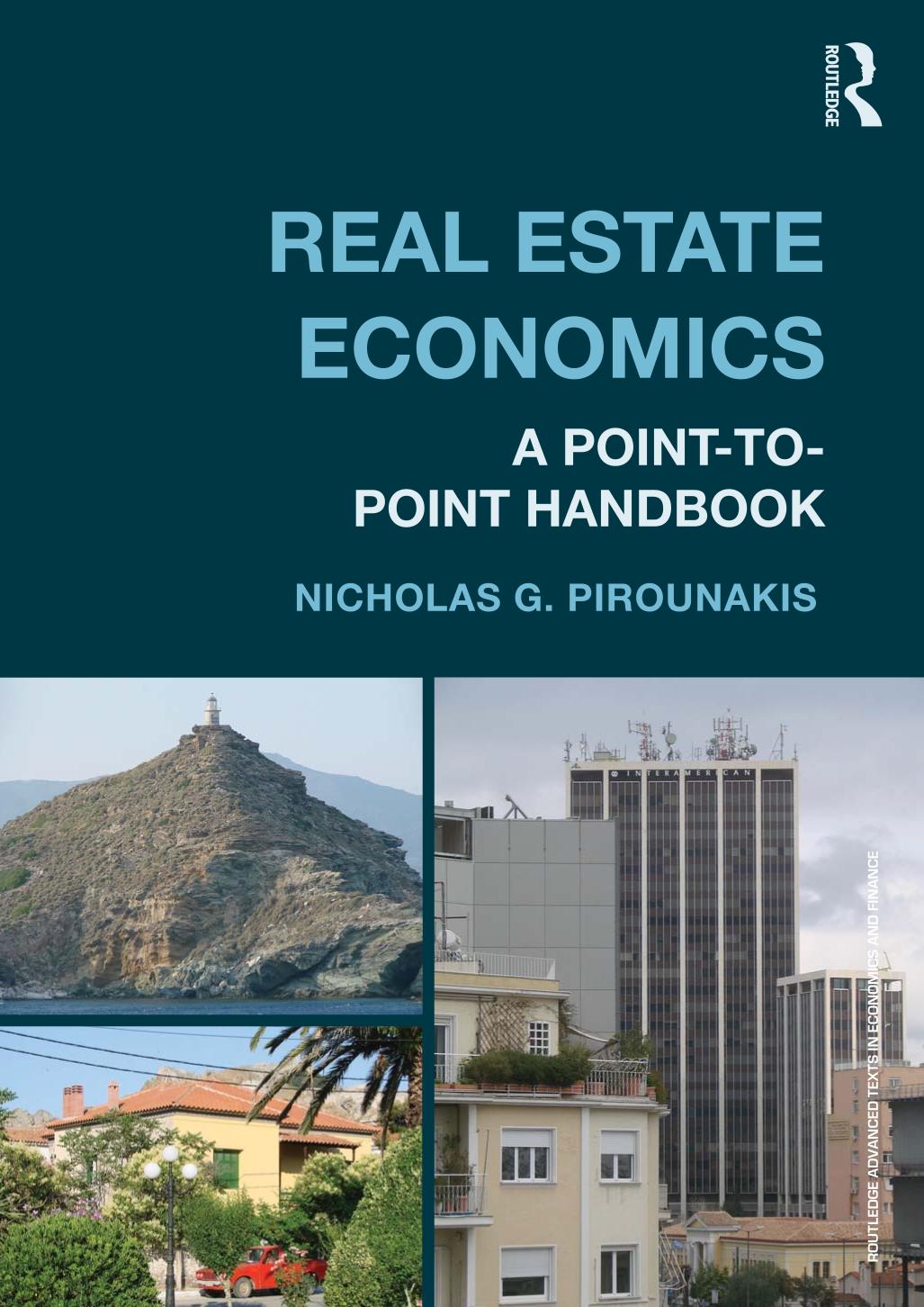
Real Estate Economics A Point to Point Handbook 1st Edition by Nicholas G Pirounakis ISBN 0415676347 9780415676342


Original price was: $50.00.$35.00Current price is: $35.00.
Real Estate Economics A Point to Point Handbook 1st Edition by Nicholas G Pirounakis – Ebook PDF Instant Download/Delivery: 0415676347, 9780415676342
Full download Real Estate Economics A Point to Point Handbook 1st Edition after payment
Product details:
ISBN 10: 0415676347
ISBN 13: 9780415676342
Author: Nicholas G Pirounakis
Real Estate Economics A Point to Point Handbook 1st Table of contents:
1 Real Estate (RE): An Overview Of The Sector
1.1 Definition Of Real Estate (RE)
1.2 RE Subsectors (Or Submarkets)
1.3 The Location Factor
1.4 Location And ‘Authentic’ Versus ‘Derived’ Demand For RE
1.5 Other Characteristics Of RE – And Wider Interactions
1.6 Why Study RE Economics?
2 RE: Tools Of Analysis
2.1 Mathematical Techniques
2.1.1 Differentiation
2.1.2 Partial And Total Differentiation
2.1.3 Optimization
2.1.4 Optimizing Functions Of More Than One Variable
2.1.5 Constrained Optimization
2.1.6 Implicit Differentiation
2.1.7 The S Curve
2.2 Economic Concepts
2.2.1 Elasticity
2.2.2 Indifference Curves
2.2.3 Useful Demand And Utility Functions
2.2.4 From Cobb–Douglas Utility To Cobb–Douglas Demand
2.2.5 Income And Substitution Effects
2.2.6 Income And Substitution Effects: Locating The Tangency Solutions
2.2.7 Income And Substitution Effects In Housing
2.2.8 Elasticity Of Substitution (εs)
2.2.9 Characteristics Theory
2.2.10 Isoquants, Isocosts, MPP, MRP, And Profit Maximization
2.3 Statistical Primer: Regression, Co-Integration, Granger Causality
2.3.1 Regression
2.3.2 Regression And Causality
2.3.3 Co-Integration
2.3.4 More On Time Series
2.3.5 A Graphical Example
2.3.6 Granger Causality
2.3.7 Further Reading
Summary Of Main Points
Review Questions And Exercises
3 RE In The Wider Economy
3.1 RE In The National Accounts
3.2 RE Investment And Economic Growth
3.2.1 Multiplier Effects
3.2.2 A Limit To The Share Of Construction In GDP?
3.2.3 Who Pulls Whom – GDP Or Construction?
3.3 Determinants Of RE Investment; Tobin’s Q
3.3.1 Utility-Driven Investment
3.3.2 Tobin’s Q
3.3.3 RE Investment As Inflation Hedge
3.3.4 The Role Of ‘Fundamentals’
3.3.5 What About Non-Residential Property?
3.4 The Effect Of RE Prices On The Economy
3.4.1 The Consumption Channel
3.4.2 The Investment Channel
3.4.3 The Financial Sector Channel
3.4.4 The Inflation Channel
3.4.5 The Government’s Fiscal Position Channel
3.5 The Housing Wealth Effect (HWE)
3.5.1 The HWE As A Home-Equity Adjustment
3.5.2 The HWE As A Pilc Adjustment
3.5.3 The HWE As A Consumer-Credit Adjustment
3.5.4 How Strong Is The HWE, Then?
3.6 Homeownership And The Labour Market
Summary Of Main Points
Review Questions And Exercises
4 RE Finance: Loans, Equity Withdrawal, And MBSs
4.1 Loans, Mortgages, And Maths
4.2 Forward Mortgages: Basic Loan Types
4.2.1 The Interest-And-Capital-Repayment Loan
4.2.2 The Interest-Only Loan
4.2.3 The Low-Start Loan
4.2.4 The Stabilized Loan
4.2.5 The Select-Payment Loan
4.2.6 The Cap-And-Collar Loan
4.2.7 The Index-Linked Loan
4.3 Remortgaging And Equity Withdrawal
4.3.1 Variable Versus Fixed Interest Rates
4.3.2 From Prepayment To Refinancing
4.3.3 Cash-Out Refinancing
4.3.4 Tapping Into One’s Home Equity
4.4 Reverse (Or Equity Release) Mortgages
4.4.1 Mechanics Of A Reverse Mortgage
4.4.2 A Right Interest Rate For A Reverse Mortgage?
4.5 Reverse Mortgages In The USA And The UK
4.6 Housing Finance And Homeownership
4.7 Mortgage Securitization (MS)
4.7.1 How MS Works
4.7.2 Types Of MBSs
4.7.3 Reasons For MS
4.7.4 Effect On Real Estate Market
Summary Of Main Points
Review Questions And Exercises
5 RE As An Investment Decision
5.1 Definition Of Commercial RE
5.2 The Language Of The Marketplace
5.2.1 Some Definitions
5.2.2 Investment Vehicles
5.3 Characteristics Of Investment In RE
5.4 A Portfolio Approach To RE Investment
5.4.1 Portfolio Basics
5.4.2 RE And Correlations Between Assets
5.4.3 RE Across Countries: Correlations (A)
5.4.4 RE And Other Asset Classes: Correlations (B)
5.4.5 An Application
5.5 Property Valuation
5.5.1 Investment Appraisal: NPV And IRR
5.5.2 Special Cases In Property Valuation
5.5.3 The Capitalization Rate
5.5.4 The Cap Rate Cycle
5.5.5 The Band-Of-Investment Concept
5.6 Physical Life And Economic Life
5.7 Property Derivatives And Options
Summary Of Main Points
Review Questions And Exercises
6 Demand For Office–Retail–Industrial Space
6.1 Demand For Office Space
6.1.1 Vacant Space–Occupied Space
6.1.2 Mathematical Modelling Of The Short Term
6.1.3 Mathematical Modelling Of The Long Term
6.1.4 A Disturbance And Re-Establishment Of Equilibrium
6.1.5 The Office Rental Cycle And The NVR
6.1.6 Determinants Of Office Demand (And Supply)
6.1.7 How Is The NVR Estimated?
6.1.8 Office Market Analysis
6.2 Demand For Retail Space
6.2.1 The Geographical Frame Of Reference
6.2.2 Methods Of Finding Trade Areas: The Checklist Method
6.2.3 Methods Of Finding Trade Areas: The Analogue Method
6.2.4 Methods Of Finding Trade Areas: Multiple Regression Analysis (MRA)
6.2.5 Methods Of Finding Trade Areas: Gravity Modelling
6.2.6 Methods Of Finding Trade Areas: Use Of GIS
6.3 Demand For Industrial Space
Summary Of Main Points
Review Questions And Exercises
7 Housing Demand And Supply
7.1 Dwelling Price Versus Dwelling Rent
7.2 Residential Demand
7.3 Modelling Residential Demand: A (Demanding!) Example
7.3.1 The De Bruyne–Van Hove Model
7.4 Adding Supply: An Extended Model
7.5 Determinants Of Housing Demand And Supply
7.6 A Practical Example Of Housing ‘Demand’ Calculation
7.7 Construction, Development, And Supply Changes
7.8 A Developer’s Profit-Maximization Problem
7.8.1 Profit Maximization In The Face Of Planning Constraints
7.8.2 The RRR Approach To Development
7.8.3 Profit Maximization In The Face Of A Land Price
7.8.4 More On The Negotiation Dimension
7.9 What Price For Land?
7.9.1 The ‘Anglo-American’ Mode Of Residential Development
7.9.2 The ‘Greek’ Mode Of Residential Development
7.9.3 Concluding Remarks
Summary Of Main Points
Review Questions And Exercises
8 Construction Flows And Market Equilibrium
8.1 Capital Stock Adjustment Models (CSAMs)
8.2 The DiPasquale–Wheaton (DiPW) Model
8.3 Summing Up The DiPW Model
8.4 From The DiPW Model To A Modified CSAM
Explanation Of Figure 8.5
8.4.1 Example A: Linear Demand
8.4.2 From Example A: Estimating Supply
8.4.3 Example B: Curvilinear Demand
8.5 CSAMs And The Role Of Expectations
8.5.1 ‘Excessive’ Response To A Price Shock
8.5.2 ‘Myopic’ And ‘Rational’ Expectations
8.5.3 Developers’ Responses To Prices In The Face Of Uncertainty
8.6 The ‘Riddle’ Of Mean Reversion
8.7 The Capitalization Factor K In The DiPW Model
8.8 RE Shocks And Cycles
8.8.1 Question (A): One Cycle Or Many?
8.8.2 Question (B): Origin Of The Shock
8.8.3 Question (C): Pro- Or Counter-Cyclical?
8.8.4 Question (D): Short Cycles, Long Swings?
8.8.5 Question (E): Different Sectors, Different Cycles?
8.8.6 Question (F): Cycles And Expectations
8.9 Appendix: A Note On Difference Equations
People also search for Real Estate Economics A Point to Point Handbook 1st:
real estate economics a point to point handbook
z in economics
kaplan real estate principles exam
microeconomics real estate
real estate economics book
Tags: Nicholas G Pirounakis, Economics, Point