

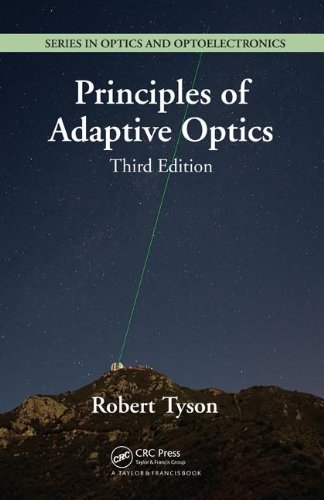
Principles of adaptive optics 3rd Edition by Robert Tyson ISBN 1439808589 9781439808580


Original price was: $50.00.$35.00Current price is: $35.00.
Principles of adaptive optics 3rd Edition by Robert Tyson – Ebook PDF Instant Download/Delivery: 1439808589, 9781439808580
Full download Principles of adaptive optics 3rd Edition after payment
Product details:
ISBN 10: 1439808589
ISBN 13: 9781439808580
Author: Robert Tyson
Principles of adaptive optics 3rd Table of contents:
1. History and Background
1.1 introduction
1.2 history
1.3 physical optics
1.3.1 propagation with aberrations
1.3.2 imaging with aberrations
1.3.3 representing the wavefront
1.3.3.1 power‑series representation
1.3.3.2 zernike series
1.3.3.3 zernike annular polynomials
1.3.3.4 lowest aberration modes
1.3.4 interference
1.4 terms in adaptive optics
2. Sources of Aberrations
2.1 atmospheric turbulence
2.1.1 descriptions of atmospheric turbulence
2.1.2 refractive‑index structure constant
2.1.3 turbulence effects
2.1.3.1 fried’s coherence length
2.1.3.2 scintillation
2.1.3.3 beam wander or tilt
2.1.3.4 higher‑order phase variation
2.1.4 turbulence modulation transfer function
2.1.5 multiple layers of turbulence
2.2 thermal blooming
2.2.1 blooming strength and critical power
2.2.2 turbulence, jitter, and thermal blooming
2.3 nonatmospheric sources
2.3.1 optical misalignments and jitter
2.3.2 large optics: segmenting and phasing
2.3.3 thermally induced distortions of optics
2.3.4 manufacturing and microerrors
2.3.5 other sources of aberrations
2.3.6 aberrations due to aircraft boundary layer turbulence
2.3.7 aberrations in laser resonators and lasing media
3. Adaptive Optics Compensation
3.1 phase conjugation
3.2 limitations of phase conjugation
3.2.1 turbulence tilt or jitter error
3.2.2 turbulence higher‑order spatial error
3.2.2.1 modal analysis
3.2.2.2 zonal analysis: corrector fitting error
3.2.3 turbulence temporal error
3.2.4 sensor noise limitations
3.2.5 thermal blooming compensation
3.2.6 anisoplanatism
3.2.7 postprocessing
3.3 artificial guide stars
3.3.1 rayleigh guide star
3.3.2 sodium guide stars
3.4 lasers for guide stars
3.5 combining the limitations
3.6 linear analysis
3.6.1 random wavefronts
3.6.2 deterministic wavefronts
3.7 partial phase conjugation
4. Adaptive Optics Systems
4.1 adaptive optics imaging systems
4.1.1 astronomical imaging systems
4.1.2 retinal imaging
4.2 beam propagation systems
4.2.1 local‑loop beam cleanup systems
4.2.2 alternative concepts
4.2.3 pros and cons of various approaches
4.2.4 free‑space laser communications systems
4.3 unconventional adaptive optics
4.3.1 nonlinear optics
4.3.2 elastic photon scattering: degenerate four‑wave mixing
4.3.3 inelastic photon scattering
4.3.3.1 raman and brillouin scattering
4.4 system engineering
4.4.1 system performance requirements
4.4.2 compensated beam properties
4.4.3 wavefront reference beam properties
4.4.4 optical system integration
5. Wavefront Sensing
5.1 directly measuring phase
5.1.1 nonuniqueness of the diffraction pattern
5.1.2 determining phase information from intensity
5.2 modal and zonal sensing
5.3 dynamic range of tilt and wavefront measurement
5.4 direct wavefront sensing – modal
importance of wavefront tilt
measurement of tilt
focus sensing
modal sensing of higher‑order aberrations
5.5 zonal direct wavefront sensing
5.6 interferometric wavefront sensing
methods of interference
principle of a shearing interferometer
practical operation of a shearing interferometer
lateral shearing interferometers
rotation and radial shear interferometers
5.7 shack‑hartmann wavefront sensors
5.8 curvature sensing
5.9 pyramid wavefront sensor
5.10 selecting a method
5.11 correlation tracker
5.12 indirect wavefront sensing methods
5.13 multidither adaptive optics
5.14 image sharpening
5.15 wavefront sampling
beam splitters
hole gratings
temporal duplexing
reflective wedges
diffraction gratings
hybrids
sensitivities of sampler concepts
5.16 detectors and noise
6. Wavefront Correction
6.1 modal‑tilt correction
6.2 modal higher‑order correction
6.3 segmented mirrors
6.4 deformable mirrors
6.5 actuation techniques
6.6 actuator influence functions
6.7 bimorph corrector mirrors
6.8 membranes and micromachined mirrors
6.9 edge‑actuated mirrors
6.10 large correcting optics
6.11 special correction devices
6.11.1 liquid‑crystal phase modulators
6.11.2 spatial light modulators
6.11.3 ferrofluid deformable mirrors
7. Reconstruction and Controls
7.1 introduction
7.2 single‑channel linear control
7.3 fundamental control tools
7.4 transfer functions
7.5 proportional control
7.6 first‑ and second‑order lag
7.7 feedback
7.8 frequency response of control systems
7.9 digital controls
7.10 multivariate adaptive optics controls
7.11 solution of linear equations
7.12 direct wavefront reconstruction
7.13 phase from wavefront slopes
7.14 modes from wavefront slopes
7.15 phase from wavefront modes
7.16 modes from wavefront modes
7.17 zonal corrector from continuous phase
7.18 modal corrector from continuous phase
7.19 zonal corrector from modal phase
7.20 modal corrector from modal phase
7.21 indirect reconstructions
7.22 modal corrector from wavefront modes
7.23 zonal corrector from wavefront slopes
7.24 beyond linear control
7.25 summary of important equations
People also search for Principles of adaptive optics 3rd:
tyson principles of adaptive optics
principles of adaptive optics pdf
principles of adaptive optics tyson pdf
principles of adaptive optics tyson
principles of adaptive optics 5th edition
Tags: Robert Tyson, adaptive optics