

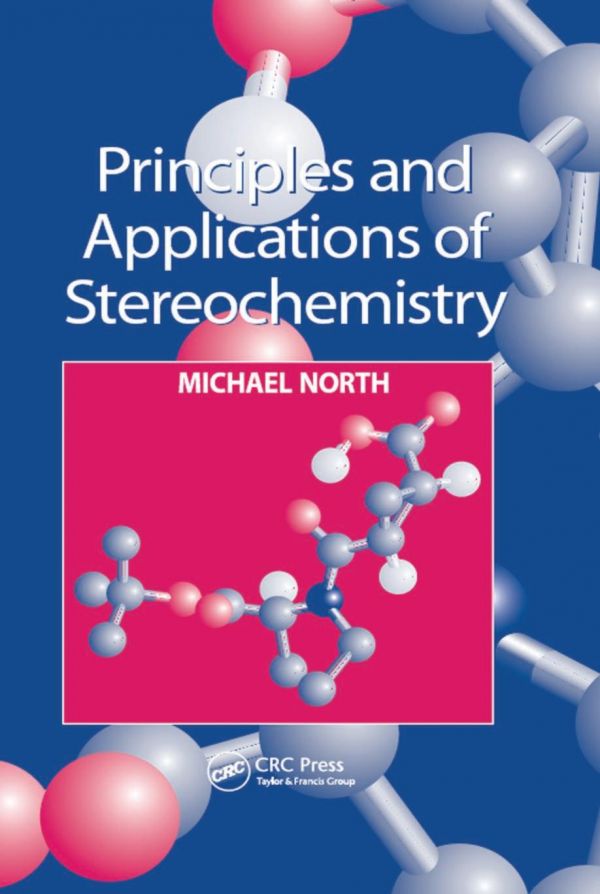
Principles and Applications of Stereochemistry 2nd Edition by Michael North ISBN 1351422065 9781351422062

Original price was: $50.00.$35.00Current price is: $35.00.
Principles and Applications of Stereochemistry 2nd Edition by Michael North – Ebook PDF Instant Download/Delivery: 1351422065, 9781351422062
Full download Principles and Applications of Stereochemistry 2nd Edition after payment
Product details:
ISBN 10: 1351422065
ISBN 13: 9781351422062
Author: Michael North
Principles and Applications of Stereochemistry 2nd Table of contents:
1 Molecular structure and bonding
1.1 Isomerism
1.2 Drawing three dimensional chemical structures
1.2.1 Fischer projections
1.2.2 Newman projections
1.3 VSEPR and the shape of molecules
1.4 Structure and bonding
1.5 Classification of stereoisomers
1.5.1 Enantiomers and diastereomers
1.5.2 Conformations and configurations
1.6 Further reading
1.7 Problems
2 Cis-trans isomerism
2.1 Cis-trans isomerism in alkenes
2.2 Cis-trans isomerism in other systems which contain a double bond
2.3 Cis-trans isomerism in cyclic systems
2.4 Cis-trans isomerism in square planar and octahedral metal complexes
2.5 Cis-trans isomerism about single bonds (conformational diastereomers)
2.6 Methods for distinguishing cis-trans isomers
2.6.1 NMR spectroscopy
2.6.2 X-ray crystallography
2.6.3 Dipole moments
2.7 Further reading
2.8 Problems
3 Enantiomers
3.1 Structure of enantiomers
3.2 Nomenclature for enantiomers (specification of absolute configuration)
3.2.1 The D/L-nomenclature system
3.2.2 The R/S nomenclature system
3.3 Chemical properties of enantiomers
3.4 Physical properties of enantiomers
3.4.1 Optical rotation
3.4.2 Other chiroptical methods (optical rotary dispersion and circular dichroism)
3.5 Enantiomeric excess
3.6 Biological properties of enantiomers
3.6.1 Origin of enantiomerically pure compounds in nature
3.7 Chirality due to stereocentres at atoms other than carbon
3.7.1 Sulphur
3.7.2 Phosphorus
3.7.3 Nitrogen
3.7.4 Metal complexes
3.8 Other stereogenic elements which can produce molecular chirality
3.8.1 Stereogenic axis
3.8.2 Stereoplane
3.8.3 Helical molecules
3.9 Further reading
3.10 Problems
4 Compounds with two or more stereocentres
4.1 Compounds with two stereocentres
4.2 Compounds with more than two stereocentres
4.3 Polymer stereochemistry
4.3.1 Stereochemical consequences of backbone stereocentres
4.3.2 Helical polymers
4.4 Relative stereochemistry nomenclature
4.5 Diastereomeric excess
4.6 Further reading
4.7 Problems
5 Interconversion and analysis of stereoisomers
5.1 Racemization
5.1.1 Thermal racemization
5.1.2 Base induced racemization
5.1.3 Acid induced racemization
5.2 Epimerization
5.3 Resolution
5.3.1 Resolution by crystallization
5.3.2 Resolution by formation of diastereomers
5.3.3 Kinetic resolution
5.3.4 Resolution by preferential absorption
5.4 Methods for determining enantiomeric excess
5.4.1 Chromatography using a chiral stationary phase
5.4.2 NMR
5.4.3 Conversion to diastereomers
5.4.4 Polarimetry
5.5 Determination of absolute configuration
5.5.1 Chiroptical methods
5.5.2 X-ray crystallography
5.5.3 Conversion to a compound of known absolute configuration
5.6 Determination of relative configuration
5.7 Further reading
5.8 Problems
6 Molecular symmetry
6.1 Introduction
6.2 Symmetry elements and symmetry operations
6.2.1 Proper axes (Cn) and proper rotations (C%)
6.2.2 The identity element (E) and the identical operation (E)
6.2.3 Plane of symmetry (a) and reflection operations (s)
6.2.4 Centre of inversion (i) and the inverse operation (i)
6.2.5 Improper axes (Sn) and improper rotations (S%)
6.3 Symmetry of molecules with multiple conformations
6.4 Point groups
6.5 Symmetry and chirality
6.6 Further reading
6.7 Problems
7 Topism and prostereogenicity
7.1 Homotopic, enantiotopic and diastereotopic groups
7.2 Homotopic, enantiotopic and diastereotopic faces
7.3 Physical and chemical properties of heterotopic groups and faces
7.3.1 The NMR spectra of compounds which contain diastereotopic groups
7.4 Nomenclature for heterotopic groups and faces
7.5 Further reading
7.6 Problems
8 Conformations of acyclic and cyclic molecules
8.1 Introduction
8.2 Conformations of acyclic molecules
8.3 Conformations of cyclic alkanes and their derivatives
8.4 Cyclopropane
8.4.1 Isomerism in cyclopropane derivatives
8.5 Cyclobutane
8.6 Cyclopentane
8.7 Cyclohexane
8.7.1 The chair conformation
8.7.2 The boat conformation
8.7.3 The twist boat conformation
8.7.4 Interconversion of cyclohexane conformations
8.7.5 Electronic effects in the conformational analysis of cyclohexane derivatives
8.7.6 Fused six-membered rings
8.8 Medium and large rings
8.9 Conformations of inorganic and organometallic compounds
8.10 Conformations of biopolymers
8.10.1 Proteins
8.10.2 Polysaccharides
8.10.3 Nucleic acids
8.11 Methods for determining molecular conformation
8.11.1 X-ray crystallography
8.11.2 NMR spectroscopy
8.11.3 Computer assisted confromational analysis
8.12 Further reading
8.13 Problems
9 Stereochemistry of chemical reactions
9.1 Introduction
9.2 Substitution reactions
9.2.1 SN2 reactions
9.2.2 SN1 reactions
9.2.3 Substitution with neighbouring group participation
9.3 Elimination reactions
9.3.1 E2 eliminations
9.3.2 E1 eliminations
9.3.3 Syn-eliminations
9.4 Addition reactions to alkenes
9.5 Addition of nucleophiles to aldehydes and ketones
9.5.1 Chelation control
9.5.2 The Felkin-Anh model
9.5.3 The aldol reaction
9.5.4 The Wittig reaction
9.6 Pericyclic reactions
9.6.1 Diels-Alder reactions: [4n + 2n] cycloadditions
9.6.2 1,3-dipolar cycloadditions
9.6.3 [2n + 2n] cycloaddition reactions
9.6.4 Cheletropic reactions
9.7 Further reading
9.8 Problems
10 Asymmetric synthesis
10.1 Introduction
10.2 Use of chiral auxiliaries
10.3 Use of enantiomerically pure reagents
10.3.1 Use of stoichiometric reagents
10.3.2 Use of enantiomerically pure catalysts
10.3.3 Use of enzymes
10.4 Further reading
People also search for Principles and Applications of Stereochemistry 2nd:
principles and applications of stereochemistry pdf
stereochemistry of organic compounds principles and applications
dynamic stereochemistry of chiral compounds principles and applications
borrow stereochemistry of organic compounds principles and applications
principle and application of nmr
Tags: Michael North, Principles, Stereochemistry