

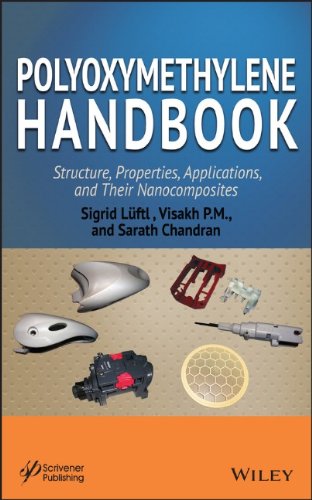
Polyoxymethylene Handbook Structure Properties Applications and their Nanocomposites 1st Edition by Sigrid Luftl ISBN 111838511X 9782272272286

Original price was: $50.00.$35.00Current price is: $35.00.
Polyoxymethylene Handbook Structure Properties Applications and their Nanocomposites 1st Edition by Sigrid Luftl – Ebook PDF Instant Download/Delivery: 111838511X, 9782272272286
Full download Polyoxymethylene Handbook Structure Properties Applications and their Nanocomposites 1st Edition after payment
Product details:
ISBN 10: 111838511X
ISBN 13: 9782272272286
Author: Sigrid Luftl
An excellent, unique, and up-to-date reference book on polyoxymethylene, its compounds, and nanocomposites, specifically dealing with synthesis, characterization, processing, morphology, and applications
Polyoxymethylene Handbook: Structure, Properties, Applications, and Their Nanocomposites summarizes many of the state-of-the-art technological and research accomplishments in the area of polyoxymethylene (POM). It discusses in length the polymerization and manufacture of polyoxymethylene and various types of additives, as well as the structure and crystallization behavior of POM and its thermal, physical, mechanical, flame retardant, chemical, electrical, and optical properties. The environmental impact of POM is also addressed.
The 15 chapters in the handbook are written by prominent researchers from industry, academia, and government/private research laboratories across the globe. Because so few books have ever been published on polyoxymethylene, the handbook is a very valuable reference tool that truly serves as a “one stop” resource for readers and users seeking solutions to both fundamental and applied problems.
Polyoxymethylene Handbook Structure Properties Applications and their Nanocomposites 1st Table of contents:
1 Polyoxymethylene: State of Art, New Challenges and Opportunities
1.1 Scope
1.2 History
1.3 Commercial Significance
References
2 Polymerization and Manufacture of Polyoxymethylene
2.1 Introduction
2.2 Monomers
2.3 Comonomers
2.4 Polymerization and Fabrication
2.5 Special Additives
References
3 Polyoxymethylene Additives
3.1 Introduction
3.2 Antioxidants
3.3 Compounds Reacting with Secondary Reaction Products
3.4 UV Stabilization
3.5 Impact Modifier
3.6 Nucleating Agent
3.7 Pigments and Dyes
3.8 Flame Retardants
3.9 Antistatic Agents
3.10 Lubricating Agents
3.11 Fillers
3.12 Processing Aids
Appendix 3.1: List of Stabilizers
References
4 Polyoxymethylene Processing
4.1 Introduction
4.2 Injection Molding
4.3 Melt Extrusion
4.4 Solid-State Extrusion
4.5 Extrusion Assisted by Supercritical Carbon Dioxide
4.6 Blow Molding
4.7 Other Methods
4.8 Highly Oriented Products
4.9 Recycling of Production Waste
4.10 Finishing and Machining of POM
4.11 Conclusions
References
5 Polyoxymethylene Applications
5.1 Introduction
5.2 Automotive Industry, Mechanical Engineering
5.3 Electrical and Electronic Industry, Fancy Goods
5.4 Medical Applications
5.5 Future Trends
References
6 Structure and Morphology of Polyoxymethylene
6.1 Introduction
6.2 Crystalline Structure of POM: Orthorhombic and Hexagonal Phases
6.3 Crystal Structure Determination
6.4 Morphology of Orthorhombic and Hexagonal POM
6.5 Morphology of Rubber‑Modified POM
6.6 Structure‑Properties Relationships
References
7 Crystal Structure and Crystallization Behavior of POM and its Microscopically‑Viewed Relation with the Physical and Thermal Properties on the Basis of X‑ray Scattering, Vibrational Spectroscopy and Lattice Dynamical Theory
7.1 Introduction
7.2 Crystal Structure Analysis of POM
7.3 Vibrational Spectra of POM
7.4 Structural Evolution in Isothermal Crystallization
7.5 Microscopically‑Viewed Mechanical Property of POM
7.6 Conclusions
Acknowledgements
References
8 Physical Properties of Polyoxymethylene
8.1 Introduction
8.2 Density
8.3 Hardness
8.4 Heat Capacity
8.5 Melt Flow
8.6 Water Absorption
8.7 Gas Permeability
8.8 Specific Absorption
References
9 POM Mechanical Properties
9.1 Short Term Properties
9.2 Long‑Term Properties
9.3 Conclusion
Acknowledgement
References
10 Thermal Properties and Flammability of Polyoxymethylene
10.1 Glass Transition and Melting Temperature
10.2 Coefficient of Linear Thermal Expansion
10.3 Thermal Conductivity and Specific Heat
10.4 HDT and Vicat
10.5 Thermo‑Oxidative Degradation Behavior and Aging
10.6 Testing of Long‑Term Heat Aging
10.7 Flammability
10.8 Hot Sterilization
References
11 Chemical Resistance of Polyoxymethylene
11.1 Introduction
11.2 Degradation and Oxidation Mechanisms in POM
11.3 Resistance to Chemicals
References
12 The Electrical Response of Polyoxymethylene (POM)
12.1 Introduction
12.2 Interactions between POM and Electromagnetic Waves
12.3 Interactions between POM and Arc Plasma
References
13 Electrical and Optical Properties of Polyoxymethylene
13.1 Introduction
13.2 Electrical Properties
13.3 Optical Properties
References
14 Nanocomposites of Polyoxymethylene
14.1 Introduction
14.2 Preparation and Structure of POM Nanocomposites with Different Nanoadditives
14.3 Properties of Polyoxymethylene‑Based Nanocomposites
14.4 POM Blends as Matrices in Nanocomposite Materials
14.5 POM Nanostructures ‑ Electrospun POM Nanofibers
14.6 Applications of POM‑Based Nanocomposites and Future Trends
14.7 Conclusions
List of Acronyms
References
15 Future, Environmental Impact and Suppliers
15.1 Introduction
15.2 Developments and Specialty Resins
15.3 Safety (Regulation and Approvals)
15.4 Environmental Impact
15.5 Suppliers and Commercial Grades
15.6 Future
People also search for Polyoxymethylene Handbook Structure Properties Applications and their Nanocomposites 1st:
polyoxymethylene handbook structure properties
polymer handbook pdf
polyoxymethylene handbook pdf
polyoxymethylene handbook
polyoxymethylene production process
Tags: Sigrid Luftl, Polyoxymethylene, Properties Applications