

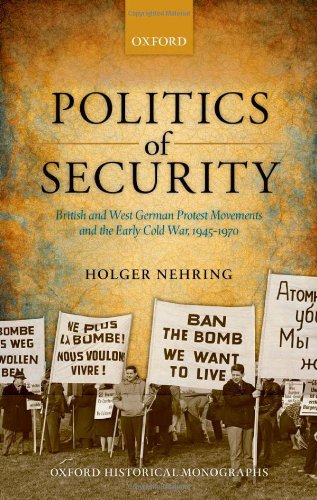
Politics of Security British and West German Protest Movements and the Early Cold War 1945 1970 1st Edition by Holger Nehring ISBN 0199681228 978-0199681228


Original price was: $50.00.$35.00Current price is: $35.00.
Politics of Security British and West German Protest Movements and the Early Cold War 1945 1970 1st Edition by Holger Nehring – Ebook PDF Instant Download/Delivery:0199681228 ,978-0199681228
Full download Politics of Security British and West German Protest Movements and the Early Cold War 1945 1970 1st Edition after payment
Product details:
ISBN 10: 0199681228
ISBN 13: 978-0199681228
Author: Holger Nehring
This is an open access title available under the terms of a CC BY-NC-ND 3.0 International licence. It is free to read at Oxford Scholarship Online and offered as a free PDF download from OUP and selected open access locations.
How did European societies experience the Cold War? Politics of Security focuses on a number of peace movements in Britain and West Germany from the end of Second World War in 1945 to the early 1970s to answer this question. Britons and West Germans had been fierce enemies in the Second World War. After 1945, however, many activists in both countries imagined themselves to be part of a common movement against nuclear armaments.
Combining comparative and transnational histories, Politics of Security stresses how these movements were deeply embedded in their own societies, but also transcended them. In particular, it highlights the centrality of the memories of the Second World War as a prism through which people made sense of the threat of nuclear war. By placing British and West German experiences side by side, Holger Nehring illuminates the general patterns and specific features of these debates, arguing that the key characteristic of these discussions was the countries’ concerns with different notions of security. The volume highlights how these ideas changed over time, how they reflected more general political, social, and cultural trends, and how they challenged mainstream assumptions of politics and government.
This volume is the first to capture in a transnational fashion what activists did on marches against nuclear warfare, and what it meant to them and to others. It highlights the ways in which people became activists, and how they were transformed by these experiences. Nehring examines how these two societies with very different experiences and memories of the cruelties and atrocities of the Second World War drew on very similar arguments when they came to understand the Cold War through the prism of the previous world war.
Table of contents:
AcknowledgementsList of FiguresIntroduction
1. From War to Post-War: Security Lost and Found
2. Identifying the Protests and the Protest Makers
3. Political Experiences and the Security of Community
4. Organising the Extra-Parliamentary Politics of Security
5. ‘Peace’, the Nation, and International Relations
6. Demonstrating Security
7. Openings: Politics, culture, and activism in the 1960s
8. Redefining SolidarityEpilogue: Redefining ExperiencesBibliographyIndex
People also search for:
uses of the west security and the politics of order
a british official appointed by the king
diplomatic security service history
history of british government
Tags: Holger Nehring, Politics of Security, British and West, Protest Movements