

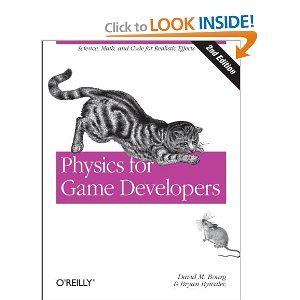
Physics for Game Developers Science math and code for realistic effects 2nd Edition by David M Bourg, Bryan Bywalec ISBN 1449392512 9781449392512


Original price was: $50.00.$35.00Current price is: $35.00.
Physics for Game Developers Science math and code for realistic effects 2nd Edition by David M Bourg, Bryan Bywalec – Ebook PDF Instant Download/Delivery: 1449392512, 9781449392512
Full download Physics for Game Developers Science math and code for realistic effects 2nd Edition after payment
Product details:
ISBN 10: 1449392512
ISBN 13: 9781449392512
Author: David M Bourg, Bryan Bywalec
Physics for Game Developers Science math and code for realistic effects 2nd Table of contents:
-
I. Fundamentals
-
Basic Concepts
-
Newton’s Laws of Motion
-
Units and Measures
-
Coordinate System
-
Vectors
-
Derivatives and Integrals
-
Mass, Center of Mass, and Moment of Inertia
-
Newton’s Second Law of Motion
-
Inertia Tensor
-
Relativistic Time
-
-
Kinematics
-
Velocity and Acceleration
-
Constant Acceleration
-
Nonconstant Acceleration
-
2D Particle Kinematics
-
3D Particle Kinematics
-
X Components
-
Y Components
-
Z Components
-
The Vectors
-
Hitting the Target
-
Kinematic Particle Explosion
-
Rigid-Body Kinematics
-
Local Coordinate Axes
-
Angular Velocity and Acceleration
-
-
Force
-
Forces
-
Force Fields
-
Friction
-
Fluid Dynamic Drag
-
Pressure
-
Buoyancy
-
Springs and Dampers
-
Force and Torque
-
Summary
-
-
Kinetics
-
Particle Kinetics in 2D
-
Particle Kinetics in 3D
-
X Components
-
Y Components
-
Z Components
-
Cannon Revised
-
Rigid-Body Kinetics
-
-
Collisions
-
Impulse-Momentum Principle
-
Impact
-
Linear and Angular Impulse
-
Friction
-
-
Projectiles
-
Simple Trajectories
-
Drag
-
Magnus Effect
-
Variable Mass
-
-
-
II. Rigid-Body Dynamics
-
Real-Time Simulations
-
Integrating the Equations of Motion
-
Euler’s Method
-
Better Methods
-
Summary
-
-
Particles
-
Simple Particle Model
-
Integrator
-
Rendering
-
The Basic Simulator
-
Implementing External Forces
-
Implementing Collisions
-
Particle-to-Ground Collisions
-
Particle-to-Obstacle Collisions
-
Tuning
-
-
2D Rigid-Body Simulator
-
Model
-
Transforming Coordinates
-
Integrator
-
Rendering
-
The Basic Simulator
-
Tuning
-
-
Implementing Collision Response
-
Linear Collision Response
-
Angular Effects
-
-
Rotation in 3D Rigid-Body Simulators
-
Rotation Matrices
-
Quaternions
-
Quaternion Operations
-
Magnitude
-
Conjugate: The ~ operator
-
QVRotate
-
Quaternion multiplication: The * operator
-
Vector multiplication: The * operator
-
MakeQFromEulerAngles
-
MakeEulerAnglesFromQ
-
Quaternions in 3D Simulators
-
-
3D Rigid-Body Simulator
-
Model
-
Integration
-
Flight Controls
-
-
Connecting Objects
-
Springs and Dampers
-
Connecting Particles
-
Rope
-
Spring structure and variables
-
Initialize the particles and springs
-
Update the simulation
-
Connecting Rigid Bodies
-
Links
-
Basic structures and variables
-
Initialize
-
Update
-
Rotational Restraint
-
-
Physics Engines
-
Building Your Own Physics Engine
-
Physics Models
-
Simulated Objects Manager
-
Collision Detection
-
Collision Response
-
Force Effectors
-
Numerical Integrator
-
-
-
III. Physical Modeling
-
Aircraft
-
Geometry
-
Lift and Drag
-
Other Forces
-
Control
-
Modeling
-
-
Ships and Boats
-
Stability and Sinking
-
Stability
-
Sinking
-
Ship Motions
-
Heave
-
Roll
-
Pitch
-
Coupled Motions
-
Resistance and Propulsion
-
General Resistance
-
Planing craft
-
Virtual mass
-
Guidance speeds
-
Propulsion
-
Maneuverability
-
Rudders and Thrust Vectoring
-
Propeller walk
-
-
Cars and Hovercraft
-
Cars
-
Resistance
-
Power
-
Stopping Distance
-
Steering
-
Hovercraft
-
How Hovercraft Work
-
Resistance
-
Steering
-
-
Guns and Explosions
-
Projectile Motion
-
Taking Aim
-
Zeroing the Sights
-
Bullet drop: Gravity and air resistance
-
Wind
-
Breathing and Body Position
-
Recoil and Impact
-
Explosions
-
Particle Explosions
-
Polygon Explosions
-
-
Sports
-
Modeling a Golf Swing
-
Solving the Golf Swing Equations
-
Billiards
-
Implementation
-
Initialization
-
Stepping the Simulation
-
Calculating Forces
-
Handling Collisions
-
-
-
IV. Digital Physics
-
Touch Screens
-
Types of Touch Screens
-
Resistive
-
Capacitive
-
Infrared and Optical Imaging
-
Exotic: Dispersive Signal and Surface Acoustic Wave
-
Step-by-Step Physics
-
Resistive Touch Screens
-
One-dimensional resistive touch sensor
-
Four-wire resistive touch screen
-
Capacitive Touch Screens
-
Self-capacitance
-
Mutual capacitance
-
Example Program
-
Multitouch
-
Other Considerations
-
Haptic Feedback
-
Modeling Touch Screens in Games
-
Difference from Mouse-Based Input
-
Custom Gestures
-
-
Accelerometers
-
Accelerometer Theory
-
MEMS Accelerometers
-
Common Accelerometer Specifications
-
Data Clipping
-
Sensing Orientation
-
Sensing Tilt
-
Using Tilt to Control a Sprite
-
Two Degrees of Freedom
-
-
Gaming from One Place to Another
-
Location-Based Gaming
-
Geocaching and Reverse Geocaching
-
Mixed Reality
-
Street Games
-
What Time Is It?
-
Two-Dimensional Mathematical Treatment
-
Location, Location, Location
-
Distance
-
Great-Circle Heading
-
Rhumb Line
-
-
Pressure Sensors and Load Cells
-
Under Pressure
-
Example Effects of High Pressure
-
Button Mashing
-
Load Cells
-
Tiny scales
-
Center of gravity
-
Barometers
-
-
3D Display
-
Binocular Vision
-
Stereoscopic Basics
-
The Left and Right Frustums
-
Types of Display
-
Complementary-Color Anaglyphs
-
Linear and Circular Polarization
-
Liquid-Crystal Plasma
-
Autostereoscopy
-
Advanced Technologies
-
Programming Considerations
-
Active Stereoization
-
Passive Stereoization
-
-
Optical Tracking
-
Sensors and SDKs
-
Kinect
-
OpenCV
-
Numerical Differentiation
-
-
Sound
-
What Is Sound?
-
Characteristics of and Behavior of Sound Waves
-
Harmonic Wave
-
Superposition
-
Speed of Sound
-
Attenuation
-
Reflection
-
Doppler Effect
-
3D Sound
-
How We Hear in 3D
-
A Simple Example
-
-
-
Appendices
-
A. Vector Operations
-
Vector Class
-
Magnitude
-
Normalize
-
Reverse
-
Vector Addition: The += Operator
-
Vector Subtraction: The −= Operator
-
Scalar Multiplication: The *= Operator
-
Scalar Division: The /= Operator
-
Conjugate: The − Operator
-
Vector Functions and Operators
-
Vector Addition: The + Operator
-
Vector Subtraction: The − Operator
-
Vector Cross Product: The ^ Operator
-
Vector Dot Product: The * Operator
-
Scalar Multiplication: The * Operator
-
Scalar Division: The / Operator
-
Triple Scalar Product
-
-
B. Matrix Operations
-
Matrix3×3 Class
-
Determinant
-
Transpose
-
Inverse
-
Matrix Addition: The += Operator
-
Matrix Subtraction: The −= Operator
-
Scalar Multiplication: The *= Operator
-
Scalar Division: The /= Operator
-
Matrix Functions and Operators
-
Matrix Addition: The + Operator
-
Matrix Subtraction: The − Operator
-
Scalar Divide: The / Operator
-
Matrix Multiplication: The * Operator
-
Scalar Multiplication: The * Operator
-
Vector Multiplication: The * Operator
-
-
C. Quaternion Operations
-
Quaternion Class
-
Magnitude
-
GetVector
-
GetScalar
-
Quaternion Addition: The += Operator
-
Quaternion Subtraction: The −= Operator
-
Scalar Multiplication: The *= Operator
-
Scalar Division: The /= Operator
-
Conjugate: The ~ Operator
-
Quaternion Functions and Operators
-
Quaternion Addition: The + Operator
-
Quaternion Subtraction: The − Operator
-
Quaternion Multiplication: The * Operator
-
Scalar Multiplication: The * Operator
-
Vector Multiplication: The * Operator
-
-
People also search for Physics for Game Developers Science math and code for realistic effects 2nd:
is physics math and science
physics data science jobs
does game development require math
how is math used in game development
physics for game developers