

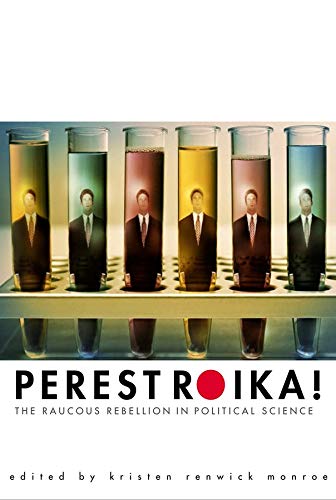
Perestroika The Raucous Rebellion in Political Science 1st Edition by Kristen Renwick Monroe ISBN 0300130201 9780300130201


Original price was: $50.00.$35.00Current price is: $35.00.
Perestroika The Raucous Rebellion in Political Science 1st Edition by Kristen Renwick Monroe – Ebook PDF Instant Download/Delivery: 0300130201, 9780300130201
Full download Perestroika The Raucous Rebellion in Political Science 1st Edition after payment
Product details:
ISBN 10: 0300130201
ISBN 13: 9780300130201
Author: Kristen Renwick Monroe
An examination of the movement that has turned the discipline of political science upside down
This superb volume describes the events and ramifications of a revolt within the political science discipline that began in 2000 with a disgruntled e-mail message signed by one “Mr. Perestroika.” The message went to seventeen recipients who quickly forwarded it to others, and soon the Perestroika revolt became a major movement calling for change in the American political science community.
What is the Perestroika movement? Why did it occur? What has it accomplished? What remains to be done? Most important, what does it tell us about the nature of political science, about methodological pluralism and diversity, about the process of publishing scholarly work, and about graduate education in the field? The contributors to the book—thoughtful political scientists who offer a variety of perspectives—set the Perestroika movement in historical and comparative contexts. They address many topics related to heart of the debate—a desire for tolerance of methodological diversity—and assess the changes that have come in the wake of Perestroika. For political scientists and their graduate students, and for those interested in the history or sociology of Social Sciences, this volume is essential reading.
Table of contents:
Part 1: History, Background, and Perspectives of Perestroika
1. The Idea: The Opening of Debate Perestroika
2. Perestroika and Its Other – Susanne Hoeber Rudolph
3. Not Here, Not Now! The Absence of a European Perestroika Movement – Catarina Kinnvall
4. Every Poet His Own Aristotle – Theodore J. Lowi
5. Letter to a Graduate Student – Samuel H. Beer
Part 2: Methodological Concerns
6. Problems, Methods, and Theories in the Study of Politics – Ian Shapiro
7. Rational Choice, Symbolic Politics, and Pluralism in the Study of Violent Conflict – Stuart J. Kaufman
8. A Return to Politics: Perestroika, Phronesis, and Postparadigmatic Political Science – Sanford F. Schram
9. The Perestroikan Challenge to Social Science – David D. Laitin
10. Interpretation and Institution: Rational Choice and the Problem of Social Action – Brian Caterino
11. The “R” Word, Narrative, and Perestroika: A Critique of Language and Method – Cecelia Lynch
12. Work That Counts – Elizabeth Sanders
13. Lost in Translation: The Challenges of State-Generated Data in Developing Countries – Kamal Sadiq
14. In the House of “Science,” There Are Many Rooms – Dvora Yanow
15. Will the Real Perestroikniks Please Stand Up? – Dorian T. Warren
16. Let a Hundred Flowers Bloom, Let a Hundred Schools of Thought Contend – Lloyd I. Rudolph
Part 3: Governance
17. The Case against Mandatory Competition for APSA Offices – Gary C. Jacobson
18. Democracy versus Diversity—A False Dichotomy – Marsha Pripstein Posusney
19. Governance: Minutes from a Public Meeting – Kristen Renwick Monroe
20. Ironic Representation – Joanna Vecchiarelli Scott
21. Introducing Democracy in the APSA – Lloyd I. Rudolph
22. Confessions of a Confused Democrat – Martha Ackelsberg
Part 4: The Journals
23. The Emperor Had No Clothes: The Politics of Taking Back the APSR – Sven Steinmo
24. Methodological Bias in the APSR – David Pion-Berlin and Dan Cleary
25. The APSR in the Perestroika Era – Lee Sigelman
26. Inventing Perspectives on Politics – Jennifer Hochschild
27. Methodological Bias in the American Journal of Political Science – Gregory J. Kasza
28. Science, Political Science, and the American Journal of Political Science – Kim Quaile Hill and Jan E. Leighley
Part 5: Graduate Education
29. 2004 Report to the Council – APSA Task Force on Graduate Education
30. The Graduate Student Experience – Peregrine Schwartz-Shea
31. Graduate Education in a Pluralist Context – Leslie E. Anderson
32. Quantitative Methods: Reflections on the Files of Recent fob Applicants – Gregory J. Kasza
33. On Curricular Perestroika: Seven Principles of Methodological Pluralism – Hayward R. Alker
Part 6: Assessment
34. Caught between Confused Critics and Careerist Co-Conspirators: Perestroika in American Political Science – Timothy W. Luke
35. After Methodology: Toward a Profession of Political Science – Maurice J. Meilleur
36. A Pox on Perestroika, a Hex on Hegemony: Toward a Critical Political Science – John S. Dryzek
37. Of Means and Meaning: The Challenges of Doing Good Political Science – Rogers M. Smith
38. Perestroika, Politics, and the Profession: Targets and Tolerance – Robert Jervis
39. Reforming the Discipline: Some Doubts – Peter J. Steinberger
People also search for:
the perestroika
perestroika and the fall of the soviet union
perestroika resulted in (choose two)
perestroika apush
perestroika economic reforms
Tags: Kristen Renwick Monroe, Perestroika, Raucous Rebellion, Political Science