

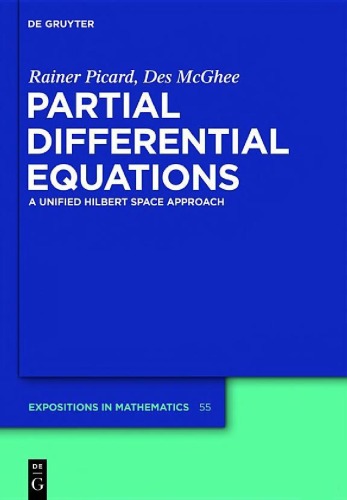
Partial Differential Equations A Unified Hilbert Space Approach 1st Edition by Rainer Picard, Des McGhee ISBN 3110250268 9783110250268

Original price was: $50.00.$35.00Current price is: $35.00.
Partial Differential Equations A Unified Hilbert Space Approach 1st Edition by Rainer Picard, Des McGhee – Ebook PDF Instant Download/Delivery: 3110250268, 9783110250268
Full download Partial Differential Equations A Unified Hilbert Space Approach 1st Edition after payment
Product details:
ISBN 10: 3110250268
ISBN 13: 9783110250268
Author: Rainer Picard, Des McGhee
This book is intended to be used as a rather informal, and surely not complete, textbook on the subjects indicated in the title. It collects my Lecture Notes held during three academic years at the University of Siena for a one semester course on “Basic Mathematical Physics”, and is organized as a short presentation of few important points on the arguments indicated in the title. It aims at completing the students’ basic knowledge on Ordinary Differential Equations (ODE) – dealing in particular with those of higher order – and at providing an elementary presentation of the Partial Differential Equations (PDE) of Mathematical Physics, by means of the classical methods of separation of variables and Fourier series. For a reasonable and consistent discussion of the latter argument, some elementary results on Hilbert spaces and series expansion in othonormal vectors are treated with some detail in Chapter 2. Prerequisites for a satisfactory reading of the present Notes are not only a course of Calculus for functions of one or several variables, but also a course in Mathematical Analysis where – among others – some basic knowledge of the topology of normed spaces is supposed to be included. For the reader’s convenience some notions in this context are explicitly recalled here and there, and in particular as an Appendix in Section 1.4. An excellent reference for this general background material is W. Rudin’s classic Principles of Mathematical Analysis. On the other hand, a complete discussion of the results on ODE and PDE that are here just sketched are to be found in other books, specifically and more deeply devoted to these subjects, some of which are listed in the Bibliography. In conclusion and in brief, my hope is that the present Notes can serve as a second quick reading on the theme of ODE, and as a first introductory reading on Fourier series, Hilbert spaces, and PDE
Partial Differential Equations A Unified Hilbert Space Approach 1st Table of contents:
1 Ordinary differential equations
Introduction
1.1 Ordinary differential equations (ODEs) of the first order
Local existence and uniqueness of solutions to the IVP
Continuation of solutions, maximal solutions, global solutions
Question: where are the (maximal) solutions of an ODE defined?
1.2 Systems of first-order differential equations
A. Solution of (1.2.4)
B. The IVP for (1.2.4)
C. Lipschitz and locally Lipschitz functions F:A⊂Rn+1→Rm
D. Local existence and uniqueness of solutions of the IVP (1.2.5)
E. Global solutions of (1.2.4) (when A=I×ℝn)
1.3 Linear systems of first-order ODEs
Fundamental system of solutions of (1.3.5). Fundamental matrix
1.4 Linear systems with constant coefficients. The exponential matrix
A. Series of matrices and their convergence
B. The exponential matrix etA as a fundamental matrix for X′=AX
Computation of etA
1.5 Higher-order ODEs
B. The IVP problem (Cauchy problem) for (1.5.1)
C. Equivalence between an nth-order ODE and a first-order system
D. Existence and uniqueness theorems for the IVP
1.6 Linear ODEs of higher order
General solution of (1.6.1) and its relation with the general solution of the homogeneous equation
Criterion for the linear independence of solutions: Wronskian determinant
1.7 Additions and exercises
A1. Boundary value problems for linear second-order ODEs
Exercises
E1. Solutions of some of the exercises given in the text
Section 1.1
Exercise 1.1
Section 1.2
Exercise 2.1
Section 1.3
Proof of Proposition 1.3.1
Proof of Proposition 1.3.2
Proof of Proposition 1.3.3
Section 1.5
Exercise 5.2
Section 1.6
Exercise 6.1
E2. Further exercises
Systems of linear equations with constant coefficients (Section 1.4)
2 Metric and normed spaces
Introduction
2.1 Sequences and series of functions. Uniform convergence
Bounded functions
Series of functions
Example: power series
2.2 Metric spaces and continuous functions
Distance. Open sets. Interior of a set
Convergent sequences and Cauchy sequences. Complete metric spaces
Continuous functions between metric spaces
Uniformly continuous and Lipschitz continuous functions
The contraction mapping theorem
Proof of Theorem 2.2.4
More on metric spaces
Closed sets. Closure of a set
Bounded sets. Diameter of a set
2.3 Some function spaces
Application: local existence and uniqueness of solutions to the IVP for first-order ODEs
2.4 Banach spaces
The spaces Ck(Ω‾),Ω⊂Rn
Convergence of series in normed and Banach spaces
Total convergence of a series of bounded functions
2.5 Compactness
Subsequences
The Bolzano–Weierstrass theorem
Compact sets
Compactness and continuity
Compactness and uniform continuity (Heine–Cantor’s theorem)
2.6 Connectedness
Connectedness and continuity
2.7 Additions and exercises
A1. Further properties of power series
Radius of convergence
Regularity properties of the function sum of a power series
Taylor expansion
A2. Equivalent norms in a vector space
A3. Further examples of bounded linear Operators
Exercises
Further exercises
3 Fourier series and Hilbert spaces
Introduction
3.1 Inner product spaces. Orthogonal projection onto a subspace
The Cauchy–Schwarz inequality
Orthogonality
Orthogonal projection onto a finite-dimensional subspace
Additional remarks
Some questions
3.2 Fourier series
Enlarging the space of 2π-periodic functions: from C2π(ℝ) to Cˆ2π(R)
Piecewise continuous functions
Back to the 2π-periodic functions
Inner product for piecewise continuous functions
Back to Fourier series
Further questions to discuss about Fourier series
1. Pointwise and uniform convergence of Fourier series
2. Abstract (i. e., general) versions of the results discussed in this section
3.3 Orthonormal systems in inner product spaces. Sequence spaces
1. A useful equality
2. Bessel’s inequality and Parseval’s identity
Two problems
Question A
Question B
3. Total orthonormal systems
The sequence spaces lp
The special case p=2
Inner product in l2
Norm induced by the inner product
A prototype orthonormal system
3.4 Hilbert spaces. Projection onto a closed convex set
The Lebesgue integral and the Lp spaces
1. Measure and integration
2. The Lp spaces
Special cases
3. The special case p=2
Additional results for Hilbert spaces
Proof of Theorem 3.4.2
Orthonormal systems in a Hilbert space
3.5 Additions and exercises
A1. Some remarks on orthonormal systems
A2. Some spectral theory for ordinary differential operators
Existence of the eigenvalues
The spectral theorem for Sturm–Liouville eigenvalue problems
1. The (possible) eigenvalues λ of (EVP) are all >0
2. The key point for the existence of the eigenvalues
3. The Green’s function
4. Further properties of eigenvalues and eigenfunctions
(a) A new function space
(b) Reduction of (EVP) to its weak form
(c) Operator form of (EVP)
Properties of K
(d) The spectral theorem for compact, symmetric, positive operators in Hilbert space
Exercises
E1. Solutions of some of the exercises given in the text
Section 3.1
Exercise 1.1
Exercise 1.2
Exercise 1.3
Exercise 1.4
Section 3.2
Exercise 2.1
Exercise 2.2
Example 3.2.4: f(x)=x(|x|≤π)
Example 3.2.6: f(x)=|x|(|x|≤π)
Section 3.3
Exercise 3.1
Exercise 3.2
Section 3.4
Exercise 4.1
Exercise 4.2
Exercise 4.3
Exercise 4.4
4 Partial differential equations
Introduction
4.1 Partial differential equations (PDEs). The PDEs of mathematical physics
PDEs of the second order
Explicit resolution of PDEs
Linear PDEs of the second order
A. The Poisson equation
B. The heat equation
C. The wave equation
General features of the BVP/IVP under study
Three general remarks
1. (Uniqueness)
2. (“Superposition principle”)
3. (Series solution of (4.1.34))
The Dirichlet and Neumann problems for Poisson’s equation
Remarks on the assumptions on Ω
Remarks on connectedness
The divergence theorem (Gauss’ theorem)
Proof of Theorem 4.1.2
4.2 The Dirichlet problem for the Laplace equation in a rectangle (I)
Methods: separation of variables + Fourier series
Boundary conditions
Conclusion
4.3 Pointwise and uniform convergence of Fourier series
Examples with numerical applications
Piecewise C1 functions
4.4 The Dirichlet problem for the Laplace equation in a rectangle (II)
Sine and cosine Fourier series
1. Regularity of functions defined as the sum of a series
2. Specific bounds for the derivatives in problem (D)
3. Uniform bounds in the whole domain is sometimes too much
4.5 The Cauchy–Dirichlet problem for the heat equation
A. Separation of variables+boundary condition+series solution
B. Imposition of the initial condition
Choose the coefficients bn
Extension to any number of space variables
Conclusion (about (CD))
People also search for Partial Differential Equations A Unified Hilbert Space Approach 1st:
partial differential equations a unified hilbert
partial differential equations a unified hilbert space approach
difference between differential equations and partial differential equations
partial differential equations explained
partial differential equations haberman
Tags: Rainer Picard, Des McGhee, Partial, Equations