

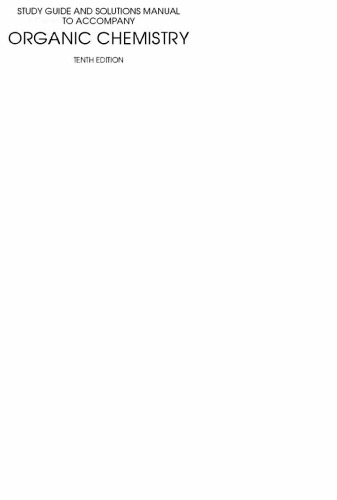
Organic Chemistry Student Study Guide 10th Edition by TW Graham Solomons, Craig B Fryhle ISBN 047047839X 9780470478394

Original price was: $50.00.$35.00Current price is: $35.00.
Organic Chemistry Student Study Guide 10th Edition by TW Graham Solomons, Craig B Fryhle – Ebook PDF Instant Download/Delivery: 047047839X, 9780470478394
Full download Organic Chemistry Student Study Guide 10th Edition after payment
Product details:
ISBN 10: 047047839X
ISBN 13: 9780470478394
Author: TW Graham Solomons, Craig B Fryhle
Organic Chemistry Student Study Guide 10th Table of contents:
Chapter 1 Chemical Bonding and Chemical Structure
Chapter 1 Summary
Study Guide Links
1.1 A Refresher on Vector Addition
Further Explorations
1.1 Electron Density Distribution in Orbitals
1.2 Fractional Hybridization
1.3 Dipole Moments and Charge Separation
Solutions to Focused Problems
Solutions to Skills Objectives Problems
Solutions to Integrated Problems
Chapter 2 Alkanes and Organic Nomenclature
Chapter 2 Summary
Study Guide Links
2.1 Nomenclature of Simple Branched Compounds
Further Explorations
2.1 Atomic Radii and van der Waals Repulsion
Reaction Review
Solutions to Focused Problems
Solutions to Skills Objectives Problems
Solutions to Integrated Problems
Chapter 3 The Curved-Arrow Notation, Resonance, Acids and Bases, and Chemical Equilibrium
Chapter 3 Summary
Study Guide Links
3.1 Rules for Use of the Curved-Arrow Notation
3.2 Identification of Acids and Bases
Solutions to Focused Problems
Solutions to Skills Objectives Problems
Solutions to Integrated Problems
Chapter 4 Introduction to Alkenes and Alkynes Structure and Reactivity
Chapter 4 Summary
Study Guide Links
4.1 Different Ways to Draw the Same Structures
4.2 Drawing Structures from Names
4.3 Solving Structure Problems
Further Explorations
4.1 Relationship between Free Energy and Enthalpy
4.2 Sources of Heats of Formation
4.3 Molecular Orbital Description of Hyperconjugation
4.4 Activation Energy
Reaction Review
Solutions to Focused Problems
Solutions to Skills Objectives Problems
Solutions to Integrated Problems
Chapter 5 Addition Reactions of Alkenes and Alkynes
Chapter 5 Summary
Study Guide Links
5.1 How to Study Organic Reactions
5.2 How to Solve Structure Problems
Further Explorations
5.1 Mechanism of Organoborane Oxidation
5.2 Mechanism of Ozonide Conversion into Carbonyl Compounds
Reaction Review
Solutions to Focused Problems
Solutions to Skills Objectives Problems
Solutions to Integrated Problems
Chapter 6 Principles of Stereochemistry
Chapter 6 Summary
Study Guide Links
6.1 Stereocenters and Asymmetric Atoms
Further Explorations
6.1 Terminology of Racemates
6.2 Isolation of Conformational Enantiomers
Solutions to Focused Problems
Solutions to Skills Objectives Problems
Solutions to Integrated Problems
Chapter 7 Cyclic Compounds and Reaction Stereochemistry
Chapter 7 Summary
Study Guide Links
7.1 Relating Cyclohexane Conformations
7.2 Reactions of Chiral Molecules
7.3 Analysis of Reaction Stereochemistry
7.4 Stereoselective and Stereospecific Reactions
7.5 When Stereoselectivity Matters
Further Explorations
7.1 Other Ways of Designating Relative Configuration
7.2 Alkenelike Behavior of Cyclopropanes
7.3 Optical Activity
7.4 Stereochemistry of Organoborane Oxidation
Solutions to Focused Problems
Solutions to Skills Objectives Problems
Solutions to Integrated Problems
Chapter 8 Nomenclature and Noncovalent Intermolecular Interactions
Chapter 8 Summary
Further Explorations
8.1 Trouton’s Rule
Solutions to Focused Problems
Solutions to Skills Objectives Problems
Solutions to Integrated Problems
Chapter 9 The Chemistry of Alkyl Halides Substitution and Elimination Reactions
Chapter 9 Summary
Study Guide Links
9.1 Deducing Mechanisms from Rate Laws
9.2 Ring Carbons as Alkyl Substituents
9.3 Diagnosing Reactivity Patterns in Substitution and Elimination Reactions
Further Explorations
9.1 Reaction Rates
9.2 Absolute Rate Theory
Reaction Review
Solutions to Focused Problems
Solutions to Skills Objectives Problems
Solutions to Integrated Problems
Chapter 10 Free-Radical Reactions, Main Group Organometallic Compounds, and Carbenes
Chapter 10 Summary
Further Explorations
10.1 Bond Dissociation Energies and Heats of Reaction
10.2 Mechanism of Formation of Grignard Reagents
Reaction Review
Solutions to Focused Problems
Solutions to Skills Objectives Problems
Solutions to Integrated Problems
Chapter 11 The Chemistry of Alcohols and Thiols
Chapter 11 Summary
Study Guide Links
11.1 More on Half-Reactions
Further Explorations
11.1 Solvation of Tertiary Alkoxides
11.2 Mechanism of Sulfonate Ester Formation
11.3 Symmetry Relationships Among Constitutionally Equivalent Groups
Reaction Review
Solutions to Focused Problems
Solutions to Skills Objectives Problems
Solutions to Integrated Problems
Chapter 12 The Chemistry of Ethers, Epoxides, Glycols, and Sulfides
Chapter 12 Summary
Study Guide Links
12.1 Learning New Reactions from Earlier Reactions
12.2 Common Intermediates from Different Starting Materials
Further Explorations
12.1 Mechanism of OsO4 Addition
Reaction Review
Solutions to Focused Problems
Solutions to Skills Objectives Problems
Solutions to Integrated Problems
Chapter 13 Introduction to Spectroscopy Infrared Spectroscopy and Mass Spectrometry
Chapter 13 Summary
Further Explorations
13.1 The Vibrating Bond in Quantum Theory
13.2 FT-IR Spectroscopy
13.3 The Mass Spectrometer
Solutions to Focused Problems
Solutions to Skills Objectives Problems
Solutions to Integrated Problems
Chapter 14 Nuclear Magnetic Resonance Spectroscopy
Chapter 14 Summary
Study Guide Links
14.1 Approaches to Problem Solving
14.2 More NMR Problem-Solving Hints
Further Explorations
14.1 Quantitative Estimation of Chemical Shifts
14.2 Fourier-Transform NMR
Solutions to Focused Problems
Solutions to Skills Objectives Problems
Solutions to Integrated Problems
Chapter 15 Dienes and Aromaticity
Chapter 15 Summary
Study Guide Links
15.1 A Terminology Review
Further Explorations
15.1 More on UV Spectroscopy
15.2 The π Molecular Orbitals of Benzene
Reaction Review
Solutions to Focused Problems
Solutions to Skills Objectives Problems
Solutions to Integrated Problems
Chapter 16 The Chemistry of Benzene and Its Derivatives
Chapter 16 Summary
Study Guide Links
16.1 NMR of Para-Substituted Benzene Derivatives
16.2 Different Sources of the Same Reactive Intermediate
16.3 Reaction Conditions and Reaction Rate
Reaction Review
Solutions to Focused Problems
Solutions to Skills Objectives Problems
Solutions to Integrated Problems
Chapter 17 Allylic and Benzylic Reactivity
Chapter 17 Summary
Study Guide Links
17.1. Synthetic Equivalence
Further Explorations
17.1 Addition versus Substitution with Bromine
Reaction Review
Solutions to Focused Problems
Solutions to Skills Objectives Problems
Solutions to Integrated Problems
Chapter 18 The Chemistry of Aryl Halides, Vinylic Halides, and Phenols
Chapter 18 Summary
Study Guide Links
18.1 Contrast of Aromatic Substitution Reactions
18.2 The Cumene Hydroperoxide Rearrangement
Further Explorations
18.1 The Fries Rearrangement
Reaction Review
Solutions to Focused Problems
Solutions to Skills Objectives Problems
Solutions to Integrated Problems
Chapter 19 The Chemistry of Aldehydes and Ketones Carbonyl-Addition Reactions
Chapter 19 Summary
Study Guide Links
19.1 Lewis Acid Catalysis
19.2 Hemiacetal Protonation
19.3 Mechanism of Carbinolamine Formation
19.4 Dehydration of Carbinolamines
19.5 Mechanism of the Wolff–Kishner Reaction
Further Explorations
19.1 IR Absorptions of Cyclic Ketones
19.2 Use of Imines for Characterization of Aldehydes and Ketones
Reaction Review
Solutions to Focused Problems
Solutions to Skills Objectives Problems
Solutions to Integrated Problems
Chapter 20 The Chemistry of Carboxylic Acids
Chapter 20 Summary
Study Guide Links
20.1 Reactions of Bases with Carboxylic Acids
20.2 Resonance Effect on Carboxylic Acid Acidity
20.3 Mechanism of Acid Chloride Formation
20.4 More on Synthetic Equivalents
20.5 Mechanism of Anhydride Formation
Further Explorations
20.1 Chemical Shifts of Carbonyl Carbons
20.2 More on Surfactants
20.3 Orthoesters
20.4 Mechanism of the LiAlH4 Reduction of Carboxylic Acids
Reaction Review
Solutions to Focused Problems
Solutions to Skills Objectives Problems
Solutions to Integrated Problems
Chapter 21 The Chemistry of Carboxylic Acid Derivatives
Chapter 21 Summary
Study Guide Links
21.1 Solving Structure Problems Involving Nitrogen-Containing Compounds
21.2 Basicity of Nitriles
21.3 Mechanism of Ester Hydrolysis
21.4 Another Look at the Friedel–Crafts Reaction
21.5 Esters and Nucleophiles
Further Explorations
Reaction Review
Solutions to Focused Problems
Solutions to Skills Objectives Problems
Solutions to Integrated Problems
Chapter 22 The Chemistry of Enolate Ions, Enols, and α,β-Unsaturated Carbonyl Compounds
Chapter 22 Summary
Study Guide Links
22.1 Ionization versus Nucleophilic Reaction at the Carbonyl Carbon
22.2 Kinetic versus Thermodynamic Stability of Enols
22.3 Dehydration of β-Hydroxy Carbonyl Compounds
22.4 Understanding Condensation Reactions
22.5 Variants of the Aldol and Claisen Condensations
22.6 More Target Analysis for the Claisen Condensation
22.7 Synthetic Equivalents in Conjugate Addition
Further Explorations
22.1 Malonic Ester Alkylations
22.2 Alkylation of Enolate Ions Derived from Ketones
22.3 Conjugate Addition of Organocuprate Reagents
Reaction Review
Solutions to Focused Problems
Solutions to Skills Objectives Problems
Solutions to Integrated Problems
Chapter 23 The Chemistry of Amines
Chapter 23 Summary
Study Guide Links
23.1 Nitration of Aniline
23.2 Mechanism of the Curtius Rearrangement
23.3 Formation and Decarboxylation of Carbamic Acids
Further Explorations
23.1 Alkyl Group Polarization in Ionization Reactions
23.2 Structures of Amide Bases
23.3 Mechanism of Diazotization
Reaction Review
Solutions to Focused Problems
Solutions to Skills Objectives Problems
Solutions to Integrated Problems
Chapter 24 Carbohydrates
Chapter 24 Summary
Study Guide Links
24.1 Acid Catalysis of Carbohydrate Reactions
24.2 Configurations of Aldaric Acids
Further Explorations
24.1 Nomenclature of Anomers
24.2 More on the Fischer Proof
Reaction Review
Solutions to Focused Problems
Solutions to Skills Objectives Problems
Solutions to Integrated Problems
Chapter 25 The Chemistry of Thioesters, Phosphate Esters, and Phosphate Anhydrides
Chapter 25 Summary
Further Explorations
25.1 Pentacovalent Intermediates in Phosphate Ester Hydrolysis
Reaction Review
Solutions to Focused Problems
Solutions to Skills Objectives Problems
Solutions to Integrated Problems
Chapter 26 The Chemistry of the Aromatic Heterocycles and Nucleic Acids
Chapter 26 Summary
Further Explorations
26.1 Relative Acidities of 1,3-Cyclopentadiene and Pyrrole
Reaction Review
Solutions to Focused Problems
Solutions to Skills Objectives Problems
Solutions to Integrated Problems
Chapter 27 Amino Acids, Peptides, and Proteins
Chapter 27 Summary
Further Explorations
27.1 Solid-Phase Peptide Synthesis
Reaction Review
Solutions to Focused Problems
Solutions to Skills Objectives Problems
Solutions to Integrated Problems
Chapter 28 Pericyclic Reactions
Chapter 28 Summary
Study Guide Links
28.1 Frontier Orbitals
28.2 Orbital Analysis of Sigmatropic Reactions
Reaction Review
Solutions to Focused Problems
Solutions to Skills Objectives Problems
Solutions to Integrated Problems
People also search for Organic Chemistry Student Study Guide 10th:
organic chemistry study guide and solutions manual pdf
organic chemistry principles and mechanisms study guide and solutions manual
study guide and solutions manual to accompany organic chemistry pdf
student study guide and solutions manual to accompany organic chemistry
organic chemistry solutions manual and study guide looseleaf with access
Tags: TW Graham Solomons, Craig B Fryhle, Organic Chemistry, Student Study