

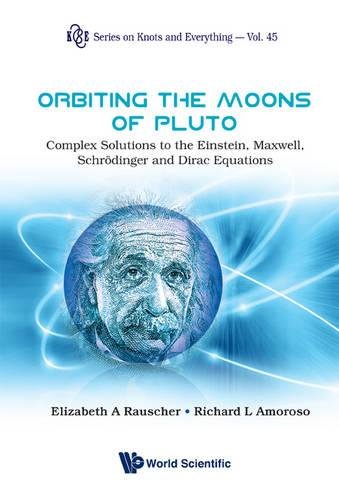
Orbiting the Moons of Pluto Complex Solutions to the Einstein Maxwell Schrodinger and Dirac Equations 1st Edition by Elizabeth A Rauscher, Richard L Amoroso ISBN 9814324248 9789814324243


Original price was: $50.00.$35.00Current price is: $35.00.
Orbiting the Moons of Pluto Complex Solutions to the Einstein Maxwell Schrodinger and Dirac Equations 1st Edition by Elizabeth A Rauscher, Richard L Amoroso – Ebook PDF Instant Download/Delivery: 9814324248, 9789814324243
Full download Orbiting the Moons of Pluto Complex Solutions to the Einstein Maxwell Schrodinger and Dirac Equations 1st Edition after payment
Product details:
ISBN 10: 9814324248
ISBN 13: 9789814324243
Author: Elizabeth A Rauscher, Richard L Amoroso
Orbiting the Moons of Pluto Complex Solutions to the Einstein Maxwell Schrodinger and Dirac Equations 1st Table of contents:
1. Introduction – Orbiting the Moons of Pluto
1.1 Introduction
1.2 Multidimensional Minkowski Space
References
2. Structure, Properties and Implications of Complex Minkowski Spaces
2.1 Some Predictions of Complex Geometries
2.2 Multidimensional Geometric Models and Macroscopic Remote Connectedness
2.3 The Lorentz Condition in Complex 8-Space Geometry and Tachyonic Signaling
2.4 Velocity of Propagation in Complex 8-Space
2.5 Kaluza-Klein Geometries: A Possible Unification of Electro- magnetic and Gravitational Phenomena
2.6 Additional Thoughts on Current Physical Theory
References
3. Major Principles of Physics: Poincaré Invariance, Analyticity, Unitarity and Complex Minkowski S
3.1 Major Principles of Physics
References
4. Nonlocal Interconnectedness as a Fundamental Principle of Reality
4.1 Bell’s Theorem and Its Experimental Verification
4.2 More Recent Long Distance Confirmations of Bell’s Nonlocality
4.3 Implications of Bell’s Nonlocality Theorem
4.4 Conceptual and Philosophical Implications of Bell’s Theorem
4.4.1 Bell’s Theorem
4.4.2 Principle of Local Causes
4.4.3 Some Possible Conclusions About Bell’s Theorem
4.4.4 Contra-Factual Definiteness Fails
4.4.5 Possible Interpretations of the Wave Function, Y
4.4.6 Objections to the Reality of Quantum Theory
4.4.7 Locality Fails
4.4.8 Concluding Remarks
4.5 Other Nonlocal Interactive Phenomenon and the Particle-Wave “Paradox” Resolved
4.5.1 Young’s Double Slit Experiment and Its Extension, the Wheeler Delayed Choice Experiment
4.5.2 Delayed Choice as an Extension of Young’s Double Slit Experiment
4.5.3 The Aharanov-Bohm Experiment, Fields and Potentials as Mechanisms of Non-Local Interactions
4.5.4 Some Topics for Interference Experiments
4.5.5 Ernst Mach, Frames of Reference and Nonlocality
4.6 Conclusion
References and Notes
5. The Complexification of Maxwell’s Equations
5.1 Complex Electromagnetic Fields
5.2 Complex Electromagnetic Variables in Complex Multidimensional Spaces
5.3 Complex Electromagnetic Field Vectors, Virtual Energy States and Magnetic Monopole Interpretatio
5.4 Higgs Field Magnetic Monopole
5.5 Some Further Speculations on Monopole Structures
5.6 The Structure of Non-Hertzian Waves in Complex Geometries and Electromagnetic Energy Transmissio
5.7 Summary and Concluding Remarks
References and Notes
6. Vector and Scalar Potentials, Advanced and Retarded Waves and Nonlocal Phenomena
6.1 Vector and Scalar Potentials and Fields
6.2 Advanced and Retarded Solutions
References
7. The Complex Form of Relativistic Maxwell’s Equations
7.1 Relativistic Conditions for Maxwell’s Equations in Complex Geometries and Invariance of the Line
7.2 Complex E and B in Real 4-Space and the Complex Lorentz Condition
7.3 Complex Electromagnetic Forces in a Gravitational Field
References
8. Real and Complex Amended Maxwell’s Equations for Non-Abelian Gauge Groups
8.1 Introduction – Extended Maxwell’s Equations
8.2 Complexified Electromagnetic Fields in Minkowski Space and Nonlocality
8.3 The General Concept of Gauge Symmetry in Current Physics
8.4 New Gauge Conditions, Complex Minkowski Space and New Implications for Physics
8.5 Concluding Remarks
References
9. Sub and Superluminal Transformations of the Complex Vector Potential
9.1 Introduction
9.2 Complex Minkowski Spaces with Time Symmetry Considerations
9.3 Complex Transformations of the Vector Potential
9.4 Superluminal Vector and Scalar Potential Transformation Laws
References
10. The Schrödinger Equation in Complex Minkowski Space
10.1 Remote Connectedness and Coherent Collective Phenomena
10.2 Complex 8-Space and the Formation of Nonlocality
10.3 Space-Like Remote Connectedness, Bell’s Theorem and its Experimental Test
10.4 Complex 8-Space and Nonlocality
10.5 Solitary Wave and Coherent Non-dispersive Solutions in Complex Geometries
10.5.1 Nonlinear Schrödinger Equation with Complex Temporal Perturbation
10.5.2 The Schrödinger Equation in Complex Space and Time
10.5.3 Discussion and Application of Coherent State Solutions
10.6 Conclusion
References
11. Spinors, Twistors, Quaternions, and Complex Space
11.1 Introduction
11.2 The Spinor Formalism and their Relationship to Twistors
11.3 The Penrose Twistor, Harmonic Sequencing and Particle Spin
11.4 Penrose Twistor Fields, Particles and Nested Tori
11.5 Quaternions, Groups, and Allowable Spatial Structures
11.5.1 The Quaternion Formalism and Simple Topological Spaces
11.5.2 Quaternions and Quantum Theory
11.6 Conclusion
References
12. Relativistic Dirac Quantum Theory in Complex Minkowski Space and Tachyonic Signaling
12.1 Introduction
12.2 The Basic Structure of Physics Theories and Their Interrelation
12.3 The Basis and Structure of the Dirac Equation
12.4 The Relativistic Dirac Equation
12.5 The Dirac Equation in Complex 8-Space
12.5.1 Complexifying Spin Space
12.5.2 Nonlinear Formalsim of the Dirac Equation
12.5.3 Generalized Wave Equations, Classical, Quantum, Nonrelativistic and Relativistic in Linear an
References and Notes
13. Speculation on a Unified Field Theory (UFT), Grand Unification Theories (GUT) and Supersymmetry
13.1 The Observer in the Quest for Truth
13.2 GUT, TOE Supersymmetry Models, Complex 8-Spacetime and Kaluza-Klein Theory
13.3 Lorentz Transforms and the Universality of the Laws of Physics, Analyticity and Unitarity
13.3.1 Lorentz Invariant Conditions
13.3.2 The Analytic S-Matrix in Particle Physics
13.3.3 Conservation Principle in Quantum Mechanics and Relativity Theory
13.4 A Brief Background on Group Theory
References
14. Unity of Consciousness Experience, Nature of the Observer and Current Physical Theory
14.1 Role of the Observer in Modern Physical Theories
14.2 States of Consciousness and Reality Perceptive Modes
14.3 Defining Science and Mysticism: Methods in the Search for Knowledge
14.4 Some Basic Tenets of Science and the Western View: Duality, Causality and Object Grouping
14.5 Physical Models of Interconnectedness
14.6 Gödel’s Incompleteness Theorem and the Search for Truth
14.7 Observer / Participant and Schrödinger’s Cat
14.8 Particle, Processes, Geometry and Spacetime Independence of Consciousness
14.8.1 Particle and Process, Logic and Reason
14.8.2 Intrinsic and Extrinsic Geometry, Mind-Universe
14.8.3 Spacetime Independence in Physics, Psychic Phenomena and Mental Imagination
14.9 Mystic Oneness: Unity
14.10 Nature of the Physical Observer and the New Noetic Paradigm
14.11 Allopathic Medicine – The Demise of Vitalism
14.12 Status of Cognitive Theory
14.13 Philosophy of Mind – Vitalism / Teleology
14.14 Current Theories of Mind
14.14.1 Computational and AI Models
14.14.2 Neural Networks and Cellular Automata
14.14.3 Synaptic Tunneling
14.14.4 Quantum Brain Dynamics
14.14.5 Pribram’s Holonomic Brain Theory
14.14.6 Orchestrated Reduction (Orch-Or) Model
14.14.7 Dualist / Interactionist Theory of Mind-Body
14.14.8 Beyond the Brain – Elemental Intelligence
14.14.9 Consciousness is a Universal Cosmological Principle
14.15 Origin of Complexity in Biological Systems: A New Model for the Origin of Life
14.15.1 Summary of Maturama’s Six-Point Key for Determination of Life
14.15.2 Non-Autopoietic Entities That Seem to Satisfy Maturana’s Conditions
14.15.3 Mechanism in Biology as a Semiclassical Limit
14.16 New Cosmology Leads to Redefinition of the Observer
14.17 Living-Systems and the Physical Observer
14.18 Is There More to Biology Than Mechanism?
14.19 Complex Systems Theory: A New Model for the Origin of Life
14.20 Action of the Unified Noetic Field
14.21 Physical Self-Organized Basis of Qualia
14.22 Cosmology of Noetic Medicine – An Introduction to Catastrophe Theory
14.23 Catastrophe Theory and Anticipatory Effects of the Noetic Formalism
14.24 Example of Noetic Medicine: The Mechanism of Protein Conformation in Prion Propagation
14.25 Implications for Transpersonal Psychology and Autoimmunity
14.26 A Noetic Effect on Autoimmune Systems
14.27 Completing Epistemology: The Utility of Transcendence as a Tool in Transpersonal Psychology
14.28 The Golden Rule Subsidiary to Love for God the Great Commandment
14.29 Transcendence as a Tool in Scientific Theory Formation
14.30 Absolute Truth in Theology and Science
14.31 The Path to Transcendence
14.32 The Law of Hierarchies and Noetic Epistemology
References
15. Holographic Wormhole Drive: Philosophical Breakthrough in FTL ‘Warp-Drive’ Technology
15.1 Overview and Current Status
15.2 The Alcubierre Warp-Drive Metric – Brief Review
15.3 The Philosophy of Potentia in a 12D Stringy Dirac Vacuum
15.4 Domain Wall Boundaries and Emission-Absorption Advanced- Retarded Wave Loci
15.5 Ising Model Lattice-Gas Energy Increase from Constructive Interference Properties
15.6 Programmable Vacuum Cellular Automata Topology
15.7 Manipulating de Broglie Matter-Waves
15.8 Coherent Control of Standing Matter-Waves
15.9 Reality as an Intermediate Collapse of Potentia
15.10 The Holographic Principle
15.10.1 Usual Formulation of the Holographic Principle
15.10.2 Extending the Holographic Principle
15.11 Essential Properties of Complex Noetic 12-Space
15.12 The Holographic Wormhole Drive (HWD)
15.13 Hyperspherical Holographic Figure-Ground Effect
15.14 Coherently Controlled Vacuum Drive Mechanism
People also search for Orbiting the Moons of Pluto Complex Solutions to the Einstein Maxwell Schrodinger and Dirac Equations 1st:
pluto orbiting the sun
pluto’s moon charon has an orbital period of 153 hours
the orbit of pluto is a perfect circle
the orbit of pluto quizlet
moons orbiting pluto