

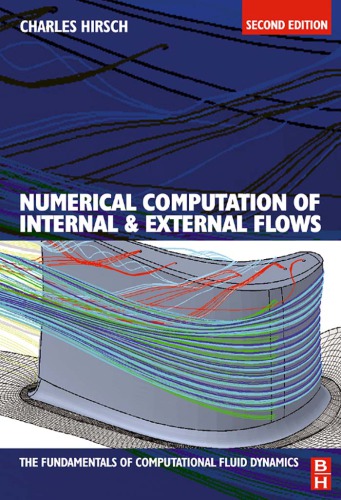
Numerical Computation of Internal and External Flows Volume 1 Fundamentals of Computational Fluid Dynamics 2nd Edition by Charles Hirsch ISBN 0080550029 9780080550022


Original price was: $50.00.$35.00Current price is: $35.00.
Numerical Computation of Internal and External Flows Volume 1 Fundamentals of Computational Fluid Dynamics 2nd Edition by Charles Hirsch – Ebook PDF Instant Download/Delivery: 0080550029, 9780080550022
Full download Numerical Computation of Internal and External Flows Volume 1 Fundamentals of Computational Fluid Dynamics 2nd Edition after payment
Product details:
ISBN 10: 0080550029
ISBN 13: 9780080550022
Author: Charles Hirsch
The second edition of this book is a self-contained introduction to computational fluid dynamics (CFD). It covers the fundamentals of the subject and is ideal as a text or a comprehensive reference to CFD theory and practice.
• New approach takes readers seamlessly from first principles to more advanced and applied topics.
• Presents the essential components of a simulation system at a level suitable for those coming into contact with CFD for the first time, and is ideal for those who need a comprehensive refresher on the fundamentals of CFD.
• Enhanced pedagogy features chapter objectives, hands-on practice examples and end of chapter exercises.
• Extended coverage of finite difference, finite volume and finite element methods.
• New chapters include an introduction to grid properties and the use of grids in practice.
• Includes material on 2-D inviscid, potential and Euler flows, 2-D viscous flows and Navier-Stokes flows to enable the reader to develop basic CFD simulations.
• Includes best practice guidelines for applying existing commercial or shareware CFD tools.
Numerical Computation of Internal and External Flows Volume 1 Fundamentals of Computational Fluid Dynamics 2nd Table of contents:
I.1 The position of CFD in the world of virtual prototyping
I.1.1 The Definition Phase
I.1.2 The Simulation and Analysis Phase
I.1.3 The Manufacturing Cycle Phase
I.2 The components of a CFD simulation system
I.2.1 Step 1: Defining the Mathematical Model
I.2.2 Step 2: Defining the Discretization Process
I.2.3 Step 3: Performing the Analysis Phase
I.2.4 Step 4: Defining the Resolution Phase
I.3 The structure of this volume
References
Part I: The Mathematical Models for Fluid Flow Simulations at Various Levels of Approximation
Chapter 1 The Basic Equations of Fluid Dynamics
Objectives and guidelines
1.1 General form of a conservation law
1.2 The mass conservation equation
1.3 The momentum conservation law or equation of motion
1.4 The energy conservation equation
A1.5 Rotating frame of reference
A1.6 Advanced applications of control volume formulations
Summary of the basic flow equations
Conclusions and main topics to remember
References
Problems
Chapter 2 The Dynamical Levels of Approximation
Objectives and guidelines
2.1 The Navier–Stokes equations
2.2 Approximations of turbulent flows
2.3 Thin shear layer approximation (TSL)
2.4 Parabolized Navier–Stokes equations
2.5 Boundary layer approximation
2.6 The distributed loss model
2.7 Inviscid flow model: Euler equations
2.8 Potential flow model
2.9 Summary
References
Problems
Chapter 3 The Mathematical Nature of the Flow Equations and Their Boundary Conditions
Objectives and guidelines
3.1 Simplified models of a convection–diffusion equation
3.2 Definition of the mathematical properties of a system of PDEs
3.3 Hyperbolic and parabolic equations: characteristic surfaces and domain of dependence
3.4 Time-dependent and conservation form of the PDEs
3.5 Initial and boundary conditions
A.3.6 Alternative definition: compatibility relations
Conclusions and main topics to remember
References
Problems
Part II: Basic Discretization Techniques
Chapter 4 The Finite Difference Method for Structured Grids
Objectives and guidelines
4.1 The basics of finite difference methods
4.2 Multidimensional finite difference formulas
4.3 Finite difference formulas on non-uniform grids
A4.4 General method for finite difference formulas
A4.5 Implicit finite difference formulas
Conclusions and main topics to remember
References
Problems
Chapter 5 Finite Volume Method and Conservative Discretization with an Introduction to Finite Elemen
Objectives and guidelines
5.1 The conservative discretization
5.2 The basis of the finite volume method
5.3 Practical implementation of finite volume method
A5.4 The finite element method
Conclusions and main topics to remember
References
Problems
Chapter 6 Structured and Unstructured Grid Properties
Objectives and guidelines
6.1 Structured Grids
6.2 Unstructured grids
6.3 Surface and volume estimations
6.4 Grid quality and best practice guidelines
Conclusions and main topics to remember
References
Part III: The Analysis of Numerical Schemes
Chapter 7 Consistency, Stability and Error Analysis of Numerical Schemes
Objectives and guidelines
7.1 Basic concepts and definitions
7.2 The Von Neumann method for stability analysis
7.3 New schemes for the linear convection equation
7.4 The spectral analysis of numerical errors
Conclusions and main topics to remember
References
Problems
Chapter 8 General Properties and High-Resolution Numerical Schemes
Objectives and guidelines
8.1 General formulation of numerical schemes
8.2 The generation of new schemes with prescribed order of accuracy
8.3 Monotonicity of numerical schemes
8.4 Finite volume formulation of schemes and limiters
Conclusions and main topics to remember
References
Problems
Part IV: The Resolution of Numerical Schemes
Chapter 9 Time Integration Methods for Space-discretized Equations
Objectives and guidelines
9.1 Analysis of the space-discretized systems
9.2 Analysis of time integration schemes
9.3 A selection of time integration methods
A9.4 Implicit schemes for multidimensional problems: approximate factorization methods
Conclusions and main topics to remember
References
Problems
Chapter 10 Iterative Methods for the Resolution of Algebraic Systems
Objectives and guidelines
10.1 Basic iterative methods
10.2 Overrelaxation methods
10.3 Preconditioning techniques
10.4 Nonlinear problems
10.5 The multigrid method
Conclusions and main topics to remember
References
Problems
Appendix A: Thomas Algorithm for Tridiagonal Systems
Part V: Applications to Inviscid and Viscous Flows
Chapter 11 Numerical Simulation of Inviscid Flows
Objectives and guidelines
11.1 The inviscid Euler equations
11.2 The potential flow model
11.3 Numerical solutions for the potential equation
11.4 Finite volume discretization of the Euler equations
11.5 Numerical solutions for the Euler equations
Conclusions and main topics to remember
References
Chapter 12 Numerical Solutions of Viscous Laminar Flows
Objectives and guidelines
12.1 Navier–Stokes equations for laminar flows
12.2 Density-based methods for viscous flows
12.3 Numerical solutions with the density-based method
12.4 Pressure correction method
12.5 Numerical solutions with the pressure correction method
12.6 Best practice advice
People also search for Numerical Computation of Internal and External Flows Volume 1 Fundamentals of Computational Fluid Dynamics 2nd:
hirsch numerical computation of internal and external flows
hirsch c numerical computation of internal and external flows
numerical computation of internal and external flows volume 2
numerical computation of internal and external flows volume 2 pdf
numerical computation of internal and external flows volume 1
Tags: Charles Hirsch, Numerical Computation, Internal, External Flows, Fluid Dynamics