

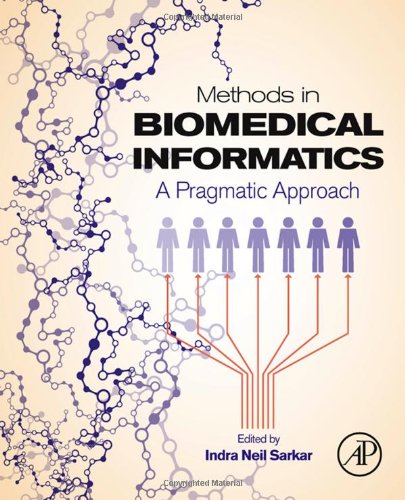
Methods in Biomedical Informatics A Pragmatic Approach 1st Edition by Neil Sarkar ISBN 0124016782 9780124016781


Original price was: $50.00.$35.00Current price is: $35.00.
Methods in Biomedical Informatics A Pragmatic Approach 1st Edition by Neil Sarkar – Ebook PDF Instant Download/Delivery: 0124016782, 9780124016781
Full download Methods in Biomedical Informatics A Pragmatic Approach 1st Edition after payment
Product details:
ISBN 10: 0124016782
ISBN 13: 9780124016781
Author: Neil Sarkar
Beginning with a survey of fundamental concepts associated with data integration, knowledge representation, and hypothesis generation from heterogeneous data sets, Methods in Biomedical Informatics provides a practical survey of methodologies used in biological, clinical, and public health contexts. These concepts provide the foundation for more advanced topics like information retrieval, natural language processing, Bayesian modeling, and learning classifier systems. The survey of topics then concludes with an exposition of essential methods associated with engineering, personalized medicine, and linking of genomic and clinical data. Within an overall context of the scientific method, Methods in Biomedical Informatics provides a practical coverage of topics that is specifically designed for: (1) domain experts seeking an understanding of biomedical informatics approaches for addressing specific methodological needs; or (2) biomedical informaticians seeking an approachable overview of methodologies that can be used in scenarios germane to biomedical research.
Methods in Biomedical Informatics A Pragmatic Approach 1st Table of contents:
1 Introduction
1.1 Biomedical Informatics and its Applications
1.2 The Scientific Method
1.3 Data, Information, Knowledge, and Wisdom
1.4 Overview of Chapters
1.5 Expectations and Challenge to the Reader
References
2 Data Integration: An Overview
2.1 Objectives of Integration
2.2 Integration Approaches: Overview
2.2.1 Scope of this Chapter
2.3 Database Basics
2.3.1 SQL Dialects
2.3.2 Design for High Performance
2.3.3 Data Integration vs. Interoperation
2.4 Physical vs. Logical Integration: Pros and Cons
2.5 Prerequisite Subtasks
2.5.1 Determining Objectives
2.5.2 Identifying Elements: Understanding the Data Sources
2.5.2.1 Identifying Redundancy and Inconsistency
2.5.2.2 Characterizing Heterogeneity: Modeling Conflicts
2.5.3 Data Quality: Identifying and Fixing Errors
2.5.4 Documenting Data Sources and Processes: Metadata
2.5.4.1 Ontologies
2.6 Data Transformation and Restructuring
2.7 Integration Efforts in Biomedical Research
2.8 Implementation Tips
2.8.1 Query Tools: Caveats
2.8.2 The Importance of Iterative Processes
2.9 Conclusion: Final Warnings
References
3 Knowledge Representation
3.1 Knowledge and Knowledge Representation
3.2 Procedural VS. Declarative Representations
3.3 Representing Knowledge Declaratively
3.3.1 Logics
3.3.2 Semantic Networks
3.3.3 Frames
3.3.4 Rules
3.3.5 Description Logic
3.4 What Does a Representation Mean?
3.5 Building Knowledge Bases in Practice
3.6 Summary
References
4 Hypothesis Generation from Heterogeneous Datasets
4.1 Introduction
4.2 Preliminary Background
4.2.1 Modeling Biological Structures and Their Interplay
4.2.2 Data and Knowledge Representation
4.2.3 Data Format Conversion
4.2.4 Text Mining for Knowledge Discovery
4.2.5 Fundamental Statistical and Computational Methods
4.3 Description of Methods
4.3.1 Determination of Study Scales and Associated Simplifying Hypotheses
4.3.2 Curse of Dimensionality, Classification, and Feature Selection
4.3.3 Approaches of Integration
4.3.3.1 Corroborative Approaches
4.3.3.1.1 Logical Filtering Evidence From Multiple Scales
4.3.3.1.2 Information Joining From Multiple Datasets
4.3.3.1.3 Correlation Among Multiple Scales
4.3.3.1.4 Similarity Measurement Between Datasets
4.3.3.2 Fusion Approaches
4.3.3.2.1 Statistical Fusion
4.3.3.2.2 Mathematical Fusion
4.3.3.2.3 Computational Fusion
4.3.4 Multiple Comparison Adjustments, Empirical and Statistical Controls
4.4 Applications in Medicine and Public Health
4.5 Summary
Acknowledgments
References
5 Geometric Representations in Biomedical Informatics: Applications in Automated Text Analysis
5.1 Introduction
5.2 The Nature of Geometric Representations
5.2.1 Vectors and Vector Spaces
5.2.2 Distance Metrics
5.2.3 Examples: Term, Concept, and Document Vectors
5.2.4 Term-Weighting
5.2.5 Example: Literature-Based Discovery
5.2.6 Summary and Implications
5.3 Dimension Reduction
5.3.1 Approaches—Latent Semantic Analysis Using SVD
5.3.2 Approaches—Topic Models Using Latent Dirichlet Allocation
5.3.3 Approaches: Random Indexing
5.3.4 Summary and Implications
5.4 Classification
5.4.1 k-Nearest Neighbor
5.4.2 Example: MEDLINE Indexing
5.4.3 SVMs
5.4.4 Clustering
5.4.5 Example: Word Sense Discrimination
5.4.6 Summary and Implications
5.5 Beyond Distance
5.5.1 Boolean Connectives
5.5.2 Conditionals and Implication
5.5.3 Typed Relations
5.5.4 Summary and Implications
5.6 Building Geometric Models with the Semantic Vectors Package
5.7 Summary and Conclusion
References
6 Biomedical Natural Language Processing and Text Mining
6.1 Natural Language Processing and Text Mining Defined
6.2 Natural Language
6.3 Approaches to Natural Language Processing and Text Mining
6.4 Some Special Considerations of Natural Language Processing in the Biomedical Domain
6.5 Building Blocks of Natural Language Processing Applications
6.5.1 Document Segmentation
6.5.2 Sentence Segmentation
6.5.3 Tokenization
6.5.4 Part of Speech Tagging
6.5.5 Parsing
6.6 Additional Components of Natural Language Processing Applications
6.6.1 Word Sense Disambiguation
6.6.2 Negation Detection
6.6.3 Temporality
6.6.4 Context Determination
6.6.5 Hedging
6.7 Evaluation in Natural Language Processing
6.8 Practical Applications: Text Mining Tasks
6.8.1 Information Retrieval
6.8.2 Named Entity Recognition
6.8.3 Named Entity Normalization
6.8.4 Information Extraction
6.8.5 Summarization
6.8.6 Cohort Retrieval and Phenotype Definition
6.9 Software Engineering in Natural Language Processing
6.9.1 Architectures
6.9.2 Scaling
6.9.3 Quality Assurance and Testing
6.10 Conclusion
Acknowledgments
References
7 Knowledge Discovery in Biomedical Data: Theory and Methods
7.1 Introduction
7.1.1 Characteristics of Biomedical Data
7.1.2 Traditional Methods for Analyzing Biomedical Data
7.1.3 A First Look at Knowledge Discovery in Databases: Mining Data
7.2 Knowledge Discovery as a Process: Data Mining in Perspective
7.3 A Brief Overview of Machine Learning
7.3.1 Concept Learning
7.3.2 Training and Testing Regimes
7.3.3 Supervised Learning
7.3.4 Unsupervised Learning
7.4 A Knowledge Discovery Life Cycle
7.4.1 Data Preparation
7.4.1.1 Variable/Value Standardization
7.4.1.2 Out-of-Range Values
7.4.1.3 Logical Inconsistencies
7.4.1.4 Variable Transformation
7.4.1.5 Discretization
7.4.1.6 Missing Data
7.4.2 Data Reduction
7.4.2.1 Feature Selection
7.4.2.2 Numerosity Reduction
7.4.2.3 Sampling
7.4.3 Data Mining Methods
7.4.3.1 Statistical Classification
7.4.3.1.1 Univariable Methods
7.4.3.1.2 Multivariable Methods
7.4.3.1.3 Clustering
7.4.3.1.4 Kernel Methods
7.4.3.1.5 Probabilistic Methods
7.4.3.2 Instance-Based Methods
7.4.3.3 Tree-Based Methods
7.4.3.4 Rule-Based Methods
7.4.3.4.1 Association Rule Discovery
7.4.3.4.2 Classification Rules
7.4.3.4.3 Prediction Rules
7.4.3.5 Data Mining Approaches Inspired by Nature
7.4.3.5.1 Evolutionary Computation
7.4.3.5.2 Neural Networks
7.4.3.5.3 Other Naturally Inspired Methods of Knowledge Discovery
7.4.3.6 Text Mining
7.4.3.7 Evaluation: Metrics for Classification and Prediction
7.5 Ethical Issues
7.6 Summary
7.7 Additional Resources
People also search for Methods in Biomedical Informatics A Pragmatic Approach 1st:
biomedical informatics the science and the pragmatics
biomedical informatics pdf
biomedical informatics meaning
methods of information in medicine
biomedical informatics program