

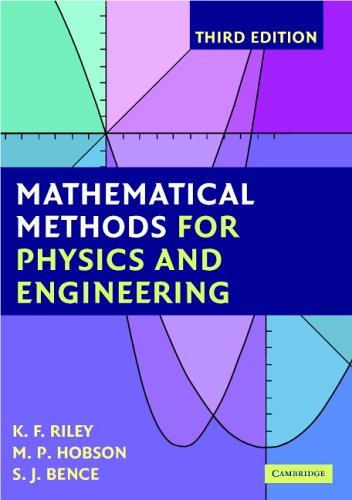
Mathematical methods for physics and engineering 3rd Edition by Riley 9780521861533 0521861535


Original price was: $50.00.$35.00Current price is: $35.00.
Mathematical methods for physics and engineering 3rd Edition by Riley – Ebook PDF Instant Download/Delivery:9780521861533, 0521861535
Full download Mathematical methods for physics and engineering 3rd Edition after payment
Product details:
ISBN 10: 0521861535
ISBN 13: 9780521861533
Author: K. F. Riley, M. P. Hobson, S. J. Bence
The third edition of this highly acclaimed undergraduate textbook is suitable for teaching all the mathematics for an undergraduate course in any of the physical sciences. As well as lucid descriptions of all the topics and many worked examples, it contains over 800 exercises. New stand-alone chapters give a systematic account of the ‘special functions’ of physical science, cover an extended range of practical applications of complex variables, and give an introduction to quantum operators. Further tabulations, of relevance in statistics and numerical integration, have been added. In this edition, half of the exercises are provided with hints and answers and, in a separate manual available to both students and their teachers, complete worked solutions.
Mathematical methods for physics and engineering 3rd Table of contents:
1. Preliminary Algebra
-
1.1 Simple Functions and Equations
-
1.2 Trigonometric Identities
-
1.3 Coordinate Geometry
-
1.4 Partial Fractions
-
1.5 Binomial Expansion
-
1.6 Properties of Binomial Coefficients
-
1.7 Some Particular Methods of Proof
-
1.8 Exercises
-
1.9 Hints and Answers
2. Preliminary Calculus
-
2.1 Differentiation
-
2.2 Integration
-
2.3 Exercises
-
2.4 Hints and Answers
3. Complex Numbers and Hyperbolic Functions
-
3.1 The Need for Complex Numbers
-
3.2 Manipulation of Complex Numbers
-
3.3 Polar Representation of Complex Numbers
-
3.4 de Moivre’s Theorem
-
3.5 Complex Logarithms and Complex Powers
-
3.6 Applications to Differentiation and Integration
-
3.7 Hyperbolic Functions
-
3.8 Exercises
-
3.9 Hints and Answers
4. Series and Limits
-
4.1 Series
-
4.2 Summation of Series
-
4.3 Convergence of Infinite Series
-
4.4 Operations with Series
-
4.5 Power Series
-
4.6 Taylor Series
-
4.7 Evaluation of Limits
-
4.8 Exercises
-
4.9 Hints and Answers
5. Partial Differentiation
-
5.1 Definition of the Partial Derivative
-
5.2 The Total Differential and Total Derivative
-
5.3 Exact and Inexact Differentials
-
5.4 Useful Theorems of Partial Differentiation
-
5.5 The Chain Rule
-
5.6 Change of Variables
-
5.7 Taylor’s Theorem for Many-Variable Functions
-
5.8 Stationary Values of Many-Variable Functions
-
5.9 Stationary Values Under Constraints
-
5.10 Envelopes
-
5.11 Thermodynamic Relations
-
5.12 Differentiation of Integrals
-
5.13 Exercises
-
5.14 Hints and Answers
6. Multiple Integrals
-
6.1 Double Integrals
-
6.2 Triple Integrals
-
6.3 Applications of Multiple Integrals
-
6.4 Change of Variables in Multiple Integrals
-
6.5 Exercises
-
6.6 Hints and Answers
7. Vector Algebra
-
7.1 Scalars and Vectors
-
7.2 Addition and Subtraction of Vectors
-
7.3 Multiplication by a Scalar
-
7.4 Basis Vectors and Components
-
7.5 Magnitude of a Vector
-
7.6 Multiplication of Vectors
-
7.7 Equations of Lines, Planes and Spheres
-
7.8 Using Vectors to Find Distances
-
7.9 Reciprocal Vectors
-
7.10 Exercises
-
7.11 Hints and Answers
8. Matrices and Vector Spaces
-
8.1 Vector Spaces
-
8.2 Linear Operators
-
8.3 Matrices
-
8.4 Basic Matrix Algebra
-
8.5 Functions of Matrices
-
8.6 The Transpose of a Matrix
-
8.7 The Complex and Hermitian Conjugates of a Matrix
-
8.8 The Trace of a Matrix
-
8.9 The Determinant of a Matrix
-
8.10 The Inverse of a Matrix
-
8.11 The Rank of a Matrix
-
8.12 Special Types of Square Matrix
-
8.13 Eigenvectors and Eigenvalues
-
8.14 Determination of Eigenvalues and Eigenvectors
-
8.15 Change of Basis and Similarity Transformations
-
8.16 Diagonalisation of Matrices
-
8.17 Quadratic and Hermitian Forms
-
8.18 Simultaneous Linear Equations
-
8.19 Exercises
-
8.20 Hints and Answers
9. Normal Modes
-
9.1 Typical Oscillatory Systems
-
9.2 Symmetry and Normal Modes
-
9.3 Rayleigh–Ritz Method
-
9.4 Exercises
-
9.5 Hints and Answers
10. Vector Calculus
-
10.1 Differentiation of Vectors
-
10.2 Integration of Vectors
-
10.3 Space Curves
-
10.4 Vector Functions of Several Arguments
-
10.5 Surfaces
-
10.6 Scalar and Vector Fields
-
10.7 Vector Operators
-
10.8 Vector Operator Formulae
-
10.9 Cylindrical and Spherical Polar Coordinates
-
10.10 General Curvilinear Coordinates
-
10.11 Exercises
-
10.12 Hints and Answers
11. Line, Surface and Volume Integrals
-
11.1 Line Integrals
-
11.2 Connectivity of Regions
-
11.3 Green’s Theorem in a Plane
-
11.4 Conservative Fields and Potentials
-
11.5 Surface Integrals
-
11.6 Volume Integrals
-
11.7 Integral Forms for Grad, Div and Curl
-
11.8 Divergence Theorem and Related Theorems
-
11.9 Stokes’ Theorem and Related Theorems
-
11.10 Exercises
-
11.11 Hints and Answers
12. Fourier Series
-
12.1 The Dirichlet Conditions
-
12.2 The Fourier Coefficients
-
12.3 Symmetry Considerations
-
12.4 Discontinuous Functions
-
12.5 Non-Periodic Functions
-
12.6 Integration and Differentiation
-
12.7 Complex Fourier Series
-
12.8 Parseval’s Theorem
-
12.9 Exercises
-
12.10 Hints and Answers
13. Integral Transforms
-
13.1 Fourier Transforms
-
13.2 Laplace Transforms
-
13.3 Concluding Remarks
-
13.4 Exercises
-
13.5 Hints and Answers
People also search for Mathematical methods for physics and engineering 3rd:
mathematical methods for physics and engineering reddit
mathematical methods for physics arfken
mathematical methods for physics by g arfken pdf
mathematical methods for physics and engineering third edition
mathematical methods for physics and engineering 4th edition
Tags: Riley, Mathematical, methods