

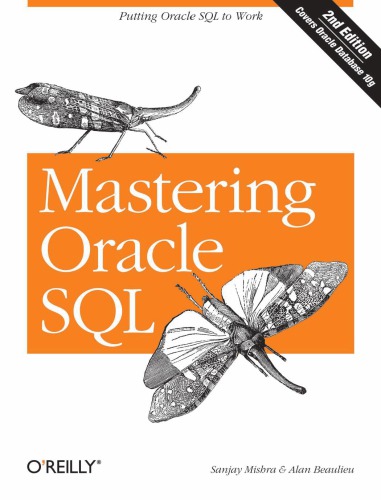
Mastering Oracle SQL Putting Oracle SQL to Work 2nd Edition by Sanjay Mishra ,Alan Beaulieu ISBN 0596006322 978-0596006327
Original price was: $50.00.$35.00Current price is: $35.00.
Mastering Oracle SQL Putting Oracle SQL to Work 2nd Edition by Sanjay Mishra ,Alan Beaulieu – Ebook PDF Instant Download/Delivery:0596006322 ,978-0596006327
Full download Mastering Oracle SQL Putting Oracle SQL to Work 2nd Edition after payment
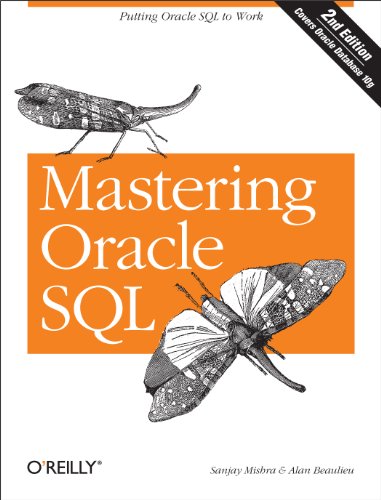
Product details:
ISBN 10:0596006322
ISBN 13:978-0596006327
Author:Sanjay Mishra ,Alan Beaulieu
The vast majority of Oracle SQL books discuss some syntax, provide the barest rudiments of using Oracle SQL, and perhaps include a few simple examples. It might be enough to pass a survey course, or give you some buzz words to drop in conversation with real Oracle DBAs. But if you use Oracle SQL on a regular basis, you want much more. You want to access the full power of SQL to write queries in an Oracle environment. You want a solid understanding of what’s possible with Oracle SQL, creative techniques for writing effective and accurate queries, and the practical, hands-on information that leads to true mastery of the language. Simply put, you want useful, expert best practices that can be put to work immediately, not just non-vendor specific overview or theory. Updated to cover the latest version of Oracle, Oracle 10g, this edition of the highly regarded Mastering Oracle SQL has a stronger focus on technique and on Oracle’s implementation of SQL than any other book on the market. It covers Oracle s vast library of built-in functions, the full range of Oracle SQL query-writing features, regular expression support, new aggregate and analytic functions, subqueries in the SELECT and WITH clauses, multiset union operators, enhanced support for hierarchical queries: leaf and loop detection, and the CONNECT_BY_ROOT operator, new partitioning methods (some introduced in Oracle9i Release 2), and the native XML datatype, XMLType. Mastering Oracle SQL, 2nd Edition fills the gap between the sometimes spotty vendor documentation, and other books on SQL that just don’t explore the full depth of what is possible with Oracle-specific SQL. For those who want to harness the untapped (and often overlooked) power of Oracle SQL, this essential guide for putting Oracle SQL to work will prove invaluable.
Table of contents:
Chapter 1: Introduction to SQL
1.1 What Is SQL?
1.2 A Brief History of SQL
1.3 A Simple Database
1.4 DML Statements
1.5 So Why Are There 17 More Chapters?
Chapter 2: The WHERE Clause
2.1 Life Without WHERE
2.2 WHERE to the Rescue
2.3 WHERE Clause Evaluation
2.4 Conditions and Expressions
2.5 WHERE to Go from Here
Chapter 3: Joins
3.1 What Is a Join Query?
3.2 Join Conditions
3.3 Types of Joins
3.4 Joins and Subqueries
3.5 DML Statements on a Join View
Chapter 4: Group Operations
4.1 Aggregate Functions
4.2 The GROUP BY Clause
4.3 The HAVING Clause
4.4 Nested Group Operations
Chapter 5: Subqueries
5.1 What Is a Subquery?
5.2 Noncorrelated Subqueries
5.3 Correlated Subqueries
5.4 Inline Views
5.5 Subquery Case Study: The Top N Performers
Chapter 6: Handling Temporal Data
6.1 Time Zones
6.2 Temporal Data Types in Oracle
6.3 Literals of Temporal Types
6.4 Getting Temporal Data In and Out of a Database
6.5 Date and Time Formats
6.6 Manipulating Temporal Data
Chapter 7: Set Operations
7.1 Set Operators
7.2 Precedence of Set Operators
7.3 Comparing Two Tables
7.4 Using NULLs in Compound Queries
7.5 Rules and Restrictions on Set Operations
Chapter 8: Hierarchical Queries
8.1 Representing Hierarchical Information
8.2 Simple Hierarchy Operations
8.3 Oracle SQL Extensions
8.4 Complex Hierarchy Operations
8.5 Restrictions on Hierarchical Queries
8.6 Enhancements in Oracle Database 10g
Chapter 9: DECODE and CASE
9.1 DECODE, NULLIF, NVL, and NVL2
9.2 The Case for CASE
9.3 DECODE and CASE Examples
Chapter 10: Partitioning
10.1 Partitioning Concepts
10.2 Partitioning Tables
10.3 Partitioning Indexes
10.4 Partitioning Methods
10.5 Specifying Partitions
10.6 Partition Pruning
Chapter 11: PL/SQL
11.1 What Is PL/SQL?
11.2 Procedures, Functions, and Packages
11.3 Calling Stored Functions from Queries
11.4 Restrictions on Calling PL/SQL from SQL
11.5 Stored Functions in DML Statements
11.6 The SQL Inside Your PL/SQL
Chapter 12: Objects and Collections
12.1 Object Types
12.2 Collection Types
12.3 Collection Instantiation
12.4 Querying Collections
12.5 Collection Unnesting
12.6 Collection Functions
12.7 Comparing Collections
12.8 Manipulating Collections
12.9 Multilevel Collections
Chapter 13: Advanced Group Operations
13.1 Multiple Summary Levels
13.2 Pushing the GROUPING Envelope
13.3 The GROUPING_ID and GROUP_ID Functions
Chapter 14: Advanced Analytic SQL
14.1 Analytic SQL Overview
14.2 Ranking Functions
14.3 Windowing Functions
14.4 Reporting Functions
14.5 Summary
Chapter 15: SQL Best Practices
15.1 Know When to Use Specific Constructs
15.2 Avoid Unnecessary Parsing
15.3 Consider Literal SQL for Decision-Support Systems
Chapter 16: XML
16.1 What Is XML?
16.2 Storing XML Data
16.3 Generating XML Documents
16.4 Summary
Chapter 17: Regular Expressions
17.1 Elementary Regular Expression Syntax
17.2 Advanced Function Options
17.3 Advanced Regular Expression Syntax
Chapter 18: Model Queries
18.1 Basic Elements of a Model Query
18.2 Cell References
18.3 Rules
18.4 Iterative Models
18.5 Reference Models
People also search for:
mastering oracle pl/sql practical solutions
sql management studio connect to oracle database
practical oracle sql mastering the full power of oracle database
how to connect sql server management studio to oracle database
ms sql server management studio connect to oracle database
Tags: Sanjay Mishra, Alan Beaulieu, Mastering, Oracle, SQL