

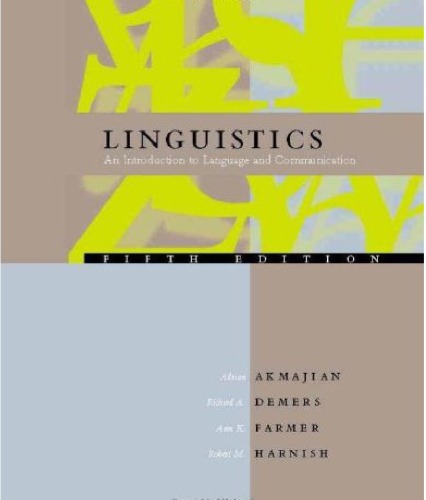
Linguistics an introduction to language and communication 5th Edition by Adrian Akmajian, Richard A Demers, Ann K Farmer, Robert M Harnish ISBN 0262511231 9780262511230
Original price was: $50.00.$35.00Current price is: $35.00.
Linguistics an introduction to language and communication 5th Edition by Adrian Akmajian, Richard A Demers, Ann K Farmer, Robert M Harnish – Ebook PDF Instant Download/Delivery: 0262511231, 9780262511230
Full download Linguistics an introduction to language and communication 5th Edition after payment
Product details:
ISBN 10: 0262511231
ISBN 13: 9780262511230
Author: Adrian Akmajian, Richard A Demers, Ann K Farmer, Robert M Harnish
This popular introductory linguistics text is unique in the way various themes are integrated throughout the book. One primary theme is the question, How is a speaker’s communicative intent recognized? Rather than treat phonology, phonetics, morphology, syntax, semantics, and pragmatics as completely separate fields, the text shows how they interact in principled ways. Similarly, language variation and acquisition are informed by results in these fields. The text provides a sound introduction to linguistic methodology while also revealing why people are intrinsically interested in language — the ultimate puzzle of the human mind.
The fifth edition has been thoroughly revised. Revisions include, but are not limited to, the addition of selected readings sections, updated examples, new discussion on the creative nature of neologisms, and the use of IPA as the primary transcription system throughout. This edition also includes an account of the patterns of occurrence of reduced vowels in English. An understanding of these patterns enables the reader to write a phonemic transcription of any English word.
Linguistics an introduction to language and communication 5th Table of contents:
PART I: INTRODUCTION TO LINGUISTICS
-
Introduction to Language
-
What is language?
-
Language and communication
-
The nature of language
-
Why study linguistics?
-
The role of linguistics in understanding human cognition and society
-
-
The Nature of Language and Linguistics
-
Defining language
-
Universal properties of language
-
The study of linguistics: areas of analysis
-
The relationship between language and thought
-
PART II: PHONETICS AND PHONOLOGY
3. Phonetics: The Sounds of Language
-
The study of speech sounds
-
Articulatory phonetics
-
Acoustic phonetics
-
Auditory phonetics
-
Transcription of speech sounds (IPA)
-
Phonology: The Sound Patterns of Language
-
The concept of phonemes
-
Phonological rules and processes
-
Allophones and variation
-
Syllable structure and stress
-
Phonological processes across languages
-
PART III: MORPHOLOGY
5. Morphology: The Structure of Words
-
The concept of morphemes
-
Types of morphemes: free and bound
-
Derivational and inflectional morphology
-
Morphological processes: affixation, compounding, and reduplication
-
Word formation in different languages
PART IV: SYNTAX
6. Syntax: The Structure of Sentences
-
Sentence structure and word order
-
Phrase structure grammar
-
Constituency and tree diagrams
-
Syntactic rules and transformations
-
Grammatical relations and syntactic categories
PART V: SEMANTICS AND PRAGMATICS
7. Semantics: The Meaning of Words and Sentences
-
The study of meaning in language
-
Lexical semantics: word meanings
-
Sentence meaning and compositionality
-
Truth conditions and reference
-
Ambiguity and vagueness
-
Pragmatics: Language Use in Context
-
The relationship between language and context
-
Speech acts: requests, promises, questions
-
Grice’s maxims and implicature
-
Conversational structure
-
Politeness and discourse strategies
-
PART VI: LANGUAGE ACQUISITION
9. Language Acquisition
-
Theories of language acquisition
-
Stages of language development in children
-
The role of input and interaction
-
Bilingualism and language learning
-
Critical period hypothesis and language disorders
PART VII: LANGUAGE VARIATION AND CHANGE
10. Language Variation: Social and Regional Variation
– Dialects and accents
– Social factors in language variation
– The role of age, gender, and social class
– Standard vs. non-standard varieties of language
-
Language Change
-
The history and evolution of languages
-
Phonological, morphological, and syntactic change
-
Theories of language change
-
The role of language contact and social factors
-
PART VIII: LANGUAGE IN SOCIETY
12. Language and Society
– Sociolinguistics and the study of language in context
– Language and identity
– Code-switching and diglossia
– Language attitudes and ideology
– The politics of language: language policies and planning
PART IX: LANGUAGE AND THE BRAIN
13. Language and the Brain
– The neurological basis of language
– Language processing in the brain
– Aphasia and language disorders
– Theories of language and cognition
– Language and the lateralization of brain function
PART X: THE FUTURE OF LINGUISTICS
14. Linguistics in the Modern World
– New directions in linguistic research
– Computational linguistics and language technology
– The role of linguistics in education and society
– Globalization and language change
– The future of endangered languages
People also search for Linguistics an introduction to language and communication 5th:
forensic linguistics an introduction to language in the justice system
forensic linguistics an introduction to language crime and the law
borrow linguistics an introduction to language and communication
interactional linguistics an introduction to language in social interaction
linguistics an introduction to language and communication 6th edition
Tags: Adrian Akmajian, Richard A Demers, Ann K Farmer, Robert M Harnish, Linguistics, language