

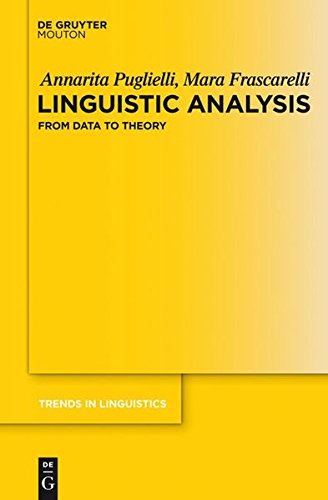
Linguistic Analysis From Data to Theory 1st Edition by Mara Frascarelli ISBN 3110222507 9783110222500


Original price was: $50.00.$35.00Current price is: $35.00.
Linguistic Analysis From Data to Theory 1st Edition by Mara Frascarelli – Ebook PDF Instant Download/Delivery: 3110222507, 9783110222500
Full download Linguistic Analysis From Data to Theory 1st Edition after payment
Product details:
ISBN 10: 3110222507
ISBN 13: 9783110222500
Author: Mara Frascarelli
Linguistic Analysis From Data to Theory 1st Table of contents:
1. Categories and functions
1.1. Different levels of analysis
1.2. The theoretical framework: Generative Grammar
-
1.2.1. X-bar (X’) Theory
-
1.2.2. The head-complement parameter
-
1.2.3. Levels of analysis and X’ structure
-
1.2.3.1. The Syntax-Semantics interface: Verb Phrase
-
1.2.3.2. The Syntax-Morphology interface: Inflectional Phrase
-
1.2.3.3. The Syntax-Discourse grammar interface: Complementizer Phrase
1.3. Parts-of-speech classification: The concept of category
-
-
1.3.1. A formal approach to classification
-
1.3.2. The concept of grammaticality
1.4. Categories: Typology and formal properties
1.5. Categories and syntactic functions -
1.5.1. Subject function
-
1.5.2. Predicate function
-
1.5.3. Modifier function
2. The structure of the verb phrase
2.1. Predicates, arguments and structural categorization
2.2. Argument structure
-
2.2.1. Macro-roles and event structure
-
2.2.2. Mono-argument verbs
-
2.2.3. Two-argument verbs
-
2.2.4. Three-argument verbs
-
2.2.5. Macro-roles and VP structure
2.3. Argument roles, event structure and overt syntax -
2.3.1. Event structure and macro-role of the subject in inflecting and agglutinative languages
-
2.3.2. Event structure and macro-role of the subject in incorporating languages
-
2.3.3. Event structure and macro-role of the subject in predicate-initial languages
2.4. Arguments realized by clauses
2.5. Clauses as nouns
3. Syntactic functions
3.1. The relationship between deep roles and surface structure
3.2. Deep and structural Cases
-
3.2.1. Correlations and tendencies
-
3.2.2. When structural function is not associated with deep Case: Expletive subjects
4. The structure of the noun phrase
4.1. The internal structure of the NP
-
4.1.1. Elements in Spec,NP
-
4.1.2. Elements in Compl,NP and restrictive noun modifiers
-
4.1.3. When the head is a nominalization
4.2. NPs as arguments
4.3. The functional area of NP: The determiner phrase (DP)
4.4. Noun head modification -
4.4.1. Adjectival modification
-
4.4.2. The relative clause
-
4.4.2.1. The internal structure of restrictive relative clauses
-
4.4.2.2. Relative clauses from a typological perspective
-
4.4.2.3. Types of relative clauses and their meaning
-
5. Adverbial modification
5.1. Adverbs and adverbials: Preliminary considerations
5.2. Properties and distribution of adverbial modifiers
5.3. Structural insertion of adverb phrases
5.4. Noun and prepositional phrases with adverbial function
5.5. Clausal structures with adverbial function
-
5.5.1. The internal syntax of adverbial clauses
-
5.5.2. The external syntax of adverbial clauses
6. The sentence as utterance
6.1. Discourse grammar and information structure
6.2. Speech acts
6.3. Information structure in declarative clauses
-
6.3.1. The notion of markedness
-
6.3.2. Given and new in marked and unmarked structures
6.4. Focus -
6.4.1. Focus strategies in typologically different languages
-
6.4.2. Focus as a specificational predicate
-
6.4.3. Focus-prominent languages
-
6.4.4. Syntactic interface: The complex structure of CP
-
6.4.5. Prosodic interface
6.5. Topicalization -
6.5.1. The functions of Topic in discourse
-
6.5.2. Phrasal restrictions on the topicalized constituent
-
6.5.3. Topicalization strategies in typologically different languages
-
6.5.4. Topic-prominent languages
6.6. Contrast
7. Illocutionary force
7.1. Types of illocutionary acts
-
7.1.1. Overt performatives
-
7.1.2. Covert performatives
-
7.1.2.1. Formal markers of the covert performative
-
7.1.2.2. Formal markers in the presence of a performative
7.2. Illocutionary force and performative structure
-
-
7.2.1. The distribution of information in different types of sentences
-
7.2.1.1. Requests for information
-
7.2.1.2. Requests for action
7.3. Illocutionary force and subordinate clauses
-
-
7.3.1. Declarative sentences
-
7.3.2. Interrogative sentences
-
7.3.3. Imperative sentences
7.4. More on illocutionary acts -
7.4.1. Performative structure modification
-
7.4.2. Indirect illocutionary acts
People also search for Linguistic Analysis From Data to Theory 1st:
linguistic analytics
linguistics analysis of text
what is a linguistic analysis
a linguistic analysis of spanglish relating language to identity
identify a criticism about the linguistic-relativity hypothesis
Tags: Mara Frascarelli, Linguistic Analysis, Data