

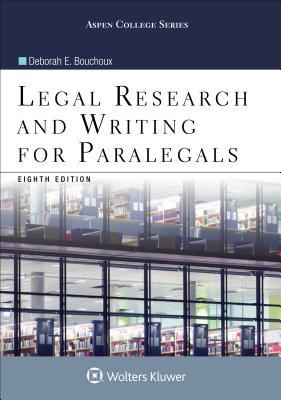
Legal Research and Writing for Paralegals 10th Edition by Deborah E Bouchoux ISBN 1454873353 9781454873358

Original price was: $50.00.$35.00Current price is: $35.00.
Legal Research and Writing for Paralegals 10th Edition by Deborah E Bouchoux – Ebook PDF Instant Download/Delivery: 1454873353, 9781454873358
Full download Legal Research and Writing for Paralegals 10th Edition after payment
Product details:
ISBN 10: 1454873353
ISBN 13: 9781454873358
Author: Deborah E Bouchoux
Legal Research and Writing for Paralegals emphasizes the skills and issues that paralegals encounter in practice. Thoroughly up to date, the Tenth Edition continues to combine clear text with visual aids, writing samples, tips, and pointers. Designed specifically for paralegal students, Deborah Bouchoux’s classroom-tested approach teaches cutting-edge research skills, writing style, and proper citation form to equip students with an essential skill set and well-founded confidence. The author’s logical and comprehensive approach enhances students’ understanding. Part I covers Primary Authorities, Part II discusses Secondary Authorities, and Part III covers the basics of Legal Writing. In addition, Bouchoux integrates writing strategies into each research chapter to demonstrate the link between the two processes. The text thoroughly explains proper citation form and updating/validating legal authorities. The Legal Writing section includes samples of legal writing, such as letters, a court brief, and a legal memorandum. New to the Tenth Edition: Significant focus on newer technologies available to legal researchers such as Lexis+ Brief Analysis, Westlaw Edge’s Quick Check, and more. Coverage of the use of analytics tools now used by legal professionals, such as Lexis+ Context. An entirely new section in Chapter 11 on the use of artificial intelligence (AI) in legal research. Expanded section on techniques to achieve gender-inclusive language. A new section in Chapter 15 on using tech tools such as ProWritingAid, BriefCatch, WordRake, NoRedInk, and Cooley GO to improve writing. A new section on texting and confidentiality issues in Chapter 16. A completely revamped and expanded discussion on e-memos in Chapter 17. Revised throughout with new ethics alerts and updated figures. All new Research Questions and Internet Legal Research Assignments included in each chapter. Professors and students will benefit from: Clear pedagogy designed to enhance the accessibility of the material. Targeted and ample exercises help students learn how to use a wide range of research sources. Charts and practice tips, updated for this edition, help students apply what they have learned. Thorough coverage of electronic research with chapters on both Internet research and fee-based services.
Legal Research and Writing for Paralegals 10th Table of contents:
Section I Legal Research: Primary Authorities
Chapter 1 Finding the Law
A. The Paralegal’s Role in Legal Research and Writing
1. Legal Research and Writing as Core Competencies
2. Ethical Duty to Research Accurately
B. Law Libraries
1. Types of Law Libraries
2. Arrangement of Law Libraries
3. Law Library Staff
4. Law Library Courtesy
5. Other Library Services
C. Sources of Law in the United States
1. Cases and Our Common Law Tradition
2. Constitutions
3. Statutes
4. Administrative Regulations
5. The Executive Branch
D. Legal Systems of Other Countries
E. Legal System of the United States
F. Law Book Publishing
G. Nonprint Research Media
H. Change in Our Legal System
I. Identifying the Holding in a Case
J. How the Legal Research Process Works: A Research Scenario
K. Case Citation Form
Internet Resources
Writing Strategies
Assignment for Chapter 1
Internet Assignment for Chapter 1
Chapter 2 The Federal and State Court Systems
A. Federalism
B. Establishment of Federal Court Structure
C. Jurisdiction
1. Federal Question Jurisdiction
2. Diversity Jurisdiction
3. Concurrent Jurisdiction
4. Exclusive Jurisdiction
D. Ground Rules for Cases
E. The Federal Court Structure
1. District Courts
2. United States Courts of Appeals
3. United States Supreme Court
4. Specialized Courts
F. State Court Organization
G. Citation Form
1. Federal Cases
2. State Cases
Internet Resources
Writing Strategies
Assignment for Chapter 2
Internet Assignment for Chapter 2
Chapter 3 Statutory Law
A. Federal Legislation
1. Enactment of Federal Statutes
2. Classification of Federal Statutes
3. Publication of Federal Statutes
a. United States Statutes at Large
b. Research Defects in United States Statutes at Large
c. United States Code
d. Annotated Versions of the United States Code
e. Use of U.S.C., U.S.C.A., and U.S.C.S.
f. Research Techniques
g. Final Research Steps
h. United States Constitution
B. State Legislation
1. Enactment of State Statutes
2. Publication and Codification of State Statutes
3. Research Techniques
a. Descriptive Word Approach
b. Title/Topic Approach
c. Popular Name Approach
d. Locating State Statutes
4. Uniform and Model Laws and Court Rules
C. Statutory Research Overview
D. Rules of Procedure and Court Rules
1. Introduction
2. Federal Rules of Procedure
3. Federal Rules of Court
4. State Rules of Procedure and Court Rules
E. Citation Form
1. Federal Statutes
2. State Statutes
3. Court Rules
Internet Resources
Writing Strategies
Assignment for Chapter 3
Internet Assignment for Chapter 3
Chapter 4 Case Law and Judicial Opinions
A. Selective Publication
1. Standards for Publishing Cases
2. The Controversy Surrounding Unpublished Opinions
B. Elements of a Case
1. Case Name
2. Docket Number and Deciding Court
3. Date of Decision
4. Case Synopsis or Summary or Background
5. Headnotes
6. Names of Counsel
7. Opinion
8. Decision
C. Publication of Cases
1. Official and Unofficial Publication
2. Series of Cases
3. Advance Sheets
D. Publication of State Cases
1. West’s National Reporter System
2. Citation Form
3. Discontinuation of Some Official Reports
E. Publication of Federal Cases
1. United States Supreme Court Cases
a. Publication
b. Rapid Access to United States Supreme Court Cases
2. United States Courts of Appeals Cases
3. United States District Court Cases
4. Cases Interpreting Federal Rules
F. Star Paging
G. Specialized National Reporter System Sets
H. Features of West’s National Reporter System
1. Tables of Cases Reported
2. Tables of Statutes and Rules
3. Table of Words and Phrases
4. List of Judges
5. Key Number System
I. Finding Parallel Cites
J. Summary of West’s National Reporter System
K. Briefing Cases
Case Brief Assignment
L. Citation Form
1. Federal Cases
2. State Cases
Internet Resources
Writing Strategies
Assignment for Chapter 4
Internet Assignment for Chapter 4
Chapter 5 Locating Cases Through Digests, Annotated Law Reports, and Words and Phrases
A. Using Digests to Locate Cases
1. Introduction
2. The American Digest System
3. Organization of the American Digest System
4. Four Strategies to Find a Topic and Key Number
a. Descriptive Word Approach
b. Topic Approach
c. Table of Cases Approach
d. “One Good Case” Approach
5. Using Your Topic and Key Number to Find Cases
6. Other West Digests
a. United States Supreme Court Digest
b. Federal Practice Digests
c. Regional Digests
d. State Digests
e. Specialized Digests
7. Common Features of West’s Digests
a. Uniform Classification
b. Descriptive Word Indexes
c. Table of Cases
d. Table of Words and Phrases
e. Supplementation
f. Cross-Referencing
8. Other Digests
9. Are the Digests Relevant Today?
B. American Law Reports
1. Introduction
2. A.L.R. Organization
3. Features of A.L.R.
4. Finding A.L.R. Annotations
a. Index or Descriptive Word Approach
b. Digest Approach
c. Miscellaneous Approaches
5. Updating A.L.R. Annotations
a. Updating Older A.L.R. Annotations
b. Updating Newer A.L.R. Annotations
C. Words and Phrases
D. Citation Form
Internet Resources
Writing Strategies
Assignment for Chapter 5
Internet Assignment for Chapter 5
Section II Legal Research: Secondary Authorities and Other Research Aids
Chapter 6 Encyclopedias, Periodicals, Treatises, and Restatements
A. Encyclopedias
1. Introduction
2. General or National Encyclopedias
a. C.J.S.
b. Am. Jur.2d
c. Features Common to C.J.S. and Am. Jur.2d
d. Research Strategies for Using National Encyclopedias
e. The Am. Jur. Total Client-Service Library
3. Local or State Encyclopedias
a. Introduction
b. Features Common to State Encyclopedias
c. Research Strategies for Using State Encyclopedias
4. Special Subject Encyclopedias
5. Summary of Encyclopedias
B. Legal Periodicals
1. Introduction
2. Law School Publications
3. Bar Association and Paralegal Association Publications
4. Specialized Publications
5. Legal Newspapers and Newsletters
6. How to Locate Periodical Articles
a. Print Indexes
b. Electronic Indexes
c. Special Subject Indexes
d. Other Finding Techniques
7. Summary of Legal Periodicals
C. Texts and Treatises
1. Introduction
2. Common Features of Treatises
3. Using and Finding Treatises
4. Research Strategies for Using Treatises
D. Restatements
1. Introduction
2. Arrangement of Restatements
3. Research Strategies
4. Effect of Restatements
E. Citation Form
Internet Resources
Writing Strategies
Assignment for Chapter 6
Internet Assignment for Chapter 6
Chapter 7 Miscellaneous Secondary Authorities
A. Attorneys General Opinions
1. Introduction
2. Research Strategies
B. Legal Dictionaries and Thesauri
C. Directories
1. Introduction
2. Martindale-Hubbell Law Directory and Internet Directories
D. Form Books
1. Introduction
2. Well-Known Form Books
3. Locating Form Books
4. Research Strategies
5. Summary
E. Uniform Laws
1. Introduction
2. Research Strategies
3. Use of Uniform Laws
F. Looseleaf Services
1. Introduction
2. Arrangement of Looseleaf Services
3. Research Strategies
G. Jury Instructions
1. Introduction
2. Research Strategies
H. Summary
I. Citation Form
Internet Resources
Writing Strategies
Assignment for Chapter 7
Internet Assignment for Chapter 7
Chapter 8 Legal Citation Form
A. Introduction to Citation Form
B. Citation Manuals
1. Introduction
2. Overview of The Bluebook
3. Other Citation Manuals
C. The Bluebook
1. Introduction
2. Typeface Conventions
D. Bluebook Citation Rules and Examples for Primary Authorities
1. Cases
a. Introduction
b. Case Names
c. Citation Form for State Court Cases
d. Citation Form for Federal Cases
e. Subsequent and Prior History
f. Parentheticals
g. Spacing in Citations
2. Statutes
a. Federal Statutes
b. State Statutes
c. Notes on Citing Statutes
3. Court and Other Rules
4. Constitutions
5. Administrative Regulations
E. Bluebook Citation Form for Secondary Authorities
1. A.L.R. Annotations
2. Encyclopedias
3. Periodicals
4. Texts and Treatises
5. Restatements
6. Attorneys General Opinions
7. Dictionaries
8. Uniform Laws
9. Looseleaf Services
F. ALWD Citation Manual
1. Introduction
2. Differences Between The Bluebook and ALWD
G. Special Citation Issues
1. Introduction
2. Punctuation
3. Quotations
a. Introduction to Pincites
b. Indicating Quotations in Text
c. Altering Quotations and Using Ellipses
4. Citation Signals
5. Short Form Citations
a. Use of Id.
b. Use of Supra
c. Short Forms for Cases
d. Short Forms for Statutes
6. Public Domain Citations
7. Capitalization Rules
8. Electronic Sources, Databases, and the Internet
a. Introduction
b. Citing to Lexis and Westlaw
c. Citing to the Internet
9. Citing to Court and Litigation Documents
10. Electronic Assistance for Citation Form
H. Tips for Effective Cite Checking
Internet Resources
Assignments for Chapter 8
Internet Assignment for Chapter 8
Chapter 9 Updating and Validating Your Research
A. Using Shepard’s in Print Form
B. Electronic Updating of Legal Authorities
1. Introduction to Electronic Updating
2. Shepardizing Online
a. How to Shepardize Cases Using Lexis+
b. Features of Shepard’s
c. Shepardizing Statutes and Regulations
d. Shepardizing Other Authorities
e. Automatic Citation Validation for Lexis
3. KeyCite
a. How to KeyCite Cases Using Westlaw
b. Features of KeyCite
c. KeyCiting Statutes and Regulations
d. KeyCiting Other Authorities
e. Automatic Citation Validation for Westlaw
4. Comparing Shepardizing Online with KeyCiting
5. Other Electronic Citator Services
6. Summary
Internet Resources
Writing Strategies
Assignments for Chapter 9
Internet Assignment for Chapter 9
Chapter 10 Special Research Issues
A. Legislative History
1. Introduction to Federal Legislative History Research
2. Documents Composing Federal Legislative History
3. The Process of Compiling a Legislative History: Three Approaches
a. Using Conventional Print Sources to Compile a Legislative History
b. Using Electronic Sources and the Internet to Compile a Legislative History
c. Using Compiled Legislative Histories
4. Alternative Methods of Obtaining Legislative History for Federal Statutes
5. State Legislative History
a. The Process of Compiling a State Legislative History
b. Alternative Methods of Obtaining Legislative History for State Statutes
6. Tracking Pending Legislation
7. Summary of Legislative History Research
B. Executive Materials
1. Introduction
2. Proclamations
3. Executive Orders
4. Compilation of Presidential Documents
C. Administrative Law
1. Introduction to Federal Administrative Law
2. Publication of Federal Administrative Law
3. Research Techniques for Administrative Law
a. C.F.R.
b. The Federal Register
4. Updating C.F.R. Regulations
a. Step One: Review the List of C.F.R. Sections Affected
b. Step Two: Review C.F.R. Parts Affected
5. Electronic and Online Methods of Administrative Law Research
6. Decisions
7. Review of Agency Decisions
8. Locating Federal Cases Reviewing Agency Decisions
9. The United States Government Manual
10. State Administrative Law
D. International Law
1. Introduction
2. Sources of International Law
3. Overview of International Law Research Procedure
4. Basic Texts and Sources
5. Treaties
a. Introduction
b. Sources for Treaties
c. Determining the Current Status of Treaties
d. Interpreting Treaties
6. International Tribunals and Organizations
E. Municipal Research
1. Introduction and Terminology
2. Municipal Research Materials and Research Procedure
3. Interpretations of Municipal Ordinances
4. Municipal Research on the Internet
F. Citation Form
Internet Resources
Writing Strategies
Assignment for Chapter 10
Internet Assignment for Chapter 10
Chapter 11 The Digital Library: Lexis+, Westlaw, Artificial Intelligence, and Other Nonprint Research Sources
A. Introduction to Computer-Assisted Legal Research
1. Lexis+ and Westlaw
2. Getting Started Using Lexis or Westlaw
3. Boolean Searching
4. Plain English Searching
5. Using Filters for Effective Searches
B. Lexis+
1. Getting Started from Your Home Screen
2. Constructing a Search and Display of Search Results
3. Specialized Searches
a. Searching for Statutes and Constitutions
b. Searching for Cases
c. Searching for Administrative and Legislative Materials
d. Searching for Law Reviews and Journals
e. Searching for Secondary Authorities
4. Shepardizing
5. Other Lexis Features
6. Quick Review of Lexis
C. Westlaw Edge
1. Getting Started from Your Home Screen
2. Constructing a Search and Display of Search Results
3. Specialized Searches
a. Searching for Statutes and Constitutions
b. Searching for Cases
c. Searching for Administrative and Legislative Materials
d. Searching for Law Reviews and Journals
e. Searching for Secondary Authorities
4. KeyCiting
5. Other Westlaw Features
6. Quick Review of Westlaw
D. Final Pointers on Computer-Assisted Legal Research
1. When to Use Lexis or Westlaw
2. Limitations of Computer-Assisted Legal Research
3. Is Using One Research Platform Sufficient?
4. The Future of Print Publishing
E. Other Competitors in Commercial Electronic Research
F. The Use of Artificial Intelligence in Legal Research
1. Introduction
2. Extractive AI Tools Used by Legal Professionals
3. Generative AI and ChatGPT
4. Use of Generative AI Tools by Legal Professionals
5. Cautionary Notes
6. Regulation
7. Conclusion
G. Nonprint Research Tools
1. Microforms
a. Types of Microforms
b. Summary of Microforms
2. Sound Recordings and Video
3. CD-ROMs, DVDs, and eBooks
H. Citation Form
Internet Resources
Writing Strategies
Assignments for Chapter 11
Internet Assignment for Chapter 11
Chapter 12 E-Research: Legal Research Using the Internet
A. Introduction
B. Glossary of Terms
C. Conducting Legal Research Online
1. Getting Started
2. Using a Good Start Page
3. Assessing the Credibility of Websites
D. Strategies and Tips for Internet Legal Research
E. Ethical Concerns Regarding Use of the Internet
F. Practical Concerns Regarding Use of the Internet
G. Providing Free Public Access to American Case Law
H. The Best Internet Legal Research Sites
1. Best Legal Start Sites
2. Best Sites for Locating Cases
3. Best Sites for Locating Statutes
4. Best Sites for Government Materials
5. Best Sites for Locating Forms
6. Paralegal Sites
7. Best Specialty Sites
8. Best Nonlegal Sites
9. Where to Start When All Else Fails
10. Tech Trends: Blogs, Apps, Podcasts, and More
I. Cautionary Notes on Internet Legal Research
J. Citation Form
Net Tips
Writing Strategies
Assignment for Chapter 12
Chapter 13 Overview of the Research Process
A. How to Begin
1. Introduction
2. Thinking Things Through
3. Tackling the Project
a. Familiarize Yourself
b. Consult Primary Sources
c. Consult Secondary Sources
d. Use Miscellaneous Research Guides
e. Implement Strategies for Effective Research
f. Expect Some Roadblocks
B. Working with the Authorities
1. Note-Taking Techniques
2. Contents of Notes
3. Staying Focused
C. When to Stop
1. Practical Considerations
2. Complex Projects
3. Quick Questions
4. Established Issues
5. Newly Emerging Issues
6. Issues of First Impression
7. How Many Authorities Are Enough?
Internet Resources
Writing Strategies
Assignment for Chapter 13
Internet Assignment for Chapter 13
Section III Legal Writing
Chapter 14 Back to Basics
A. The Mechanics of Writing
B. Grammar, Spelling, and Punctuation
1. Grammar Do’s and Don’ts
a. Subject-Verb Agreement
b. Sentence Fragments
c. Run-on Sentences
d. Modifiers
e. Split Infinitives
f. Dangling Participles
g. Pronouns
2. Spelling
3. Punctuation
a. Introduction
b. Commas
c. Apostrophes
d. Colons
e. Semicolons
f. Quotation Marks
g. Parentheses
h. Dashes
i. Exclamation Marks
j. Hyphens
k. Slashes or Virgules
Internet Resources
Assignment for Chapter 14
Internet Assignment for Chapter 14
Chapter 15 Strategies for Effective Writing and Electronic Communications
A. Introduction
B. The Plain English Movement
C. Prewriting
1. Purpose
2. Audience
D. Precision
1. Word Choice
2. Vague Words
3. Word Connotation
E. Clarity
1. Elegant Variation
2. Negatives
3. Word Order
F. Readability
1. Prefer the Active Voice
2. Use Lists
3. Avoid Nominalizations
4. Avoid Legal Jargon
5. Keep Subjects and Verbs in Proximity
6. Use Forceful Words
7. Repeat Strong Words and Phrases
8. Vary the Length of Sentences
G. Brevity
1. Omit Needless Words
2. Avoid “Throat-Clearing” Introductions
3. Avoid Redundancy
4. Avoid Repetition
H. Using Tech Tools to Improve Writing
I. Order
1. Outlines
2. Internal Organization
a. Use Headings
b. Use Effective Paragraphs
c. Use Effective Transitions
d. Use Position and Voice for Emphasis
J. Drafting Techniques
1. Getting Started
2. Finishing on Time
3. Methods of Writing
a. Writing by Hand
b. Dictating
c. Using a Word Processor
K. Electronic Communications
1. Phones and Voice Mail
2. Communication by Facsimile
3. Email
4. Text Messaging
Internet Resources
Assignment for Chapter 15
Internet Assignment for Chapter 15
Chapter 16 Legal Correspondence
A. Letterwriting
1. Introduction
a. Who Will Be Reading This Letter?
b. What Will This Letter Say?
2. The Elements of Letters
a. Letterhead
b. Date
c. Special Mailing and Privilege Notations
d. Inside Address
e. Reference or Subject Notation
f. Salutation
g. Body
h. Closing and Signature
i. Reference Initials, Enclosures, and Copies
j. Format Considerations
3. Types of Letters
a. General Correspondence
b. Demand Letters
c. Opinion Letters
4. Email Letters and Texting
a. Introduction
b. Components and Style of Email Letters
c. Cautionary Notes
d. Texting
B. Conclusion
Internet Resources
Assignments for Chapter 16
Internet Assignment for Chapter 16
Chapter 17 Legal Memoranda
A. Introduction
1. Be Objective
2. Be Specific
3. Be Complete
B. Format of Memoranda
1. Heading
2. Issue(s) or Question(s) Presented
3. Brief Answer(s)
4. Statement of Facts
5. Applicable Statutes (Optional)
6. Analysis or Discussion
7. Conclusion
C. A Blueprint for Preparing a Memorandum
D. E-Memos
1. Introduction
2. Components and Style of E-Memos
3. Cautionary Notes
Internet Resources
Assignments for Chapter 17
Internet Assignment for Chapter 17
Chapter 18 Legal Briefs
A. Introduction
B. Five Tips for Effective Briefs
1. Be Persuasive
2. Be Concise
3. Use a Thesis Statement
4. Be Honest
5. Know the Rules
C. Trial Court Briefs
1. Introduction
2. Elements of a Trial Brief
a. Caption
b. Introductory Statement
c. Statement of Facts
d. Argument
e. Conclusion
f. Signature and Date
g. Certificates of Service and Compliance
h. Exhibits
i. Order
D. Appellate Briefs
1. Introduction
2. Steps in the Appeal Process
3. Standards of Appellate Review
4. Amicus Curiae Briefs
5. Elements of an Appellate Brief
a. Cover Sheet
b. Identification of Parties
c. Table of Contents
d. Table of Authorities
e. Jurisdictional Statement
f. Constitutional and Statutory Provisions
g. Questions Presented
h. Statement of the Case
i. Summary of the Argument
j. Argument
k. Conclusion
l. Signature and Date
m. Certificates of Service and Compliance
n. Appendix
E. Ten Pointers for Effective Brief Writing
Internet Resources
Court Brief Exercise for Chapter 18
Assignment for Chapter 18
Internet Assignment for Chapter 18
Chapter 19 Postwriting Steps
A. Reviewing and Revising: Stage One
B. Reviewing and Revising: Stage Two
1. Sentence Length
2. Needless Words and Phrases
3. Legalese
4. Passive Voice
C. Proofreading
D. Proofreading Projects by Others
E. Proofreaders’ Marks
F. Polishing Your Writing
1. Paper
2. Typeface
3. Type Size
4. Length of Document
5. Headings
6. Quotations and Lists
People also search for Legal Research and Writing for Paralegals 10th:
legal research and writing for paralegals
legal research and writing for paralegals 10th edition
borrow legal research and writing for paralegals
legal research and writing for paralegals 9th edition pdf free
legal research and writing for paralegals 9th edition
Tags:
Deborah E Bouchoux,Legal Research,Writing,Paralegals