

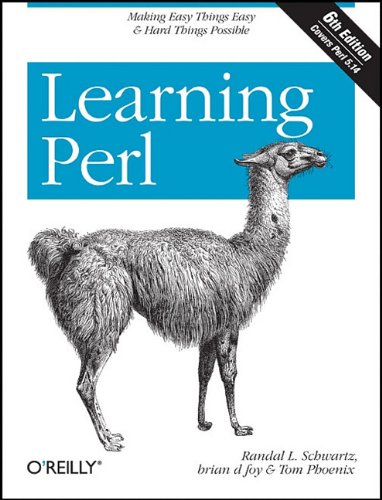
Learning Perl 6th Edition by Randal L Schwartz, Brian D Foy, Tom Phoenix ISBN 1449303587 9781449303587
Original price was: $50.00.$35.00Current price is: $35.00.
Learning Perl 6th Edition by Randal L Schwartz, Brian D Foy, Tom Phoenix – Ebook PDF Instant Download/Delivery: 1449303587, 9781449303587
Full download Learning Perl 6th Edition after payment
Product details:
ISBN 10: 1449303587
ISBN 13: 9781449303587
Author: Randal L Schwartz, Brian D Foy, Tom Phoenix
Learning Perl 6th Table of contents:
Chapter 1. Introduction
-
Questions and Answers
-
Is This the Right Book for You?
-
Why Are There So Many Footnotes?
-
What About the Exercises and Their Answers?
-
What Do Those Numbers at the Start of the Exercise Mean?
-
What If I’m a Perl Course Instructor?
-
What Does “Perl” Stand For?
-
Why Did Larry Create Perl?
-
Why Didn’t Larry Just Use Some Other Language?
-
Is Perl Easy or Hard?
-
How Did Perl Get to Be So Popular?
-
What’s Happening with Perl Now?
-
What’s Perl Really Good For?
-
What Is Perl Not Good For?
-
How Can I Get Perl?
-
What Is CPAN?
-
How Can I Get Support for Perl?
-
Are There Any Other Kinds of Support?
-
What If I Find a Bug in Perl?
-
How Do I Make a Perl Program?
-
A Simple Program
-
What’s Inside That Program?
-
How Do I Compile Perl?
-
A Whirlwind Tour of Perl
-
Exercises
Chapter 2. Scalar Data
-
Numbers
-
All Numbers Have the Same Format Internally
-
Floating-Point Literals
-
Integer Literals
-
Nondecimal Integer Literals
-
Numeric Operators
-
Strings
-
Single-Quoted String Literals
-
Double-Quoted String Literals
-
String Operators
-
Automatic Conversion Between Numbers and Strings
-
Perl’s Built-in Warnings
-
Scalar Variables
-
Choosing Good Variable Names
-
Scalar Assignment
-
Binary Assignment Operators
-
Output with print
-
Interpolation of Scalar Variables into Strings
-
Operator Precedence and Associativity
-
Comparison Operators
-
The if Control Structure
-
Boolean Values
-
Getting User Input
-
The chomp Operator
-
The while Control Structure
-
The undef Value
-
The defined Function
-
Exercises
Chapter 3. Lists and Arrays
-
Accessing Elements of an Array
-
Special Array Indices
-
List Literals
-
The qw Shortcut
-
List Assignment
-
The pop and push Operators
-
The shift and unshift Operators
-
Interpolating Arrays into Strings
-
The foreach Control Structure
-
Perl’s Favorite Default: $_
-
The reverse Operator
-
The sort Operator
-
Scalar and List Context
-
Using List-Producing Expressions in Scalar Context
-
Using Scalar-Producing Expressions in List Context
-
Forcing Scalar Context
-
in List Context
-
Exercises
Chapter 4. Subroutines
-
Defining a Subroutine
-
Invoking a Subroutine
-
Return Values
-
Arguments
-
Private Variables in Subroutines
-
Variable-Length Parameter Lists
-
A Better &max Routine
-
Empty Parameter Lists
-
Notes on Lexical (my) Variables
-
The use strict Pragma
-
The return Operator
-
Omitting the Ampersand
-
Nonscalar Return Values
-
Persistent, Private Variables
-
Exercises
Chapter 5. Input and Output
-
Input from Standard Input
-
Input from the Diamond Operator
-
The Invocation Arguments
-
Output to Standard Output
-
Formatted Output with printf
-
Arrays and printf
-
Filehandles
-
Opening a Filehandle
-
Bad Filehandles
-
Closing a Filehandle
-
Fatal Errors with die
-
Warning Messages with warn
-
Using Filehandles
-
Changing the Default Output Filehandle
-
Reopening a Standard Filehandle
-
Output with say
-
Exercises
Chapter 6. Hashes
-
What Is a Hash?
-
Why Use a Hash?
-
Hash Element Access
-
The Hash As a Whole
-
Hash Assignment
-
The Big Arrow
-
Hash Functions
-
The keys and values Functions
-
The each Function
-
Typical Use of a Hash
-
The exists Function
-
The delete Function
-
Hash Element Interpolation
-
The %ENV hash
-
Exercises
Chapter 7. In the World of Regular Expressions
-
What Are Regular Expressions?
-
Using Simple Patterns
-
About Metacharacters
-
Simple Quantifiers
-
Grouping in Patterns
-
Alternatives
-
Character Classes
-
Character Class Shortcuts
-
Negating the Shortcuts
-
Exercises
Chapter 8. Matching with Regular Expressions
-
Matches with m//
-
Option Modifiers
-
Case-Insensitive Matching with /i
-
Matching Any Character with /s
-
Adding Whitespace with /x
-
Combining Option Modifiers
-
Other Options
-
Anchors
-
Word Anchors
-
The Binding Operator, =~
-
Interpolating into Patterns
-
The Match Variables
-
The Persistence of Memory
-
Noncapturing Parentheses
-
Named Captures
-
The Automatic Match Variables
-
General Quantifiers
-
Precedence
-
Examples of Precedence
-
And There’s More
-
A Pattern Test Program
-
Exercises
Chapter 9. Processing Text with Regular Expressions
-
Substitutions with s///
-
Global Replacements with /g
-
Different Delimiters
-
Option Modifiers
-
The Binding Operator
-
Case Shifting
-
The split Operator
-
The join Function
-
m// in List Context
-
More Powerful Regular Expressions
-
Nongreedy Quantifiers
-
Matching Multiple-Line Text
-
Updating Many Files
-
In-Place Editing from the Command Line
-
Exercises
Chapter 10. More Control Structures
-
The unless Control Structure
-
The else Clause with unless
-
The until Control Structure
-
Expression Modifiers
-
The Naked Block Control Structure
-
The elsif Clause
-
Autoincrement and Autodecrement
-
The Value of Autoincrement
-
The for Control Structure
-
The Secret Connection Between foreach and for
-
Loop Controls
-
The last Operator
-
The next Operator
-
The redo Operator
-
Labeled Blocks
-
The Ternary Operator, ?:
-
Logical Operators
-
The Value of a Short-Circuit Operator
-
The defined-or Operator
-
Control Structures Using Partial-Evaluation Operators
-
Exercises
Chapter 11. Perl Modules
-
Finding Modules
-
Installing Modules
-
Using Simple Modules
-
The File::Basename Module
-
Using Only Some Functions from a Module
-
The File::Spec Module
-
CGI.pm
-
Databases and DBI
-
Exercise
Chapter 12. File Tests
-
File Test Operators
-
Testing Several Attributes of the Same File
-
Stacked File Test Operators
-
The stat and lstat Functions
-
The localtime Function
-
Bitwise Operators
-
Using Bitstrings
-
Exercises
Chapter 13. Directory Operations
-
Moving Around the Directory Tree
-
Globbing
-
An Alternate Syntax for Globbing
-
Directory Handles
-
Recursive Directory Listing
-
Manipulating Files and Directories
-
Removing Files
-
Renaming Files
-
Links and Files
-
Making and Removing Directories
-
Modifying Permissions
-
Changing Ownership
-
Changing Timestamps
-
Exercises
Chapter 14. Strings and Sorting
-
Finding a Substring with index
-
Manipulating a Substring with substr
-
Formatting Data with sprintf
-
Using sprintf with “Money Numbers”
-
Advanced Sorting
-
Sorting a Hash by Value
-
Sorting by Multiple Keys
-
Exercises
Chapter 15. Smart Matching and given-when
-
The Smart Match Operator
-
Smart Match Precedence
-
The given Statement
-
Dumb Matching
-
when with Many Items
-
Exercises
Chapter 16. Process Management
-
The system Function
-
Avoiding the Shell
-
The exec Function
-
The Environment Variables
-
Using Backquotes to Capture Output
-
Using Backquotes in a List Context
-
Processes as Filehandles
-
Getting Down and Dirty with Fork
-
Sending and Receiving Signals
-
Exercises
Chapter 17. Some Advanced Perl Techniques
-
Trapping Errors with eval
-
Picking Items from a List with grep
-
Transforming Items from a List with map
-
Unquoted Hash Keys
-
Slices
- Array Slice
- Hash Slice -
Exercise
People also search for Learning Perl 6th:
is it worth learning perl
learning perl o’reilly
machine learning perl
learning perl pdf
learning perl 8th edition
Tags: Randal L Schwartz, Brian D Foy, Tom Phoenix, Learning Perl