

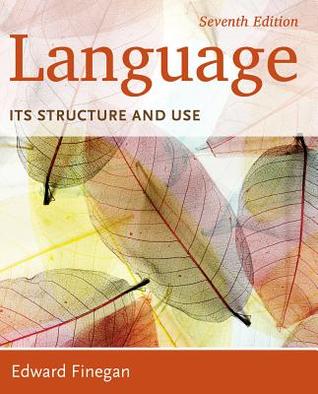
Language Its Structure and Use 7th Edition by Edward Finegan ISBN 1285052455 978-1285052458

Original price was: $50.00.$35.00Current price is: $35.00.
Language Its Structure and Use 7th Edition by Edward Finegan – Ebook PDF Instant Download/Delivery:1285052455 ,978-1285052458
Full download Language Its Structure and Use 7th Edition after payment
Product details:
ISBN 10:1285052455
ISBN 13:978-1285052458
Author:Edward Finegan
Whatever you do and wherever you go, you use language to interact. This text explains what human language is and how it works, giving you a look into the multiple fascinating and surprising facets of this uniquely human trait. You’ll find many opportunities to ask your own questions and explore the language in use all around you.
Table of contents:
1,Languages and Linguistics
What Do You Think?
How Many Languages Are There in the World?
Does the United States Have an Official Language?
What Is Human Language?
Signs: Arbitrary and Non-arbitrary
Languages as Patterned Structures: Grammatical Competence
Speech as Patterned Language Use: Communicative Competence
Modes of Linguistic Communication
Do Only Humans Have Language?
Can Chimpanzees Learn a Human Language?
The Origin of Human Languages: Babel to Babble
What Is Linguistics?
Computers and Linguistics
Summary
What Do You Think? REVISITED
Exercises
Other Resources
Part 1: LANGUAGE STRUCTURES
2.1 Words and Their Parts: Lexicon and Morphology
What Do You Think?
Introduction: Words Seem Tangible
What Does It Mean to Know a Word?
Lexical Categories
Morphemes: Word Parts with Meaning or Function
How Are Morphemes Organized Within Words?
How Does a Language Increase Its Vocabulary?
What Types of Morphological Systems Do Languages Have?
Variant Pronunciations of a Morpheme: Allomorphy
Summary
What Do You Think? REVISITED
Exercises
Other Resources
2.2 The Sounds of Languages: Phonetics
What Do You Think?
Sounds and Spellings: Not the Same Thing
Phonetics: The Study of Sounds
Describing Consonant Sounds
Kinds of Consonant Sounds
Vowel Sounds
Summary
What Do You Think? REVISITED
Exercises
Other Resources
2.3 Sound Systems of Language: Phonology
What Do You Think?
Introduction: Sounds in the Mind
Phonological Rules and Their Structure
Syllables and Syllable Structure
Stress
Syllables and Stress in Phonological Processes
Morphology and Phonology Interaction: Allomorphy
From Lexical Entries to Surface Realizations: What the Brain Knows
Summary
What Do You Think? REVISITED
Exercises
Other Resources
2.4 The Structure and Function of Phrases and Sentences: Syntax
What Do You Think?
Introduction
Constituency
Major Constituents of Sentences: Noun Phrases and Verb Phrases
Phrase-Structure Expansions
Grammatical Relations: Subject, Direct Object, and Others
Surface Structures and Underlying Structures
Types of Syntactic Operations
Functions of Syntactic Operations
Recursion and Novel Sentences
Summary
What Do You Think? REVISITED
Exercises
Other Resources
2.5 The Study of Meaning: Semantics
What Do You Think?
Introduction
Linguistic, Social, and Affective Meaning
Word, Sentence, and Utterance Meaning
Lexical Semantics
Function Words and Categories of Meaning
Semantic Roles and Sentence Meaning
Semantic Roles and Grammatical Relations
Summary
What Do You Think? REVISITED
Exercises
Other Resources
2.6 Language Universals and Language Typology
What Do You Think?
Similarity and Diversity Across Languages
Phonological Universals
Syntactic and Morphological Universals
Types of Language Universals
Explanations for Language Universals
Language Universals, Universal Grammar, and Language Acquisition
Summary
What Do You Think? REVISITED
Exercises
Other Resources
Part 2: LANGUAGE USE
3.1 Information Structure and Pragmatics
What Do You Think?
Introduction: Encoding Information Structure
Categories of Information Structure
Information Structure: Intonation, Morphology, Syntax
The Relationship of Sentences to Discourse: Pragmatics
Summary
What Do You Think? REVISITED
Exercises
Other Resources
3.2 Speech Acts and Conversation
What Do You Think?
Language in Use
Sentence Structure and the Function of Utterances
Speech Acts
The Cooperative Principle
Violations of the Cooperative Principle
Politeness
Speech Events
The Organization of Conversation
Cross-Cultural Communication
Summary
What Do You Think? REVISITED
Exercises
Other Resources
3.3 Language Variation Across Situations of Use: Registers and Styles
What Do You Think?
Introduction
Language Varies Within a Speech Community
Speech Situations
Registers in Monolingual Societies
Similarities and Differences Between Spoken and Written Registers
Two Registers Compared
Summary
What Do You Think? REVISITED
Exercises
Other Resources
3.4 Language Variation Among Social Groups: Dialects
What Do You Think?
Language or Dialect: Which Do You Speak?
How Do Languages Diverge and Merge?
National Varieties of English
Regional Varieties of American English
The Atlas of North American English
Ethnic Varieties of American English
Ethnic Varieties and Social Identification
Socioeconomic Status Varieties: English, French, and Spanish
The Language Varieties of Women and Men
Why Do Stigmatized Varieties Persist?
Summary
What Do You Think? REVISITED
Exercises
Other Resources
Part 3: LANGUAGE CHANGE, LANGUAGE DEVELOPMENT, AND LANGUAGE ACQUISITION
4.1 Language Change Over Time: Historical Linguistics
What Do You Think?
Do Living Languages Always Change?
Language Families and the Indo-European Family
How to Reconstruct the Linguistic Past
What Are the Language Families of the World?
Languages in Contact
Summary
What Do You Think? REVISITED
Exercises
Other Resources
4.2 Historical Development in English
What Do You Think?
Old English: 700-1100
Companions of Angels: A Narrative in Old English
Middle English: 1100-1500
Where Men and Women Go All Naked: A Middle English Travel Fable
Modern English: 1500-Present
Summary
What Do You Think? REVISITED
Exercises
Other Resources
4.3 Acquiring First and Second Languages
What Do You Think?
Introduction
Acquiring a First Language
How Do Researchers Study Language Acquisition?
Acquiring a Second Language
Summary
What Do You Think? REVISITED
Exercises
Other Resources
People also search for:
how does the writer use language and structure
structure language definition and examples
parallel structure in language
organizational structure in english language
anguages with the same sentence structure as english
Tags: Edward Finegan, Language, Structure